

Table of contents
Table of contents- Sales planning explained: definition, methods and benefits
- Sales planning: definition and scope
- Strategic and operational, short-term and long-term sales planning
- Forecasting methods used in sales planning
- Data aggregation, basic data pools, planning groups and procedures
- Benefits of sales planning
- Ongoing sales planning and monitoring
- Influence of sales planning on production and supplier management
- Conclusion
Overview
Sales planning determines sales volumes, forms part of corporate and supply chain planning, and is divided into strategic (long-term) and operational (short-term) planning. It increasingly relies on automated forecasting methods to improve accuracy and achieve cost savings, inventory optimisation and enhanced service quality. At the same time, it must be continuously coordinated with other planning areas, such as production and suppliers.
Most teams agree that planning is important, yet sales planning is still one of the areas that’s frequently rushed or overlooked. When done properly, though, it can save a huge amount of effort later on. In this blog, we break down the purpose of sales planning, the different types, the forecasting methods behind it and the impact it has across the business.
Sales planning: definition and scope
Sales refers to the number or quantity of goods or services sold within a specified period. Within a company, the sales plan for each product quantifies the volume or number of units the company aims to sell during a planning period. Sales planning is therefore an integral part of corporate planning and is supplemented by revenue planning.
Sales planning in marketing
Sales planning documents the intentions and forecasts of individuals within a company regarding how often a particular product should or will be sold within a defined future period. It aligns the company’s intentions with expected sales figures and is therefore of fundamental importance to strategic planning. Responsibility for sales planning usually lies with the marketing department.
Sales planning in logistics and the supply chain
Sales planning is a key component of the supply chain. Due to constantly changing and increasing demands resulting from globalisation and digitalisation, continuous optimisation of sales planning is required across all areas. This is reflected in the growing interconnection between sales planning and every other area of the supply chain.
Strategic and operational, short-term and long-term sales planning
Sales planning takes different forms depending on its purpose. The general objective of sales planning is to plan and safeguard the company’s output in a forward-looking and success-oriented manner. A sales plan is more than a simple forecast, as it represents a commitment by sales management.
A distinction is made between strategic (long-term) and operational (short-term) sales planning, with the planning horizon serving as the key differentiating factor. Strategic or long-term sales planning typically covers a period of five years or more. Operational planning usually refers to a period of several months up to one year. Between these lies tactical (medium-term) sales planning, which covers a period of one to a maximum of five years. There are significant differences between these planning types.
Operational sales planning
Operational or short-term sales planning forms part of a company’s objective planning. Its aim is to optimise factors that can be expressed in objectively measurable figures, such as detailed resource and budget planning, and a high level of detail in specific measures. Operational sales planning is derived from long-term planning, strategic corporate objectives and the operational planning of the previous period.
This information reflects the company’s or project’s current situation and forms the basis for adjustment measures relating to targets and budgets. The planning horizon is limited and the degree of freedom is relatively low. Operational sales planning does not primarily reflect a company’s future orientation, but instead focuses on measurable objectives. Nevertheless, it can be understood as a concretisation of strategic sales planning.
Short-term planning mainly serves to compare strategic planning with the current actual situation and to adjust the planning model in response to changing conditions.
Strategic sales planning
Strategic or long-term sales planning is based on a company’s overall competitive positioning, as well as its guiding principles and policies. It draws on the company’s target plan and long-term sales objectives, and provides the framework for the entire sales planning structure.
The primary objective is to ensure responsiveness to market developments. Specific instruments or actions are not defined at this planning level. In many respects, strategic planning can therefore also be described as adaptation planning and may be influenced by the results of short-term planning. As a consequence, targets, measures or budgets may be adjusted.
Strategic sales planning can be broken down into a number of individual steps, each of which involves intensive information gathering that feeds into the decision-making process.
When companies refer to long-term planning in a strategic sense, this often represents an extension of medium-term planning. In such cases, the focus tends to be on formal objectives, particularly monetary results, meaning that it can also be described as long-term operational planning.
Forecasting methods used in sales planning
Forecasting is part of budgeting and involves planning the optimal use of available resources. Forecasts are developed by evaluating information and deriving expectations about future developments. They provide the basis for decision-making in subsequent planning processes within the company.
Traditional forecasting methods are based on manual planning, historical extrapolation or time series analysis. Manual approaches may involve expert assessments, such as the Delphi method, while extrapolation involves extending an existing plan. Time series analysis uses mathematical methods to interpret past values in order to identify patterns relevant for the future.
A fundamental issue with these approaches is their reliance on subjective factors. Even when mathematical models are used, subjectivity can influence when, how and why a particular model is applied. Updates also have limitations, as they are retrospective and may fail to fully capture current conditions.
With increasing digitalisation and the availability of real-time data, traditional forecasting methods are becoming progressively less relevant. As a result, automated forecasting methods based on software-controlled algorithms are being used more frequently. By applying multiple algorithms in parallel, these methods achieve a significantly higher degree of objectivity.
The overarching aim of forecasting is to minimise the margin of error as far as possible. Actual market developments cannot, however, be predicted with complete accuracy.
Data aggregation, basic data pools, planning groups and procedures
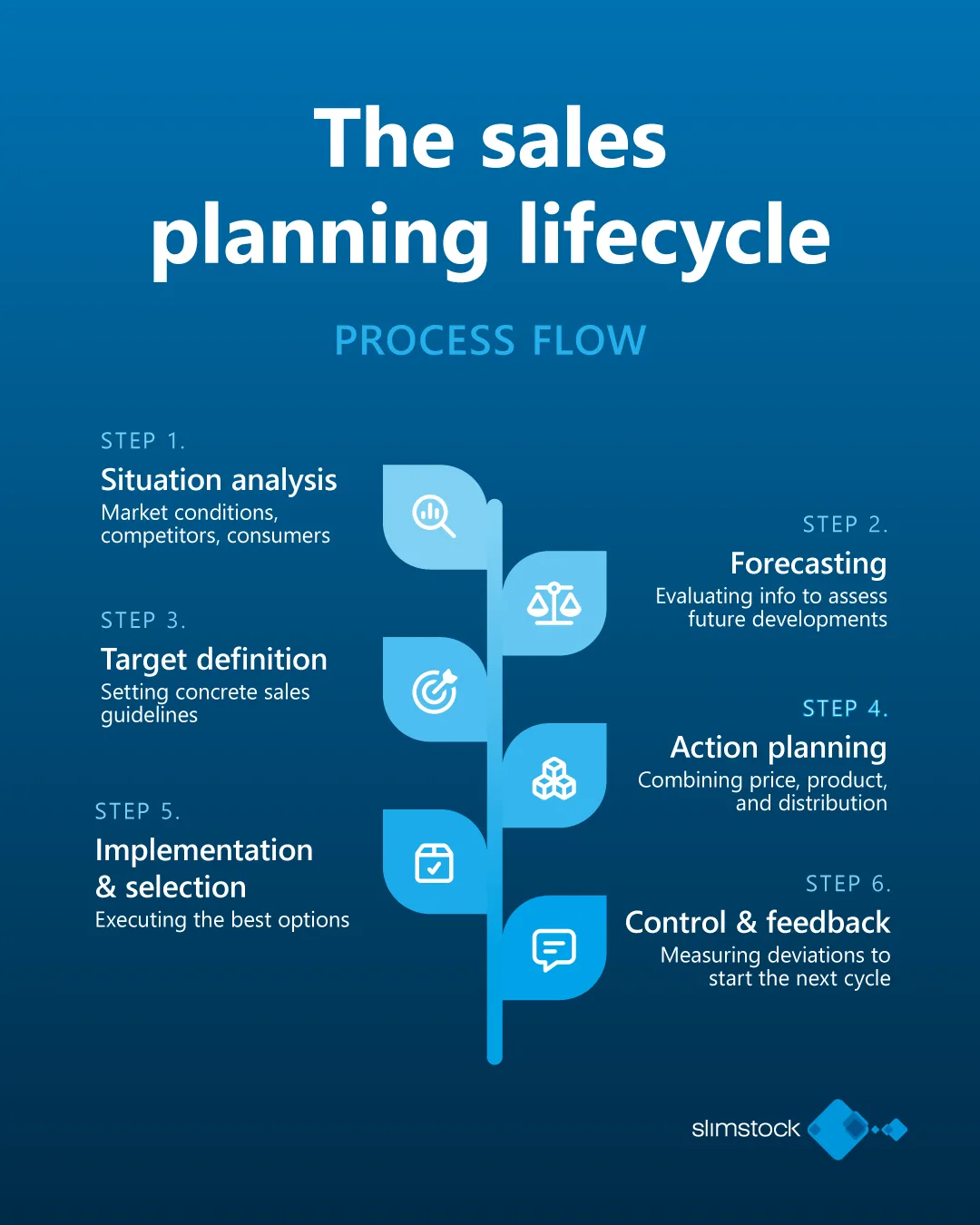
The quality of sales planning largely depends on the quality of the information used to support decision-making. Consequently, detailed information is required for situation analysis. This analysis examines past and present market conditions and requires the collection and evaluation of information relating to:
Based on this information, forecasts are developed to assess likely market developments. These forecasts are essential for identifying future opportunities and risks, and it is therefore crucial that all relevant data from the situation analysis is incorporated.
Sales targets are then defined as concrete guidelines for implementing sales planning. These targets are established through a coordination process between the company’s overall objectives and the findings from analysis and forecasting.
Implementation begins with the identification of possible courses of action, consisting of various combinations of sales policy instruments relating to product, price, communication and distribution. Experience from previous planning processes and competitors’ approaches is also taken into account.
The alternative courses of action are then evaluated in terms of their contribution to achieving the defined targets. Forecasts are prepared for each option to assess its expected effectiveness. This includes evaluating the impact of measures such as price reductions, product quality improvements or increased advertising expenditure on sales targets.
A decision is subsequently made regarding the specific instruments to be implemented, with those options offering the highest degree of target achievement being selected. It should be noted that sales targets remain subordinate to the overarching objective of long-term profit maximisation.
The selected measures are then organised and implemented. The sales planning process concludes with control measures that assess whether progress aligns with the defined targets. In the event of deviations, the causes must be identified. This analysis provides valuable insights for corrective actions and future planning. As the control phase captures the current situation, it can also be regarded as the starting point for a new planning cycle.
Benefits of sales planning
Business planning generally has a positive impact on corporate success, as demonstrated by studies conducted over several decades across small and large companies in both stable and uncertain markets worldwide. Sales planning is therefore one of the most important planning elements and is essential for achieving systematic success.
Despite this, sales planning is inadequately implemented in many organisations. Research indicates that planning is often not perceived as helpful for actively shaping or influencing future outcomes.
Professional sales planning enables companies to pursue a clear strategic direction. At the same time, new challenges continually arise in achieving the required quality of operational sales planning. Increasing product diversity, shorter product life cycles and heightened market volatility are among the key challenges.
The main advantages of professional or software-supported sales planning include cost savings, more efficient resource utilisation, higher product availability, inventory optimisation, simplified purchasing processes and improved service quality.
Large-scale studies examining factors such as the degree of formalisation, interaction within planning processes, perceived quality, market orientation and the integration of sales planning with other sub-planning processes have found a clear positive impact on both companies and employees. These findings also provide a counterargument to advocates of beyond budgeting, who are highly critical of operational planning. Even companies operating in dynamic market environments with decentralised structures were shown to benefit from effective sales planning.
Further studies suggest that the greatest impact on business success occurs when little or no planning was previously in place. Beyond a certain level of detail, however, planning and budgeting may have a negative effect, although this threshold is difficult to determine precisely. Successful planning is characterised by rationality, openness and integration, and is typically kept concise. Cooperation and participation across all relevant departments and employees are essential for successful implementation.

Ongoing sales planning and monitoring
Sales planning should be understood as a continuous process that plays a central role in corporate success. Strategic analysis, strategy formulation, implementation through specific instruments and systematic performance monitoring are closely interconnected and form a complex field of activity.
As part of overall financial planning, sales planning interacts with other planning areas, including production, procurement and cost planning. The role of controlling is to harmonise these sub-plans in line with the company’s objectives. In addition to general controlling mechanisms, further tools may be used in sales planning, such as:
- a head of sales planning
- a sales planning staff unit
- specialised planning groups
The degree of centralisation or decentralisation of planning tasks and decisions can vary. Decisions should be made where information availability is highest and where responsibility for implementation lies. The greater the concentration of these factors within a single person or group, the higher the degree of centralisation.
The general trend is towards centralised strategic planning and decentralised operational planning. Strategic planning benefits from centralisation due to its longer planning horizon and reliance on complex, general information. Decentralised strategic planning would be difficult to coordinate and justify in terms of skills and responsibilities. By contrast, the detailed information required for operational sales planning is more readily available at decentralised levels, where responsibility is also typically assigned.
Turn sales forecasts into executable supply plans. Discover how Slimstock’s Sales & Operations Planning solution🔗 aligns demand, supply and inventory.
Influence of sales planning on production and supplier management
Planning the production programme is critically important, as companies can only remain competitive in the long term if their products meet market requirements. This highlights the close relationship between sales and production programmes, as manufacturing products is only meaningful if they can be sold. Production programme planning therefore represents a key interface between sales and production.
The objective of production programme planning is to develop a long-term production plan that balances market demand with feasibility. This requires close coordination between sales and production.
The information base for the sales plan is derived from sales statistics and trends, with aggregated historical data used for forecasting future demand. Alternatively or additionally, profit and revenue planning may provide relevant inputs. Existing customer orders are also considered. Where historical data is unavailable, planned sales volumes are allocated to individual product groups in line with sales targets.
Companies that produce components, assemblies or products anonymously for customers must determine requirements based on statistical sales forecasts. The choice of forecasting method depends on the specific sales trend. The resulting sales plan must be aligned with production through primary requirements and rough resource planning.
Primary demand planning
Gross primary requirements are determined by sales planning, existing customer orders and internal requirements. After reconciliation with inventory levels, they are reported as net primary requirements. Products associated with customer orders must be specified in terms of design and provisionally assigned to a product group if this has not already been done. This ensures that they are included in primary requirements planning, particularly where customer orders fall into longer-term planning horizons. The preliminary production programme proposal is then assessed against available resources.
Rough resource planning
In the next step, rough resource planning assesses whether sufficient resources are available to meet the net primary requirements of the preliminary production programme. Resources include personnel, materials, operating resources and auxiliary resources. These are compared against the type, quantity and timing of production requirements, resulting in the long-term production programme.
If planning is based on aggregated or representative data, the requirements must be allocated to corresponding reference data, such as product profiles. For standard products, standard bills of materials and routing data are used.
Short delivery times and high service levels can often only be achieved economically through close supplier integration. Supplier performance and the quality of supplier relationships are therefore key factors in both strategic and operational success. Corporate and competitive strategies must be aligned with supplier strategies.
Supplier management is responsible for aligning the company’s requirements with its sales plans. In procurement markets, companies compete with other buyers, often from different industries requiring similar materials. As a result, competitive conditions may differ significantly from those in sales markets.
Due to lean production practices, reduced inventory levels and rising material costs, supplier management has become increasingly important. Its primary focus is on establishing reliable, cooperative and long-term relationships with suppliers.
Key objectives include identifying suitable and innovative suppliers, continuously monitoring and improving their performance, increasing quality and reducing costs within the cooperation network, and synchronising processes between suppliers and the company. Supplier management therefore encompasses the following activities:
- Supplier strategy: segmentation of suppliers and identification of strategic suppliers.
- Supplier selection: application of clearly defined quality, cost, delivery and development criteria.
- Supplier evaluation: systematic and periodic assessment using quantitative and qualitative criteria.
- Supplier development: implementation of measures to enhance supplier capabilities.
- Supplier integration: integration of suppliers into relevant business processes.
- Supplier controlling: evaluation and documentation of progress through systematic controlling.
Conclusion
Sales planning is far more than a forecasting exercise; it is a central management process that connects strategy, operations and execution across the entire organisation. From defining long-term strategic objectives to coordinating short-term operational activities, effective sales planning provides the structure needed to respond to market developments while maintaining internal efficiency.
Ultimately, successful sales planning depends not only on tools and methods, but also on organisational integration, transparency and collaboration between departments. When sales planning is treated as an ongoing, company-wide process rather than a one-off exercise, it becomes a decisive factor in achieving sustainable competitive advantage and long-term business success.