
Table of contents
Table of contents- Mastering the Long Tail: how to turn niche products into profit
- What does long tail mean?
- Characteristics of long tail products
- Variety is good, but it must be strategic
- Efficient inventory management in a long tail model
- Real-world example: Slimstock & Tennant Company
- Final reflections
Overview
Long tail inventory (low-volume items) must be managed strategically using ABC analysis, aligned with business goals, to balance profitability and customer satisfaction, as these products differentiate the business. This process guides stocking decisions, policy reassessment and prioritization of optimization efforts.
In today’s world, where Amazon and Alibaba dominate and customers refuse to wait, companies must offer exactly what their customers need, precisely when they need it. As a result, even the most niche businesses now manage a massive long tail of thousands of product lines. Customers demand choice, speed and availability, yet managing such an extensive assortment often becomes a burden on resources, service levels and profitability.
Not long ago, it was far more profitable to focus on the mass market, selling large volumes of a few products. But with the rise of the internet, the landscape has changed dramatically. One of the most significant innovations brought by the digital era is the Long Tail business model, a concept coined by Chris Anderson. Today, the Long Tail allows companies to monetise diversity and serve highly specific niches across global markets.
What does long tail mean?
Before diving into optimisation strategies, it is essential to understand what the long tail represents. In simple terms, a small proportion of your assortment generates the majority of your turnover, while a disproportionately large number of items sell only in small quantities, but together represent a substantial business opportunity. Chris Anderson introduced this concept to describe how variety, enabled by the internet and digital commerce, allows niche products to reach global demand.
Customers now expect vast assortment, next-day delivery and the availability of highly specialised items. However, managing this Long Tail often places significant strain on planning teams and working capital.
Characteristics of long tail products
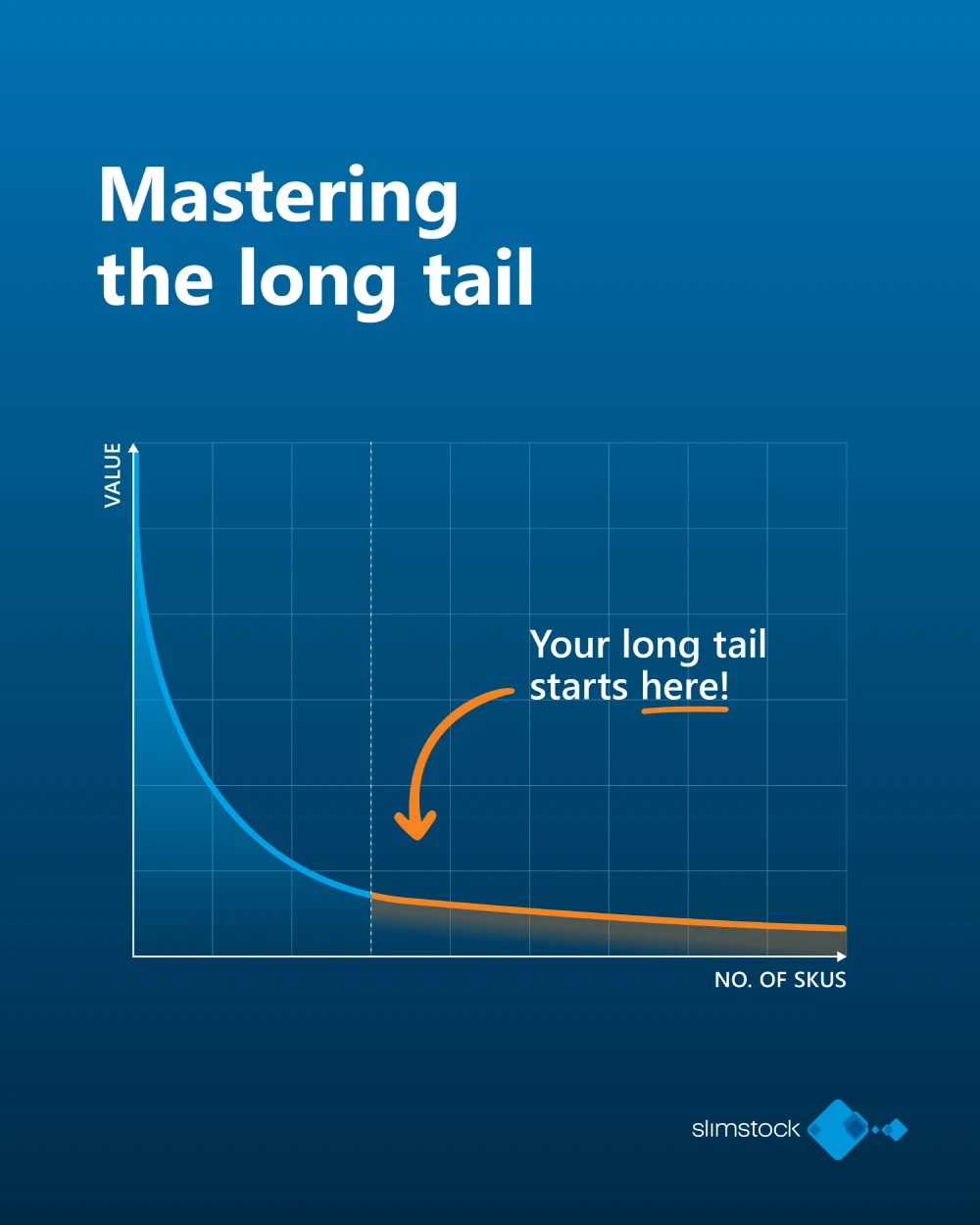
Typically, around 80% of a company’s turnover comes from just 20% of its assortment. However, long tail business models are not about “selling a lot of a little”, but rather “selling a little of a lot”. This means managing thousands of items that individually offer limited value, yet together define the customer experience and help differentiate your business.
Examples such as Amazon, Netflix and eBay demonstrate that diversity and specialisation enable companies to serve highly fragmented and specialised audiences. For many businesses, these niche products are precisely what set them apart from competitors.
Key characteristics in more detail:
Extensive variety
Long Tail products cover a broad spectrum of options and niches. Rather than concentrating on a handful of popular products, the approach is to offer extensive diversity that meets a wide range of customer preferences and needs.
Niche and specialisation
Each Long Tail item typically focuses on a specific niche. These products are often highly specialised, designed to satisfy particular requirements of a smaller but distinct market segment.
Relatively low individual sales
Individually, Long Tail products tend to have lower sales compared to mainstream bestsellers. However, the aggregated sales of many low-volume items become a significant component of overall business success.
Global accessibility
The Long Tail model, especially in digital environments, allows products to reach a global audience. Consumers can access specialised items that may not be readily available in local markets.
Fragmented demand
Demand for Long Tail products tends to be dispersed across many unique items, rather than concentrated in a few bestsellers. This distribution allows companies to diversify their portfolios and reduce reliance on individual products.
Lower storage and distribution costs
Because Long Tail items often sell in smaller quantities, storage and distribution costs can be lower. This facilitates inventory management and reduces the risk of obsolescence, provided processes are well controlled.
Personalised recommendations
In digital platforms, Long Tail products benefit from recommendation algorithms and data analytics. These tools improve product discovery, making niche items more visible to customers and driving additional sales.
Long sales curve
Graphically, the sales distribution of Long Tail products forms an extended “tail,” where many products contribute to overall sales instead of relying solely on a few high-volume items.
Connection with specific audiences
Long Tail products are ideal for engaging with segmented, niche audiences. Companies can build communities around specialised products, generating loyalty and repeat business within these specific markets.
Technology as a key enabler
Digital platforms and advanced technologies are fundamental to the success of Long Tail products. This includes the use of data analytics, recommendation engines and e-commerce platforms that enhance visibility, accessibility and operational efficiency.
In theory, managing these items should be straightforward. In practice, the real challenge is deciding which to retain, which to eliminate, and how to manage them without compromising service or tying up capital.

Variety is good, but it must be strategic
Although Long Tail items contribute little profit individually, for many businesses they are the reason customers choose them in the first place.
Just as a supermarket must stock both essentials and specialist items, companies must maintain a careful balance. Removing niche products can harm the customer experience, while keeping them without control can immobilise capital and lead to excess stock and obsolescence.
This is why the key lies in strategic refinement and segmentation, not in cutting products indiscriminately.
Efficient inventory management in a long tail model
Achieving a streamlined, profitable assortment requires visibility, strategic segmentation and data-driven decisions.
1. Define and segment the long tail (ABC analysis)
A structured ABC analysis provides insight into which products matter most.
Segment items by factors such as:
- Margin.
- Volume or rotation.
- Impact on customer satisfaction.
- Strategic relevance.
- Contribution to associated sales.
This segmentation enables targeted decision-making:
- Prioritise high-impact items.
- Identify products that drive cross-sales.
- Detect items that add no value and can be discontinued.
2. Stocking decisions and inventory policy
Once segmentation is clear, businesses can decide:
- Which Long Tail items should not be held in stock due to minimal margins.
- Which currently non-stocked items should be stocked because of long lead times or supplier unreliability.
- Which items are essential for cross-selling (e.g., nuts and bolts).
- Which require renegotiated MOQs, better lead times or new suppliers.
Inventory policy must be dynamic. The challenge is balancing:
- Too much stock → tied-up capital and obsolescence.
- Too little stock → lost sales and dissatisfied customers.
- Flexibility and advanced forecasting are essential to managing the volatility inherent in Long Tail demand.
3. Prioritise areas that require attention
Insights from ABC analysis help determine:
- Which categories require urgent review.
- Opportunities for improving MOQs or lead times.
- Where to focus planning time.
- How to increase service levels without inflating stock.
A strong ABC analysis allows planners to focus on critical areas of the Long Tail, optimise categories and align inventory with business objectives.
Real-world example: Slimstock & Tennant Company
Tennant Company is a clear example of how technology can unlock the power of the Long Tail.
Managing 50,000–60,000 SKUs—22,000 of which were stocked—made manual planning ineffective. With Slim4:
- Service levels increased from 96.5% to 98.5%
- Forecast accuracy improved significantly
- Operational efficiency rose by 80%
- Backorders and incomplete shipments were drastically reduced
This demonstrates how combining the Long Tail model with advanced analytics can transform a complex inventory into a source of sustainable profitability.
“Thanks to Slim4, we now have a reliable forecast. As a result, we can now maximise the profitability of our assortment, something which is essential for long tail articles”. Richard Ornek, Materials Manager
Final reflections
Success in the Long Tail model depends not only on variety but also on intelligent inventory management. To unlock its full potential, companies must:
- Segment strategically.
- Adapt stock policies dynamically.
- Use tailored ABC analyses.
- Leverage advanced forecasting and optimisation technology.
- Balance stock investment with service levels.
- Prioritise high-impact actions.
When businesses understand how each item contributes to their goals, they can maximise profitability without sacrificing availability, turning Long Tail inventory into a highly profitable asset and building a Long Tail model that is sustainable, competitive and future-ready.