
Table of contents
Table of contents- Navigating the Complexities of Aftermarket Inventory Management
- Demand Planning Strategies for the Spare Parts Industry
- Proactive Approaches to Supply Planning in the Aftermarket Industry
- Data-Driven Assortment Planning to Tackle Forecasting Challenges
- Conclusion
- FAQs on Aftermarket Inventory Management
Overview
Aftermarket inventory management is complex due to high customer expectations for availability, long lead times, broad assortments and difficulty forecasting slow-moving spare parts. Strategies to overcome these challenges include improving demand planning with advanced forecasting, adopting a proactive, service-level-driven supply strategy with management-by-exception and using data-driven assortment planning with automated reviews to minimize costly obsolescence and overstocking.
Imagine your car breaks down, and as if that weren’t inconvenient enough, you’re told the exact part needed to fix it is out of stock and won’t arrive for another week. Practical issues start to pile up—like not being able to drive your kids to school or bring home the weekly shop. Unexpected expenses for public transport, delivery fees, and disrupted plans quickly add up. Frustrated, you can’t help but wonder: How can they not have such a vital part in stock?
This example clearly illustrates the pressure customers place on aftermarket companies to ensure essential spare parts are always available for urgent repairs. However, what customers often don’t see are the complexities these businesses must navigate. Aftermarket providers face high expectations for availability, knowing that delays can result in lost sales or broken contracts. On top of this, they must also manage long lead times, a broad assortment, and items that are difficult to forecast.
This article explores why effectively managing these critical spare parts is so challenging —and, more importantly, discusses strategies aftermarket companies can adopt to overcome these challenges and improve their inventory management practices. These insights come from Roberto David, a Solution Architect at Slimstock with extensive expertise in the aftermarket industry.

Demand Planning Strategies for the Spare Parts Industry
Understanding demand is a key step in effective inventory management: knowing how much inventory to hold starts with accurately predicting what customers will need.
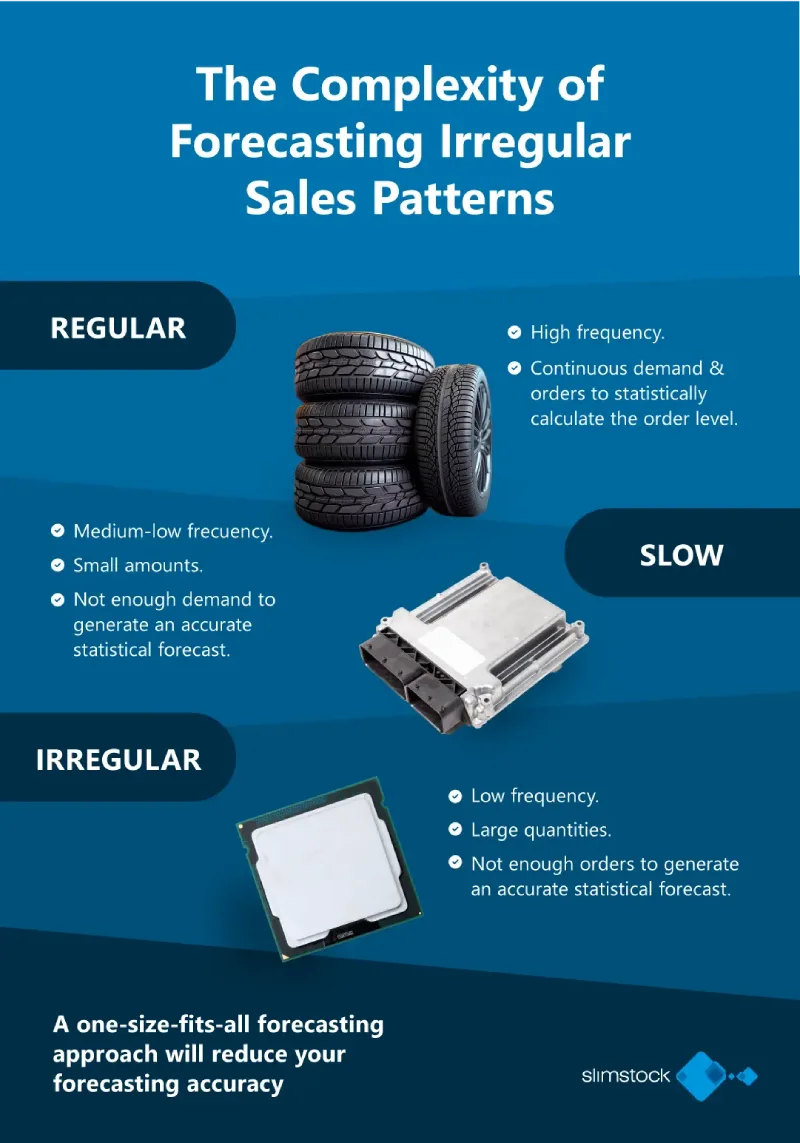
Within a broad assortment, different techniques are needed to forecast the diverse items effectively. Fast-movers, like tyres, with frequent and steady sales, are easier to forecast due to their continuous demand patterns. Slow-movers, like specific chips, on the other hand, have infrequent sales, making accurate statistical forecasting challenging due to a lack of data points.
For aftermarket companies, the majority of their assortment consists of slow-moving items, which complicates the forecasting process.
- Uncertainty in order timing: Take wiper blades, for instance—these parts rarely break in normal conditions, but when a storm hits, the demand increases significantly. This unpredictability makes forecasting more challenging.
- Balancing availability and forecast accuracy: High availability becomes challenging when forecasts are unreliable, often resulting in missed opportunities or excess stock.
- High safety stock requirements: To maintain availability in the face of high uncertainty, high safety stock levels are required, which is costly and inefficient in terms of space.
- Accident vs periodic maintenance: This uncertainty will be influenced by whether the part is most often used for accident-related repairs or periodic maintenance. Items used in periodic maintenance tend to have a less volatile demand pattern than parts needed for accident repairs.
To avoid excessively high safety-stock levels, improving forecast accuracy is crucial. Using the right forecasting algorithm—rather than a simple moving average—can help reduce uncertainty. Less uncertainty will allow for lower safety stock while still meeting customer demand. A more reliable forecast not only enhances availability but also enables planners to make confident, data-driven decisions.
Another challenge lies in the changing nature of SKU numbers, as parts evolve or get replaced by newer models. A challenge with new or reintroduced SKUs is the lack of historical data for reliable forecasting. Like-for-like modelling addresses this by transferring demand history from predecessor SKUs, enabling data-driven forecasts for new items.
Additionally, when forecasting demand for parts related to a new vehicle model, another critical factor comes into play: the value of the vehicle itself. Parts for high-value, luxury vehicles are more likely to require OEM (Original Equipment Manufacturer) replacements, while owners of lower-budget vehicles often choose cheaper aftermarket parts. By factoring in this repair ratio between OEM and aftermarket parts, demand forecasts for new model parts can be more accurate from the start.
Proactive Approaches to Supply Planning in the Aftermarket Industry
Demand planning is already challenging due to forecasting complexities and high availability requirements. However, supply planning presents its own set of difficulties, as most spare parts are sourced from Asia, resulting in long lead times for much of the world.
- Long lead times require a proactive approach: Orders placed today must anticipate demand of months in advance. Failing to meet that demand could result in lost sales or costly urgent purchase orders.
- Management by exception: To be able to be proactive, you need the right tools to forecast demand, as well as a system that alerts you when items are at risk of going out of stock. This approach has proven effective in helping companies shift from reacting to anticipating, minimising stockouts and reducing the need for expensive expedited orders.
To manage both the uncertainty in demand and supply while maintaining the right availability, a service-level -driven inventory strategy is essential. Where your goal is not to hold a certain day of cover, but to reach your end goal: ensuring timely and cost-efficient service for your customers.
Setting service levels can be challenging, but using segmentation methods such as ABC classification and considering product-specific factors can help optimise them. For instance, in the automotive aftermarket, critical parts marked as VOR (vehicle off road) mean a car remains inoperable until the part is available. Stockouts of these parts negatively impact both customers, who experience downtime, and suppliers, who may need to provide alternative vehicles. For such items, assigning higher target service levels can help prevent these costly delays.
Data-Driven Assortment Planning to Tackle Forecasting Challenges
An effective inventory strategy must address the broad aftermarket assortment, tailoring approaches for each category—like tyres, filters, and oils—with specific service levels and forecast methods to match demand patterns.
Tyres, for example, have steady demand, making them suitable for automated management. In contrast, high-cost items like turbochargers are unpredictable and costly to stock, requiring a balanced approach that combines automation with focused monitoring to avoid overstock and prevent stockouts.
A significant part of this broad assortment is hard to forecast, but there is still immense pressure on availability. This combination creates a high risk of overstock, which often results in obsolete stock, as these items are not sold regularly. So, how can you reduce the instances where stock becomes obsolete?
- Review of the assortment: Given the high risk of obsolescence, it is crucial for aftermarket companies to regularly review their assortments and make data-driven decisions about what to stock and what to retire.
- Segmented approach: Adopting a segmented approach to inventory management ensures that excessive stock is kept to a minimum, and therefore the risk of obsolescence is limited as well.
- Automated processes: Automating these processes with timely triggers for parts approaching the end of their lifecycle can help prevent overstocking and the associated costs of obsolete inventory.
- Management by exception: A management-by-exception approach is vital to automate this process effectively. This includes setting up alerts for forecast deviations, declining demand, or changes in the product lifecycle. These alerts provide timely insights, allowing businesses to make adjustments before problems arise.
Conclusion
Keeping all essential spare parts in stock without overfilling your warehouse is no easy task in the aftermarket industry. With hard-to-forecast items, long lead times, and a broad assortment to manage, it’s easy to fall into the trap of stockouts and frustrated customers—while also trying to keep the business profitable.
Fortunately, these challenges can be overcome. By improving demand planning, using smarter forecasting techniques, and adopting a proactive supply chain strategy, aftermarket companies can ensure that the right parts are available when customers need them. Automating assortment reviews and setting up alerts for demand changes can further help prevent costly overstock or obsolete inventory. With the right tools and strategies in place, aftermarket companies can meet customer needs while optimising their inventory management, ultimately improving both profitability and customer satisfaction.

FAQs on Aftermarket Inventory Management
What are the main challenges of demand planning in the aftermarket industry?
Demand is highly unpredictable due to irregular sales patterns, long lead times, and a broad assortment of SKUs. Most items are slow movers, requiring tailored forecasting methods to balance availability and minimize excess stock.
How can companies improve the quality of their forecast for slow-moving items?
Use advanced forecasting techniques like like-for-like modeling for new SKUs and factor in repair patterns (e.g., OEM vs. aftermarket parts). This reduces uncertainty and allows for optimized safety stock levels.
Why is the risk of obsolescence especially high for aftermarket companies?
Broad assortments and unpredictable demand lead to overstock and obsolescence. Periodic assortment reviews, automated alerts for lifecycle changes, and segmentation strategies can reduce the risk of obsolescence.
What steps can improve supply planning despite long lead times?
Implement a service-level-driven inventory strategy and use tools for exception management. This allows businesses to anticipate demand proactively and optimize reorder cycles, avoiding costly expedited shipments.