
Table of contents
Table of contents- Wholesale distribution: how distributors operate
- Characteristics of wholesale distribution
- Types of wholesale distribution
- Challenges in wholesale distribution
- Keys to optimisation in wholesale distribution
- Conclusion: wholesale distribution is a highly demanding sector
Overview
Wholesale distribution is the vital link between manufacturers and retailers, ensuring products reach businesses efficiently and reliably. This sector faces unique challenges, including irregular demand, complex product ranges, diverse lead times and dependence on strategic customers. In this article, we explore the characteristics of wholesale distribution, the different types of distributors, the operational challenges they face and the key strategies for optimising inventory, service and purchasing processes.
There are three main links in any supply chain: manufacturers, distributors and retailers. While manufacturers contend with the complexities of production planning, and retailers focus on the shopping experience and assortment management, distributors face the challenge of operating in an environment of irregular demand and highly exacting B2B customers.
In this article, we will examine the middle link, the one that moves finished goods from the factory to the shop: wholesale distribution.
Characteristics of wholesale distribution
Wholesale distribution is defined by demanding operations, with unpredictable demand, extensive catalogues and customers whose business depends directly on the level of service provided by the distributor.
1. Irregular demand
One of the key characteristics of wholesale distribution is that demand is often irregular. In B2B distribution, sales are influenced by a wide variety of factors. Whether customers have planned well or poorly, or need to supply a specific campaign, sudden and significant changes in demand can occur.
For example, a construction company may require specific materials for a one-off project. Once the project is complete, it is unlikely those same products will be needed again. Similarly, an installer may approach the end of the year poorly organised, requiring an unusual volume of stock to prepare for the next financial year. This results in a demand history that is far from “clean,” with irregularities that are difficult to interpret without context.
2. Wide and technical range
Distributors typically offer a very broad and technical range. As their customers are other businesses, the offering must be extensive and precise. Take a small plumbing business, for instance: the plumber is unlikely to compare prices daily, weekly, or even monthly. They will instead look for a reliable supplier. To meet this expectation, distributors often keep highly specific items in stock, even parts that may not have been manufactured for years, just in case.
3. High levels of service
Service levels are critical in distribution. Returning to the construction example: if materials for a building’s formwork fail to arrive, the project may be halted entirely. Stock shortages can therefore have a major impact, potentially jeopardising significant contracts.
4. Complex purchasing processes
Purchasing in wholesale distribution is often complex. With such broad catalogues, distributors frequently face high minimum order quantities compared with actual sales. For example, if a supplier requires the purchase of 500 units of each variant of a tap, the distributor must absorb that volume, even if some stock remains dormant.
5. Highly diverse lead times
Lead times vary widely, from short domestic deliveries to months-long international shipments. Planning to order 15 days in advance is very different from planning five months ahead. With long lead times, errors may not be correctable for months once goods are en route.
6. Restrictions and purchase contracts
Purchase contracts can add further complexity. Minimum order quantities often come with conditions. For instance, a distributor of cleaning products may be required to buy at least 100 units of cleaning cloths, with the option to mix colours. Such stipulations introduce additional variables into planning.
Types of wholesale distribution
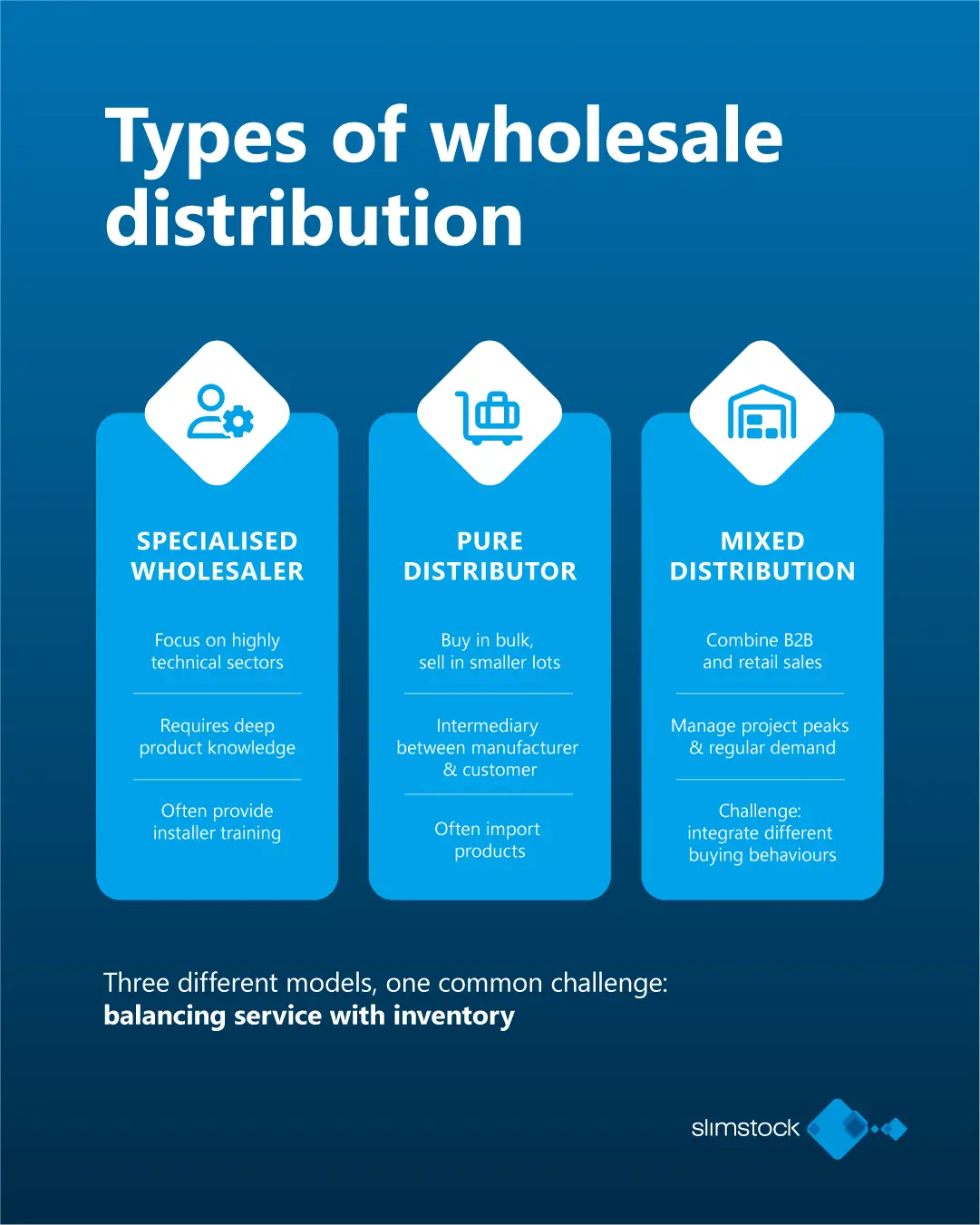
Wholesale distribution encompasses a variety of company profiles, each with specific operational dynamics and challenges. These range from highly specialised technical companies to pure distributors handling large volumes, or hybrid models combining B2B and retail channels.
Specialised wholesaler
These companies focus on highly technical sectors, such as heating or air conditioning installation. Their complexity stems not only from the products themselves but also from the technical knowledge required: installation methods, compatible combinations and sector-specific requirements. Many offer training to installers as a loyalty-building strategy.
Pure distributor
Pure distributors focus on breaking bulk, buying, often via importation, in large volumes and selling in smaller lots. They act as intermediaries between manufacturer and customer, making purchases more accessible.
Mixed distribution
Mixed distributors combine B2B and retail sales, creating two distinct sales patterns for the same product: project-driven peaks and regular retail demand. The main challenge here is integrating these differing behaviours effectively.
Challenges in wholesale distribution
Distributors operate in an environment where high service expectations coexist with numerous operational constraints. Irregular demand, extensive product ranges, geographically dispersed stock and dependence on strategic customers make day-to-day management a delicate balancing act.
Balancing service levels and inventory
One primary challenge is balancing service with inventory. Distributors often face high customer expectations. Many wholesalers we work with at Slimstock report: “We have to provide a service for everything.” This ambition creates constant tension between maintaining excellent service and avoiding excessive stock, particularly when minimum purchase requirements or restrictions prevent small orders.
Managing product range complexity
Managing a complex product range is another significant challenge. Differentiating between critical items and the long tail is essential. Distribution catalogues are typically extensive, and service expectations often require maintaining availability even for low-rotation items. Consider a company selling fasteners: a single model may have dozens of variants in size, finish and thickness. The level of assortment detail is enormous.
Multi-warehouse coordination
Many distributors operate a central warehouse with multiple branches. Coordinating stock between locations is crucial: poor distribution can result in excess in one branch and shortages in another, causing inefficiencies and service issues.
Dependence on strategic customers
B2B customers often exert significant influence, imposing strict service agreements due to their impact on total sales. Unlike retail, where consumers may simply shop elsewhere if a product is unavailable, a business customer may cease working with a distributor if deliveries fail, and these customers often represent a substantial portion of turnover.
Keys to optimisation in wholesale distribution
Optimising wholesale distribution requires rigorous planning, given the irregular demand, extensive product ranges and varying lead times. Key principles include:
Advanced forecasting
Optimisation begins with reliable forecasting. In an environment with peaks in demand and irregular consumption, anticipating trends and isolating atypical behaviour is essential. Using the appropriate forecasting model for each SKU allows decisions to be adjusted and both stockouts and excess inventory to be minimised.
Customer forecasting for strategic customers
When a large part of demand depends on a few customers, aggregate analysis is not enough. Anticipating the specific needs of key accounts ensures the availability of critical products and allows service levels to be adapted according to each customer’s relevance to the business.
Cleaning historical data using machine learning
Historical distribution data often contains noise: peaks due to projects, stockouts or exceptional orders. Cleaning this data helps to separate real demand from one-off consumption and allows you to work with more robust forecasts that are less exposed to past distortions.
Automatic adaptation to demand variability
Each SKU has a different pattern. Adjusting models according to seasonality, intermittency or volatility improves accuracy and avoids typical errors, such as underestimating critical SKUs or over-stocking long-tail products.
Stock optimisation by SKU and warehouse
Each SKU behaves differently in each warehouse. Adjusting inventory levels to local needs improves service, reduces excesses, and promotes better coordination between the central warehouse and branch offices.
Purchases with logistical conditions
Wholesalers work with minimums, multiples, and restrictions per supplier. Integrating these conditions into planning allows for more efficient order definition, reduces unnecessary accumulation, and better balances logistics costs with the required level of service.
Scenario simulation and ‘what if’ analysis
Simulating the impact of changes in demand, lead times or service levels helps you make informed decisions without taking unnecessary risks. This advanced analysis allows you to correct earlier and plan with greater certainty.
Conclusion: wholesale distribution is a highly demanding sector
Wholesale distribution operates in a sector marked by variable demand, competitive pressure and the vital importance of service levels. In this context, good inventory management, coordination of multiple warehouses and responsiveness to the needs of strategic customers are key factors for profitability and business continuity.
For all these reasons, optimising distribution requires tools that provide visibility, rigour, and speed. Solutions such as Slim4 allow you to anticipate demand, adapt inventory to the reality of each SKU, simulate scenarios and manage complex purchases with reliable data. In a sector where the margin for error is very small, advanced planning makes the difference between reacting to problems and anticipating them.