
Table of contents
Table of contents- How food industry companies can make the most of demand peaks
- Daily challenges: predicting demand
- The event factor, especially the weather
- Big opportunities, or margin killers?
- Forecasting isn’t guesswork
- But forecasting alone isn’t enough
- The BBQ button: scenario planning made simple
- From chaos to peace of mind
Overview
Food companies can actually make the most of those unpredictable demand spikes—think BBQ season when the weather turns nice, or the holiday rush—without just relying on gut feeling. The trick is having solid forecasts that account for different scenarios. There's specialized software out there, like Slimstock's Slim4, that even has what they call a 'BBQ button' to automatically tweak forecasts and inventory plans based on what typically happens during specific events.
Some moments trigger a shopping frenzy: Christmas, the World Cup, and the first warm day of spring when BBQs come out in full force. These events lead to a huge spike in demand for certain food and drink products, often over just a few days.
If you’re in the food industry, these peaks offer a great opportunity, but capitalising on them is not always straightforward. How do you ensure the right stock is in the right place at the right time? And how do you avoid being left with surplus products when the rush is over?
In this article, we share how food businesses can anticipate these peak moments and respond with speed, confidence and precision.
Daily challenges: predicting demand
Food businesses deal with an ongoing balancing act: producing, sourcing, and stocking the right items, all based on what they think customers will want.
But forecasting demand is rarely simple.
- Sales patterns are seasonal , like kale in winter and asparagus in spring.
- They vary during the week, premium products sell more on Fridays and Saturdays.
- Promotions cause unpredictable spikes. If a supermarket launches an offer on vegetarian snacks, demand can soar overnight.
Planning gets even more complicated when supply affects demand, especially with fresh produce. Add to that the pressure to respond quickly with limited production capacity, and the need for accurate forecasting becomes critical.
The event factor, especially the weather
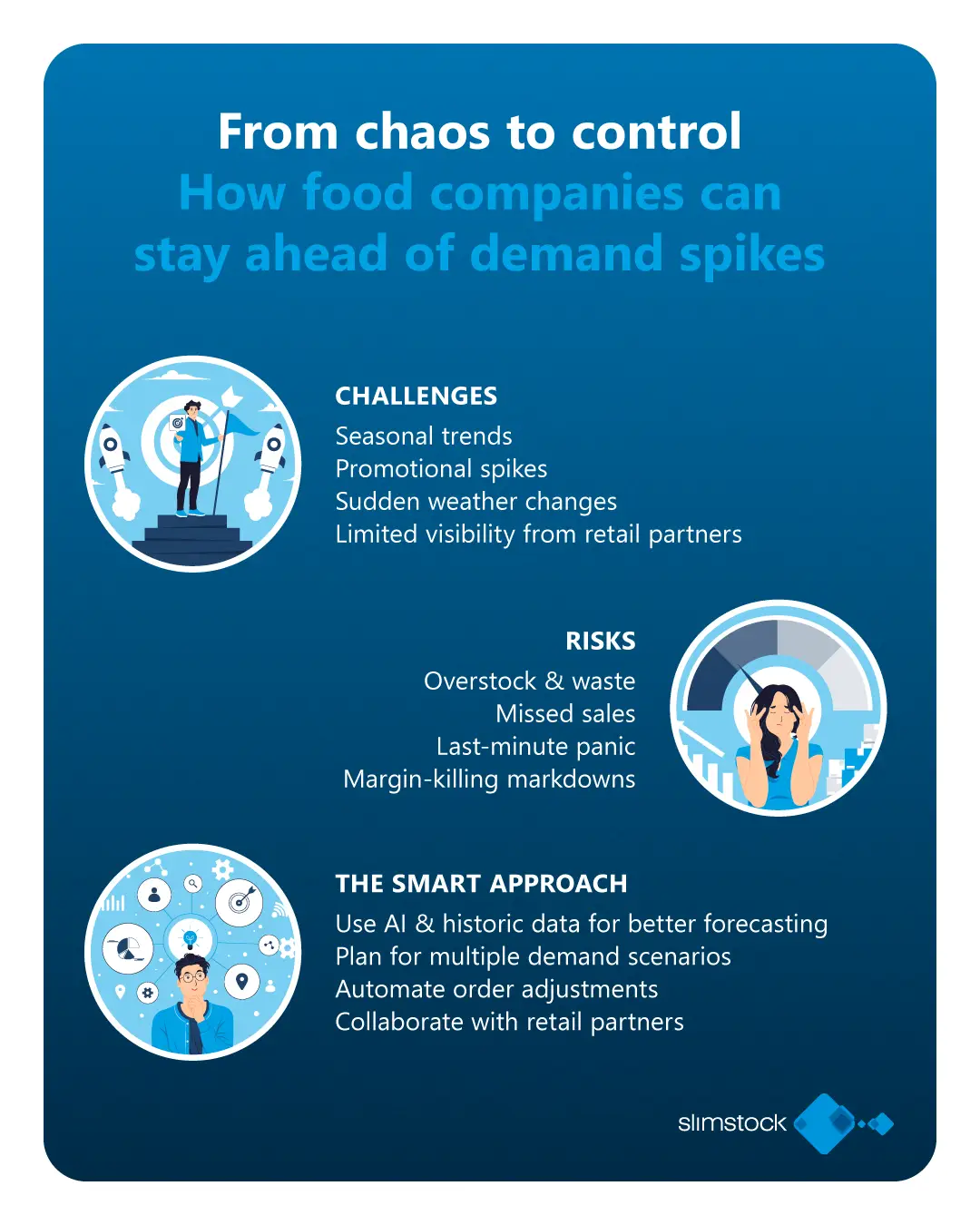
Beyond weekly and seasonal trends, events have a major impact on food sales. Not just Christmas and Easter, but also:
- Major sporting events.
- Music festivals.
- Sudden warm spells or cold snaps.
Weather-driven events are the hardest to prepare for. You can see the World Cup coming a year ahead. But when temperatures hit 20°C for the first time in spring, and everyone suddenly wheels out their BBQs, you may only have a couple of days to react.
For suppliers of meat, sauces or fresh salads, that can mean being asked to deliver triple your usual volume, tomorrow.
Big opportunities, or margin killers?
Events create huge commercial opportunities, and retailers pull out all the stops with deals, discounts and advertising.
But the window is short, and getting the supply right is a real challenge.
When events happen unexpectedly (like warm weekends), planners are often forced to act on instinct. They may lack visibility into how demand will actually unfold. And in the rush, it’s easy to overlook knock-on effects, like:
- Other products selling less (known as cannibalisation).
- Stock piling up on the wrong items.
- Misreading patterns, BBQ behaviour in April isn’t the same as in August.
What should be a sales boost can easily turn into lost profit, markdowns, and waste.
Forecasting isn’t guesswork
The key to getting it right? A strong, reliable forecast. And that’s no small feat.
Good forecasting pulls together:
- Sales data from similar past events.
- Real-time insight into weather and market trends.
- Promotion schedules from retailers.
- Smart software tools – often powered by AI.
The goal is simple: predict what people will want to buy, and when, with confidence.
But forecasting alone isn’t enough
Having a great forecast is just the start, success depends on what you do with it.
Retailers need planning systems that automatically adjust expected sales for each event and wind things down again at the right time. Suppliers need to build inventory in advance and be ready to respond as soon as the sun shines or a campaign goes live.
That means having:
- Skilled planners.
- Agile processes.
- Systems that support scenario-based thinking and real-time decision-making.
Example: Planning for different scenarios
Is warm weather expected in April? ➜ Plan A goes live.
Is there a competitor promotion? ➜ Adjust to Plan B.
Did your national team get knocked out of the World Cup early? ➜ Scale down demand instantly.
Smart supply chains don’t rely on manual adjustments. They use automated systems that react to changes, fast and accurately.
The BBQ button: scenario planning made simple
At Slimstock, we work with food companies that regularly deal with these event-driven spikes in demand. Our inventory solution, Slim4, includes an Events Management module that helps businesses plan for both expected and unexpected demand shifts.
One standout feature? What users call the ‘BBQ button’.
Here’s how it works:
- When warm weather is forecast, planners select the BBQ scenario profile.
- Forecasts and orders automatically rise for BBQ items like meat, sauces and charcoal.
- Items that usually sell less in heat (like mince or microwave meals) are scaled down.
- It distinguishes between one-off items (like charcoal) and restockable ones (like fresh veg).
- Planners can customise everything by store, region, date and more.
In just a few clicks, the planning system updates, and the business is ready to meet demand without overstocking.
From chaos to peace of mind
Whether you’re a retailer, wholesaler, or manufacturer, using the right tools means you can turn unpredictable events into well-managed success stories.
With Slim4’s Events Management functionality, the impact of an event is factored into your forecast and automatically translated into optimised production and stock orders.
The benefits?
- Higher availability during peaks.
- More sales.
- Less waste and fewer markdowns.
- Better use of production capacity.
- Less stress for your planning team.
In short, you replace guesswork with smart, scenario-based decisions – and stay in control, whatever the weather.