

Table of contents
Table of contents- Global dynamics call for a responsive food supply chain
- Market volatility is intensifying
- Recognising deviations early
- Management by exception
- Collaboration across the supply chain
- Sales & Operations Planning (S&OP)
- Building a resilient supply chain
Overview
The global food supply chain faces intense pressure from rising costs, geopolitical tensions, climate change and labor shortages. To maintain profits and customer satisfaction, food companies must build a truly responsive and resilient supply chain through early deviation recognition, 'management by exception,' strong supply chain collaboration and robust Sales & Operations Planning (S&OP) to ensure quick, coordinated responses to shifts in demand or supply.
The global food supply chain is under immense pressure. Rising energy costs, ongoing geopolitical tensions, climate-related disruptions, and labour shortages are making supply chains more dynamic and unpredictable than ever. How can food companies respond effectively to these challenges? How can they adapt swiftly to shifts in demand or sudden supply disruptions, while maintaining customer satisfaction and protecting profit margins? In this blog post, food industry expert Arjan Levisson explains what it takes to build a truly responsive supply chain.
Market volatility is intensifying
The food industry faces unprecedented volatility. Skyrocketing fuel prices, geopolitical conflicts, and climate-related crop failures are putting pressure on the availability and cost of key ingredients such as grains, vegetable oils and dairy products. Retailers and suppliers are navigating complex negotiations, and empty shelves remain a real risk in some markets.
Consumer behaviour adds another layer of uncertainty. Will shoppers prioritise premium products, switch to cheaper alternatives or limit their overall spending? Predicting demand is increasingly challenging but a responsive supply chain can help companies prepare for any scenario.
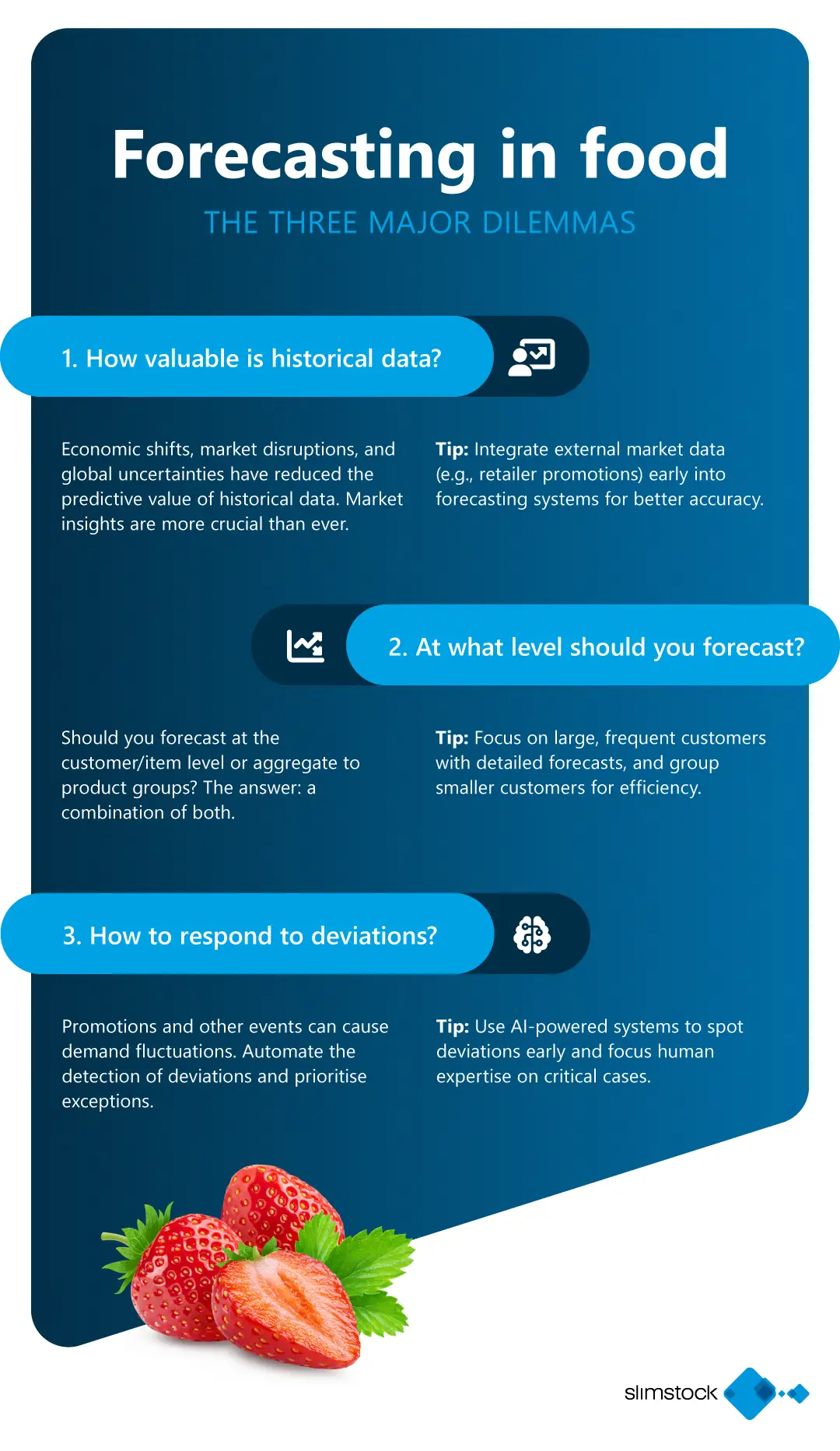
To fully understand how food supply chains are responding to today’s challenges, it is worth revisiting the insights shared in our earlier article, Forecasting in Food: The Three Major Dilemmas. In that piece, we explored three key forecasting dilemmas facing the food industry: the reliability of historical data, the level of forecast aggregation, and the ability to react to deviations.
The following visual summarises these challenges and provides a useful foundation for discussing how global dynamics now call for a more agile and collaborative supply chain.
Recognising deviations early
For a food company, responsiveness is essential. Failing to react in time to shifts in demand can have serious consequences for profit margins. Producing batches that do not meet actual demand generates unnecessary costs, while missed sales or late deliveries risk eroding customer trust.
Accurate demand forecasting is important, but recognising deviations early is even more critical. Identifying potential shortages or bottlenecks and reacting promptly through well-coordinated supply chain operations can make all the difference.
Management by exception
Complete visibility across the supply chain, from supplier to end customer, from “farm to fork”, is vital for informed decision-making. Planners must spot even minor issues and quickly assess their potential impact on delivery performance.
Management by exception allows routine decisions about production and purchasing to be automated. When a deviation occurs, such as a key ingredient being unavailable, alarm bells should ring. Planners can then focus entirely on collaborating with partners to find solutions.
Collaboration across the supply chain
A responsive supply chain requires continuous monitoring of key performance indicators (KPIs) and the capacity to act quickly. While advanced supply chain software and skilled planners are crucial, collaboration with partners is equally important.
Sharing sales forecasts, stock levels and purchasing needs with suppliers and customers fosters trust and transparency. Retailers, for example, might share details of upcoming promotions or product launches, allowing suppliers to adjust production and ensure availability. This collaboration reduces waste, optimises costs and benefits the entire chain.
In today’s environment of limited resources, collaboration is more important than ever. Companies must make tough decisions: which sales channels to prioritise, which markets can accept alternative products and which customers can wait. Transparency and trust enable scarce resources to be deployed optimally, minimising disruption for the end consumer.
Sales & Operations Planning (S&OP)
Responsiveness also starts internally, through Sales & Operations Planning (S&OP). Departments align on an aggregated sales plan across all product groups and channels, based on a single set of figures. From this, production, purchasing plans and associated budgets are developed.
Forecasts rarely match reality exactly. The challenge lies in identifying gaps early, analysing their causes, and implementing the right corrective actions to maintain operational responsiveness.
Building a resilient supply chain
Managing a food supply chain today requires navigating extreme uncertainty. Producers are caught between scarce resources and rising costs on one side, and demanding retailers and unpredictable consumers on the other.
The key pillars for survival? Visibility, management by exception, collaborative partnerships, and robust S&OP processes. Together, these strategies give food companies the flexibility and responsiveness they need to thrive, even in the most challenging circumstances.
Optimise your fresh item management and gain full supply chain visibility. Discover how with our Fresh Item Management solution.