

Table of contents
Table of contents- Seasonality and product life cycle in the automotive market: A guide to forecasting demand
- Understanding the automotive market and its demand
- What is the product life cycle?
- The product life cycle in the automotive industry
- Phases of the product life cycle in the automotive market
- What is seasonality and how does it affect the automotive market?
- Factors that drive seasonality
- Why seasonality complicates planning
- Integrating product life cycle and seasonality to improve demand planning
- Conclusion
Overview
This article examines how the product life cycle and seasonality interact to shape demand in the automotive market. It explains how each stage of a vehicle’s life cycle affects sales patterns, and how recurring seasonal factors such as economic conditions, consumer behaviour and promotional events can further influence demand.
In the automotive market, forecasting demand is not merely a competitive advantage, it is an operational necessity. Demand planning in this sector requires a clear understanding of how two key variables interact: the product life cycle and seasonality. The combination of complex products, multiple configurations and increasingly demanding customers forces companies to plan with precision, taking into account not only economic trends and consumer behaviour but also the structural evolution of each model and periodic market fluctuations.
In this article, we analyse how to interpret demand trends strategically in the automotive industry, examining tools and approaches that enable the integration of product life cycle and seasonality within a single planning framework. We also explore how behavioural patterns can be identified over time and how these directly influence decisions relating to production, inventory and sales planning.
Every model passes through distinct stages (introduction, growth, maturity and decline) and demand behaves differently at each stage. Seasonal factors such as promotional campaigns, year-end periods or periodic economic fluctuations can either amplify or moderate these patterns. Analysing how these two dimensions interact enables organisations to anticipate market changes, avoid stock-outs, reduce surpluses and protect profit margins in an increasingly competitive environment.
Understanding the automotive market and its demand
The automotive industry is characterised by significant structural and operational complexity. Each vehicle may be available in multiple versions, engine types, colours, optional packages and trim levels, exponentially increasing the number of SKUs that must be managed. This diversity affects not only production but also procurement planning, warehousing, distribution and after-sales service.
Added to this are long development cycles, substantial investment in innovation, global supplier networks and a strong reliance on logistics coordination.
Furthermore, the sector operates through highly interconnected supply chains, where any disruption, whether caused by geopolitical tensions, component shortages or transport delays, can trigger a cascade of consequences. In such circumstances, efficient inventory management becomes critical. Excess stock results in high financial and storage costs, whilst insufficient inventory can lead to stock-outs, delivery delays and lost sales.
Demand in this sector is rarely linear or entirely predictable. Economic conditions, new model launches, regulatory changes, fluctuations in interest rates and even weather conditions can significantly alter expected volumes. For this reason, planning cannot rely solely on simple historical projections. Instead, it must be based on a structured analysis of market behaviour that incorporates both internal and external variables, enabling companies to anticipate fluctuations and respond with greater agility.
Understanding these dynamics is the first step in designing robust supply chain and inventory management strategies capable of adapting to a demanding, volatile and highly competitive market.

What is the product life cycle?
The product life cycle describes the stages a product passes through from its launch to its withdrawal from the market: introduction, growth, maturity and decline. This framework highlights the fact that no product maintains the same level of demand indefinitely. Rather, demand evolves according to its positioning, market acceptance and competitive context.
Each phase presents distinct demand patterns that must be reflected in planning and inventory availability. During the introduction stage, demand is often uncertain and may fluctuate considerably, requiring caution in production and procurement. During the growth phase, sustained increases in sales require responsiveness and sufficient availability to avoid missed opportunities. In maturity, stability allows for the optimisation of inventories and margins, whilst during decline it becomes essential to adjust volumes in order to avoid surpluses and obsolescence.
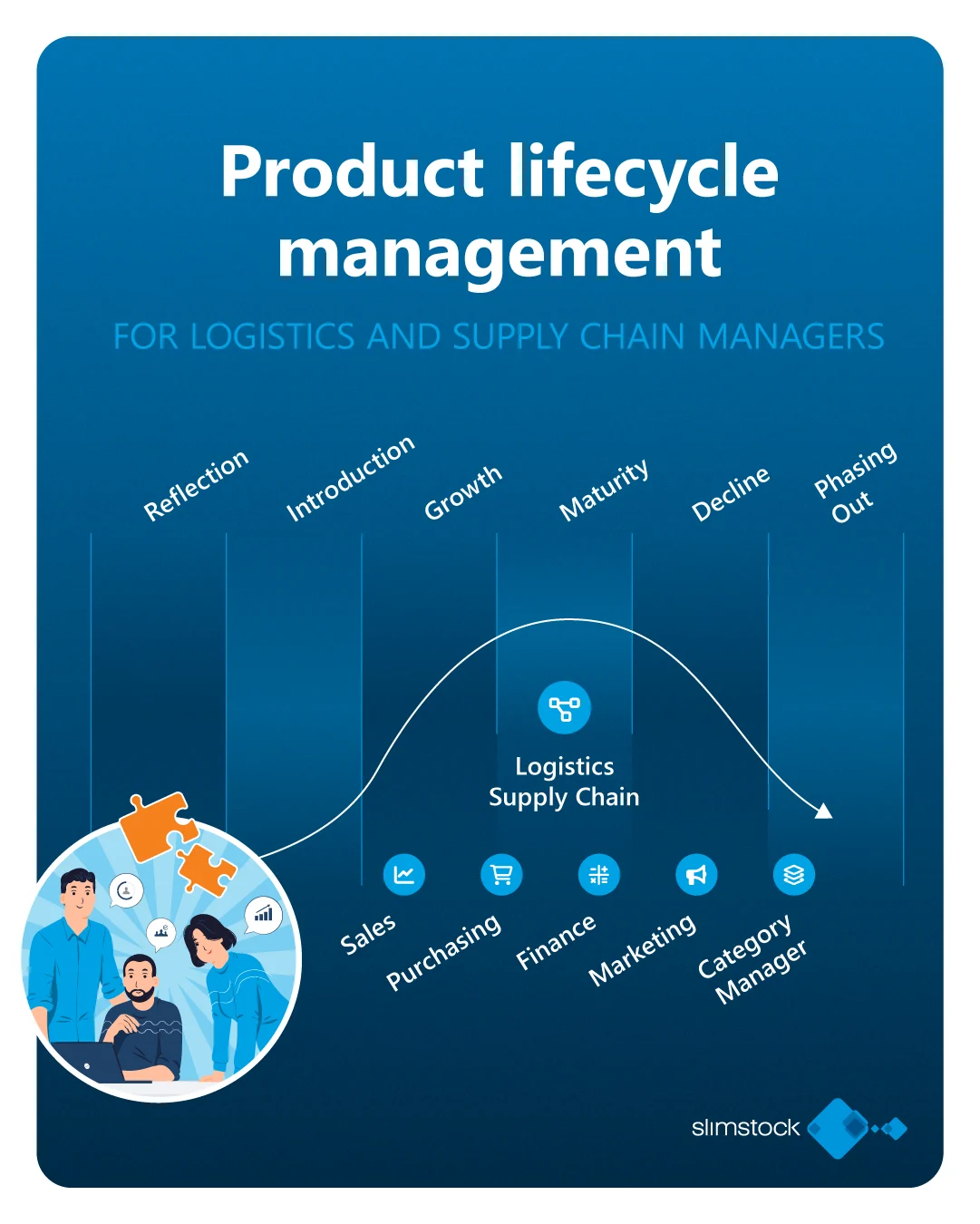
From introduction to gradual phase-out, each stage demands specific decisions regarding logistics, procurement, finance and sales. This perspective highlights the importance of adapting demand planning and inventory management dynamically according to the stage each model has reached.
Understanding the product life cycle is therefore essential for aligning demand with availability. Effective planning must anticipate these changes to ensure that inventory levels are sufficient to meet customer demand without generating unnecessary costs. Operational efficiency and business profitability depend largely on achieving this balance.
The product life cycle in the automotive industry
In the automotive sector, the product life cycle takes on particular importance due to the scale of investment, lengthy development timelines and operational complexity associated with each model. Although a vehicle may remain on the market for several years, its commercial performance rarely remains constant throughout that period.
Customer response, competitive pressure and technological developments continuously influence a model’s performance.
In this context, the product life cycle has a direct impact on production, supply and marketing strategies. A newly launched model behaves very differently from one that is already established or approaching the end of its life.
During the introduction phase, demand may be volatile and difficult to predict. In the growth stage, sales typically accelerate. During maturity, demand tends to stabilise, whilst in the decline phase it gradually decreases. Anticipating these variations enables companies to adjust production capacity, inventory levels and commercial strategies, reducing risk and optimising profitability throughout the product’s life cycle.
Phases of the product life cycle in the automotive market
In the automotive industry, the phases of the product life cycle are often marked by clearly defined milestones such as the launch of a new model, its commercial expansion, market consolidation, mid-cycle updates or facelifts, and finally its transition towards the end of its life.
Unlike other sectors where changes may occur gradually, each stage in the automotive market typically involves strategic decisions with significant financial and operational implications.
1. Introduction
This stage begins with the official launch of the model. Demand is still uncertain and may be influenced by marketing campaigns, market expectations and initial availability. Production is usually increased gradually, while procurement and the supply chain must balance the risk of overstocking with the need to ensure sufficient availability.
2. Growth
If the model is well received, sales increase steadily. The priority at this stage is to scale production, secure the supply of critical components and avoid bottlenecks. Accurate forecasting is essential to prevent lost opportunities caused by stock shortages.
3. Maturity
At this stage, the model reaches relative stability in terms of sales and market share. Demand becomes more predictable, enabling organisations to optimise inventory levels, negotiate better terms with suppliers and improve margins. Manufacturers often introduce special versions or minor improvements to maintain the product’s appeal.
4. Update or facelift
In the automotive industry, it is common to introduce partial redesigns or technological updates midway through the product cycle. These modifications can stimulate demand, but they also create additional complexity in inventory management as old and new versions coexist during the transition period.
5. Decline and end-of-life
Demand begins to fall, either due to the launch of a replacement model or shifts in the market. At this stage, the priority is to gradually reduce production, manage remaining inventory and avoid obsolescence, particularly for model-specific components.
Understanding these stages enables organisations to anticipate structural changes in demand and align the supply chain with commercial strategy, minimising risk and safeguarding profitability throughout the vehicle’s life cycle.
However, demand behaviour does not depend solely on the product’s position within the life cycle. Even within the same phase, periodic fluctuations may occur that influence forecast volumes. This brings us to a second key factor in demand planning: seasonality.
What is seasonality and how does it affect the automotive market?
Seasonality refers to recurring and predictable variations in demand that occur at specific times of the year. Unlike the structural changes associated with the product life cycle, seasonality represents temporary fluctuations that can occur within any phase and must therefore be incorporated into operational planning.
In the automotive market, seasonality may appear as sales peaks during particular months, increased demand for certain components depending on the time of year, or fluctuations linked to marketing campaigns, financial year-end periods or promotional events.
Although these variations are generally predictable, they can place significant pressure on the supply chain if they are not properly incorporated into forecasting models.
Understanding seasonality means recognising that demand evolves not only over the long term throughout the product life cycle but also through short-term cyclical fluctuations. Integrating both dimensions, etructural evolution and periodic variation, is essential for achieving more accurate planning and truly effective inventory management.
Factors that drive seasonality
Seasonality in the automotive market does not occur randomly. It reflects recurring patterns that repeat year after year and can be identified through the analysis of historical data. Understanding these drivers is essential for anticipating demand variations and adjusting purchasing, production and inventory planning accordingly.
1. Climate and consumption patterns
Weather conditions can directly influence consumer behaviour and the demand for certain vehicles or components. In many markets, for example, demand for SUVs or all-wheel-drive vehicles increases ahead of winter, alongside a rise in sales of seasonal tyres.
Consumption patterns linked to the calendar also play a role. Holiday periods, year-end deadlines, model changes and seasonal promotions frequently generate sales peaks concentrated in specific months. Because these patterns tend to repeat, they provide valuable indicators for demand forecasting.
2. Economic and regulatory factors
Seasonality may also be influenced by macroeconomic variables. Changes in interest rates, financing availability, government incentives or tax regulations can bring forward or delay purchasing decisions.
In some markets, the end of the financial year or the introduction of new emissions regulations can lead to temporary spikes in vehicle registrations before the changes take effect.
3. Specific events and marketing campaigns
New model launches, promotional campaigns, motor shows and incentive schemes can also generate clear peaks in demand at specific times of the year. While the intensity of these events may vary, many follow relatively predictable patterns within the commercial calendar.
Identifying and quantifying these drivers allows companies to develop more robust forecasts aligned with real market behaviour. The key is not only to recognise that demand fluctuates, but also to understand why it does so and when.
Why seasonality complicates planning
Seasonality introduces an additional layer of complexity into demand planning. Although these variations are recurring and theoretically predictable, their operational impact can be significant if they are not modelled correctly.
In a sector such as automotive, characterised by thousands of SKUs, long lead times and global supplier networks, even small forecasting errors can have major consequences.
One of the most common risks is lost sales caused by stock-outs during demand peaks. If seasonal increases are not anticipated sufficiently early, production capacity and supply availability may prove inadequate. Conversely, overestimating demand during slower periods can lead to excess inventory, higher financial costs, increased risk of obsolescence and pressure on margins.
Seasonality also complicates forecasting models based purely on aggregated historical data. Analysing annual averages without separating demand into its components can produce distorted forecasts and decisions that are poorly aligned with operational reality.
Another important effect is the amplification of variations along the supply chain. Small changes in end-customer demand can lead to much larger fluctuations upstream when visibility and coordination are limited. This phenomenon creates volatility, inefficiencies and greater difficulty in managing purchasing and production decisions.
For these reasons, managing seasonality effectively is not simply an analytical challenge, it is a strategic priority. Implementing demand planning solutions that combine advanced predictive models, real-time visibility and cross-functional collaboration allows organisations to anticipate fluctuations, reduce risk and maintain the right balance between availability and operational efficiency.
Integrating product life cycle and seasonality to improve demand planning
Effective demand planning requires analysing the product life cycle and seasonality together rather than as separate variables. Both factors influence demand behaviour simultaneously and must therefore be integrated into a single planning framework.
Only by combining these perspectives can companies balance availability, service levels, inventory turnover and financial efficiency, particularly in the automotive sector.
Adjust inventory policies according to the life cycle phase
Inventory strategies should evolve alongside the product. During the introduction phase, cautious and flexible policies are advisable due to uncertainty in demand. During growth, higher safety stock levels may be necessary to prevent stock-outs. In the maturity stage, stability allows organisations to optimise coverage and improve inventory turnover. During decline, the focus shifts towards reducing obsolescence risks and gradually lowering stock levels.
Continuously review forecasts against actual data
Neither the product life cycle nor seasonality remain static. Market conditions, economic changes and shifts in consumer behaviour can alter previously observed patterns. For this reason, forecasting models must be continuously reviewed, comparing predictions with real outcomes and adjusting assumptions where necessary.
Use statistical models and seasonal adjustment tools
Accurate demand planning requires statistical methods capable of separating demand into its main components: trend, seasonality and irregular variation. Seasonal adjustment techniques make it easier to identify the true evolution of a product within its life cycle, preventing temporary fluctuations from distorting long-term strategic decisions.
Integrating structural evolution with periodic variation allows organisations to develop more robust planning processes, reduce uncertainty and improve decision-making across the supply chain.
In a sector such as automotive, where margins are tight and operational complexity is high, effectively combining the product life cycle with demand seasonality is not optional. It is essential for competing efficiently and sustainably.
Conclusion
In the automotive market, understanding the interaction between the product life cycle and seasonality is not a theoretical exercise, it is the foundation of profitable and sustainable demand planning.
Each model progresses through distinct phases, and within each of these, demand may fluctuate due to seasonal factors. If these variations are not anticipated, they can result in stock-outs, excess inventory and unnecessary pressure on the supply chain.
Integrating both dimensions into planning reduces uncertainty, improves forecasting accuracy and optimises working capital. In a competitive environment such as the automotive sector, the difference between reacting and anticipating has a direct impact on service levels, operational efficiency and financial performance.
At Slimstock, we help automotive companies transform data into smarter decisions by combining technology, expert knowledge and best practices in demand planning and inventory management.
If you would like to strengthen your forecasting capabilities and take your planning to the next level, we invite you to get in touch with our team and discover how to turn market complexity into a genuine competitive advantage.