
Table of contents
Table of contents- Keys to effective Phase-in and Phase-out management in retail
- The structural complexity of retail
- Omnichannel: Another layer of complexity
- Phase-in: Introducing new products without destroying value
- Phase-out: Withdrawing products without eroding margin
- The importance of timing in assortment management
Overview
Effective phase-in and phase-out management helps retailers introduce and withdraw product references with clear rules across merchandising, supply and logistics. It improves availability whilst limiting obsolescence, forecast distortion and margin erosion by aligning lifecycle decisions with omnichannel complexity and network constraints.
In retail, no product is permanent: every item is introduced to the catalogue, grows, reaches a peak in demand, and eventually disappears from the shelves. However, this transition varies considerably depending on the type of product. While a lettuce has a clear consumable expiry, a T-shirt, a spare part or a technological item has a commercial expiry: it ceases to turn over, loses relevance or is replaced by a new reference. This is where phase-in and phase-out management comes into play.
Introducing a new product reference too early, too late or with incorrect stock can cause shortages, overstocking or cannibalisation. Withdrawing a product without proper planning can tie up capital, distort forecasts and erode margins. Managing these transitions effectively is not only a tactical concern, it’s a strategic decision that impacts service, inventory and profitability.
This article examines the key principles for optimising these two critical phases of the product lifecycle and highlights common errors made by organisations in their planning.
The structural complexity of retail
Before delving into phase-in and phase-out specifics, it’s essential to recognise a fundamental reality: retail operates within highly complex logistical and commercial structures. It’s no coincidence that one of the sector’s maxims is ‘retail is detail’, it’s not simply a matter of introducing or removing products but doing so within an ecosystem comprising multiple distribution centres, cross-flows and decentralised decision-making.
Many retailers operate with various distribution centres that fulfil differentiated roles. Typically, there is a main DC supplying stores and a secondary DC serving as a buffer for imports or seasonal peaks.
Added to this is procurement heterogeneity: some suppliers deliver to a single centre, others to several, and some even supply directly to stores. Further, value-added processes (such as labelling, tagging or repackaging) often take place within the warehouse itself, adding further operational layers.
This context is crucial: any phase-in or phase-out decision affects not only the product assortment but the entire logistics network.
Omnichannel: Another layer of complexity
One factor that has significantly increased the complexity of lifecycle management in retail is omnichannel. Product flow is no longer linear. An item can be sold online, delivered to a home and returned to a physical store. Alternatively, it may be sold in-store and later collected at home. The range of possibilities is vast.
This behaviour introduces critical complexity: returns are no longer tied to a single point of sale, which directly impacts planning. Many retailers choose not to attribute returns to store demand to avoid distortions, especially when the volume is low. For example, if returns represent less than 1% of sales, incorporating them may generate more analytical noise than value. However, this is not a universal rule. For high-value or low-turnover products, ignoring returns can lead to significant planning errors. Phase-in and phase-out management must include explicit rules for handling such exceptions.

Phase-in: Introducing new products without destroying value
The assortment does not expand, it’s replaced
One of the most common mistakes in retail is treating the introduction of new products as an additive process. In reality, operational constraints are much stricter: sales space is finite. Shelves are not elastic and each new reference that enters forces another out. Phase-in becomes a substitution decision. The aim is not to expand the assortment, but to optimise it.
This principle is especially evident during seasonal campaigns: entire categories may temporarily disappear to make room for others with higher sales potential or margins, such as toys during Christmas replacing less profitable categories for that period. Introducing a product is not an isolated decision, but a redistribution of available commercial space.
Structured introduction: From supplier to shelf
In mature retailers, phase-in begins well before the product enters the system. There is a structured process in which the supplier provides crucial information such as logistical data, purchasing terms, pricing and commercial characteristics. The commercial team then assesses whether the product aligns with the strategy: expected margin, positioning and coherence with the existing assortment. This initial filter is vital to prevent proliferation of references that add no value.
Often, decisions are made at the outset regarding where the product will be sold. Not all items launch with the intention of full distribution, it’s common to introduce them in specific clusters or stores before expanding their reach.
Clustering: Introduce with criteria
Given the volume of combinations in retail, product introduction cannot be managed store by store. Clustering allows grouping points of sale with similar characteristics and making consistent decisions. For example, a chain may define different levels of assortment according to store size or potential. A new product can be introduced only in certain clusters to test performance before scaling sales to other stores. This approach reduces risk and enables gradual deployment, whilst allowing for assortment adjustment based on actual behaviour.
The uncertainty of new products
A major challenge with phase-in is the lack of historical data. Without demand records, any forecast is highly uncertain. In this context, the key is not to get it right straight away, but to learn quickly. This requires intensive monitoring, frequent reviews and the ability to react. Occasionally, analogous products are used as reference, but always with caution. Planning in this phase should be flexible and geared towards adaptation, not optimisation.
The commercial dimension of phase-in
Introducing a product in retail is not only an operational decision but also a commercial negotiation. Often, the supplier assumes part of the entry cost: in-store visibility, shelf space or promotional activities. The rationale is clear, the retailer provides market access and the supplier funds part of that exposure. In extensive store networks, this relationship intensifies as the value of the distribution channel is substantial. Thus, phase-in is also built upon commercial agreements that influence its execution.
Phase-out: Withdrawing products without eroding margin
While product introduction often receives considerable attention, withdrawal is frequently overlooked. Yet, it’s at this stage that a significant portion of immobilised capital accumulates. Many retailers remain focused on new and mature products, neglecting those that have lost traction. The result is stock accumulation, forecast distortion and loss of profitability. Active phase-out management is important for maintaining assortment efficiency.
GMROI: When a product should exit
The decision to withdraw a product must be data-driven, not based on intuition. GMROI (Gross Margin Return on Inventory Investment) is one of the most widely used indicators for this purpose. This KPI measures how much margin each pound invested in inventory generates. When the value is low, especially below the recovery threshold, the product becomes a clear candidate for removal from the assortment. In some cases, products are withdrawn from stores and redistributed. In others, they are simply discontinued and their gradual exit managed.
Exit strategies: Recall, redistribution or clearance
Once a product has reached end-of-life, the next decision is how to manage its exit. Several options exist: remove the product from the point of sale and return it to the distribution centre (recall), redistribute it to stores with higher turnover or clear it directly in-store through discounts.
The choice depends largely on logistical context. In markets with high transport costs, in-store clearance is often more efficient than recall. The goal is not merely to eliminate the product, but to do so while maximising the return on remaining stock.
Dynamic assortment adjustment
Phase-out does not always entail definitive removal from the assortment. Often, products leave the most prominent shelf positions but continue to be managed residually until stock is exhausted. Furthermore, the assortment must be constantly adjusted to seasonality. Products withdrawn during one campaign may return in another, requiring dynamic lifecycle management. This continuous adjustment is crucial for retailers to react swiftly to demand changes and maximise commercial opportunities.
Rules and responsibilities for defining the lifecycle
Efficiency in phase-out depends on having clear rules. Defining when a product reaches end-of-life, what criteria trigger its removal and what actions should be taken is fundamental to avoiding reactive decisions. These rules must be aligned with business strategy and supported by data. Without this framework, product withdrawal becomes inconsistent and can harm the business.
The importance of timing in assortment management
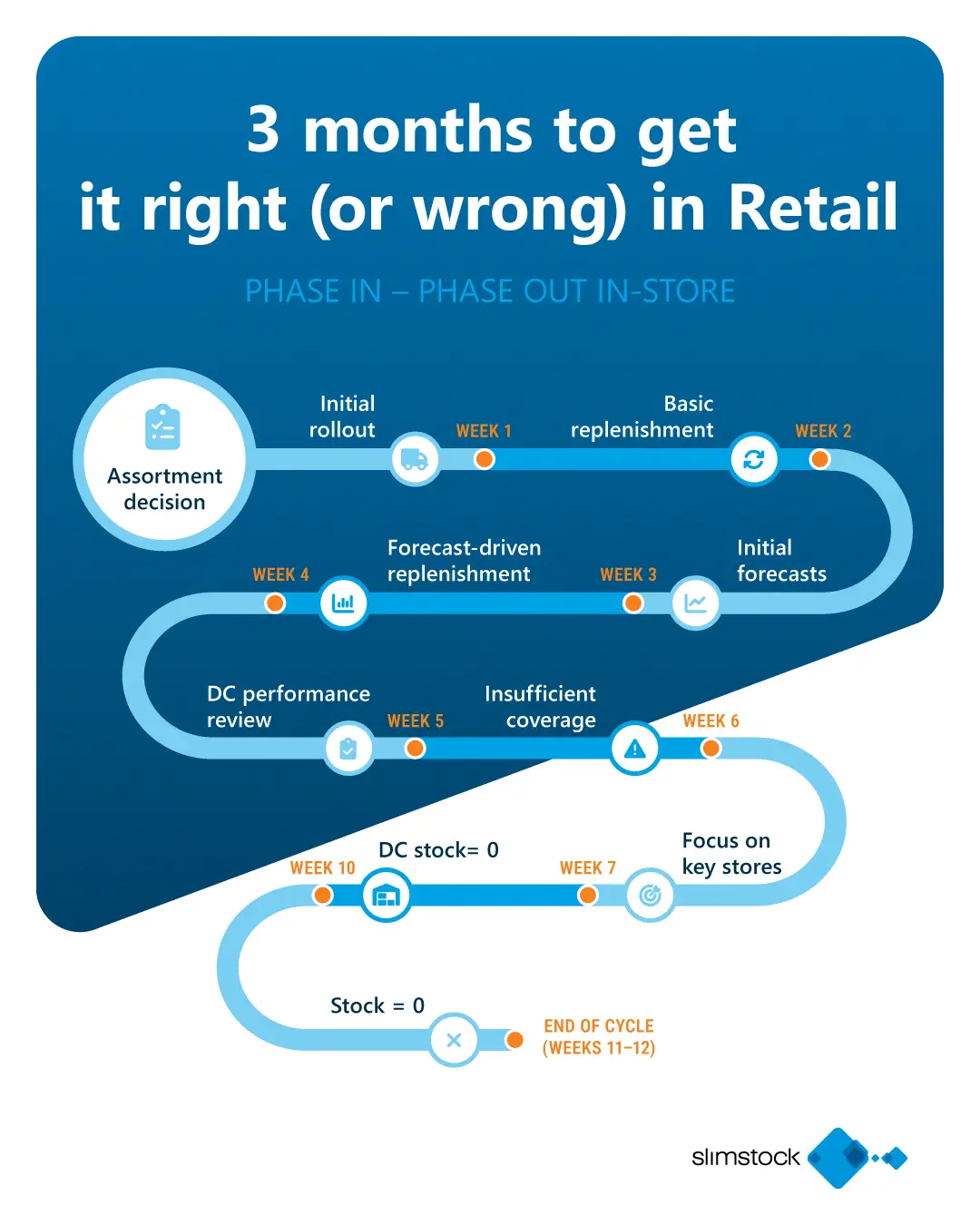
Choosing the right moment to introduce or withdraw a product, as well as how it is executed, is important for successful assortment management. Timing determines not only availability and service levels, but also capital efficiency and market adaptability. Therefore, rather than sporadic decisions, phase-in and phase-out should be seen as continuous processes, backed by data, clear rules and regular reviews. Only in this way is it possible to align the assortment with business realities and turn planning into a sustained competitive advantage.