
Table of contents
Table of contents- ESG in supply chain: A step-by-step roadmap to compliance and impact
- What does ESG (Environmental, Social, and Governance) mean?
- What is ESG in supply chain?
- Importance of ESG in supply chain
- ESG issues in supply chain
- ESG risks in supply chain
- How to achieve ESG compliance in supply chains
- Roadmap to operationalise ESG in supply chain
- Conclusion
Overview
As outlined in this article, ESG in the supply chain has evolved from a reputational concern into a core strategic priority. By integrating environmental, social and governance criteria across supplier networks, improving transparency and using digital tools to monitor performance, companies can mitigate operational and regulatory risks, strengthen resilience and enhance efficiency.
Over the past few years, ESG has gained consistent traction on the agendas of C-level executives worldwide. What was once treated as a reputational topic now sits at the core of strategic decision-making.
After the COVID-19 pandemic, this movement intensified. The crisis exposed vulnerabilities in global supply chains, revealed operational weaknesses, and made it clear that mitigating risks is no longer a differentiator, but a condition for survival.
Within the supply chain, this discussion gains an additional layer of complexity. It is at the operational level that environmental, social, and governance commitments move beyond rhetoric and become real practice.
What does ESG (Environmental, Social, and Governance) mean?
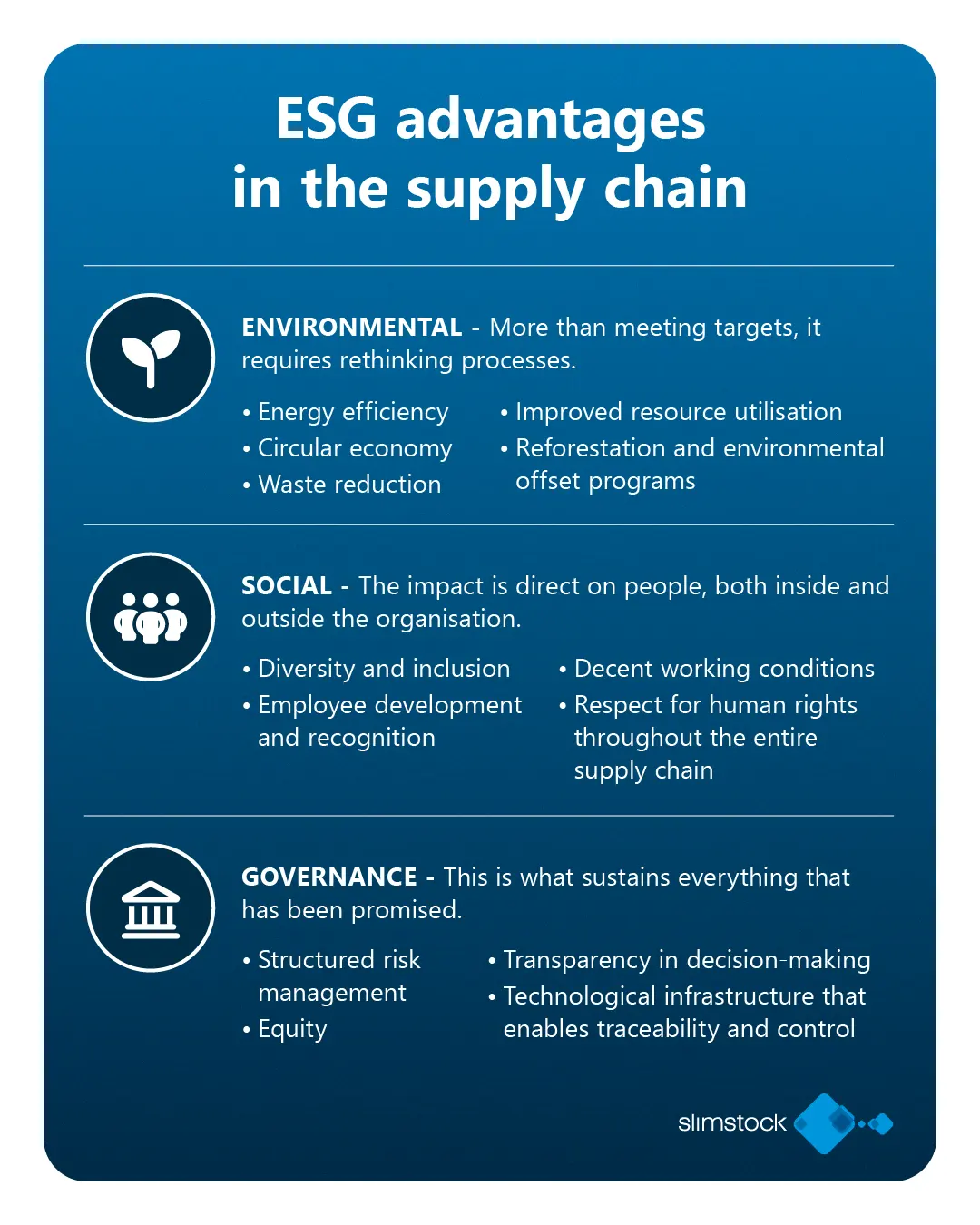
ESG stands for Environmental, Social and Governance, and represents a set of criteria used to assess how a company manages its environmental impacts, social responsibilities and corporate governance practices.
The environmental pillar includes issues such as carbon emissions, natural resource use, energy efficiency and waste management. It objectively measures how operations affect the environment and what commitments are in place to reduce that impact.
The social pillar looks at the company’s relationship with people: working conditions, respect for human rights, diversity, inclusion and relationships with employees, suppliers, customers and other stakeholders.
Governance refers to how the organisation is managed. It involves ethics, transparency, compliance, management structures, internal controls and accountability mechanisms.
When analysed together, these three pillars provide a broader perspective on sustainability, corporate responsibility and, above all, a company’s ability to manage risk and generate long-term value.
What is ESG in supply chain?
The ESG agenda cuts across the entire organisation, but it becomes especially concrete within the supply chain. This is where environmental impact materialissies in production, where waste appears in the numbers, and where operational decisions reveal the true alignment between discourse and execution.
Because it directly manages suppliers, inventory, transportation, resource consumption, and operational efficiency, the supply chain becomes one of the main strategic domains for executives who need to turn ESG targets into measurable results.
In recent years, this discussion has gained even more relevance with the advancement of digital transformation. The growing presence of artificial intelligence, including generative and agentic AI, has expanded the ability to analyse scenarios, anticipate risks, and structure data-driven decisions.
In this context, ESG moves beyond being a set of guidelines and becomes a structural approach to risk mitigation strategies, regulatory compliance, and investment direction.
Advanced supply chain planning and management solutions contribute by transforming operational data into smarter decisions. By optimizing inventory levels, reducing waste, and increasing demand predictability, technology plays a practical role in enabling ESG goals as an integrated part of operations, rather than as a parallel reporting layer.
Importance of ESG in supply chain
Pressure on supply chains has intensified. This movement is driven by regulatory requirements, increased investor scrutiny, exposure to operational risks and, above all, clearer expectations from internal and external stakeholders.
ESG therefore acts both as a risk mitigation mechanism and as a strategic driver of value creation.
Supply chains expose companies to environmental, social and governance risks that are often beyond their direct control. Unmonitored suppliers can generate carbon liabilities, labor scandals, corruption risks and reputational damage that is difficult to repair. In this context, ESG has a direct impact on risk management and resilience building.
In addition, companies are becoming legally co-responsible for the practices of their partners under stricter regulations, such as sustainability reporting directives and due diligence laws. ESG is no longer optional. It is essential for regulatory compliance and business continuity.
However, the agenda goes beyond protection.
ESG transparency also improves operational efficiency. Reducing waste, optimising resources, and making logistics smarter directly impact costs, margins and financial predictability. More structured and monitored supply chains strengthen profitability resilience and protect brand reputation by preventing crises that could undermine years of institutional development.
Reducing excess inventory and stockouts, for example, simultaneously impacts financial performance and environmental indicators. Advanced inventory planning systems such as Slim4 support this balance by generating more accurate forecasts and intelligent replenishment recommendations, reducing waste throughout the chain and aligning operational efficiency with ESG goals.
ESG issues in supply chain
The main ESG issues in the supply chain focus on managing environmental, social and governance risks across multiple supplier tiers, often beyond the company’s direct control. This cascading effect is where complexity arises.
A significant share of carbon emissions occurs at this stage, particularly indirect emissions. The difficulty of obtaining reliable supplier data, limited carbon traceability, excessive energy and water consumption, and inadequate waste management remain recurring bottlenecks. At the same time, initiatives such as green innovation and smart manufacturing are emerging as ways to improve ESG performance without compromising efficiency.
On the social dimension, working conditions throughout the supply chain are under growing pressure from regulators, investors, and society. The combination of transparency requirements and increased public scrutiny makes it clear that well-written policies are not enough. Real visibility and the ability to demonstrate compliance are essential.
ESG risks in supply chain
Numerous risks can impact supply chains, many of them outside the focal company. From an environmental perspective, a large share of the corporate carbon footprint occurs across the supply chain. Excessive use of natural resources, inadequate waste generation, deforestation and biodiversity loss increase exposure to regulatory fines, divestment, and higher capital costs.
Social risks are also significant. Poor working conditions, child or forced labor, human rights violations and industrial accidents can result in contract losses, reputational damage, and even exclusion from international markets. In an environment of heightened scrutiny, tolerance for misconduct continues to decline.
Governance risks include corruption, lack of transparency and low levels of supply chain digitalisation. Multi-tier visibility remains a challenge. Hidden risks may emerge at deeper supplier levels, exacerbated by fragmented data and disconnected systems. This fragmentation makes it harder to control inventory, suppliers and service levels.
Integrated supply chain systems help consolidate critical information and support data-driven decisions, reducing exposure to operational risks and strengthening supply chain governance.
How to achieve ESG compliance in supply chains
Achieving ESG compliance in the supply chain requires more than formal policies. It depends on the structured integration of environmental, social, and governance practices across all supplier tiers, combining transparency, active risk management, consistent contractual governance and digital monitoring.
Recent studies indicate that multi-tier visibility and collective transparency are decisive factors in reducing ESG risk exposure and improving overall supply chain performance. Standardising information disclosure, using independent audits and adopting digital systems strengthen not only reporting credibility but also operational efficiency. When data stops being fragmented and begins guiding decisions, compliance becomes part of routine operations rather than a parallel effort.
In addition, strategic collaboration with suppliers and investment in sustainable innovation transform compliance from a regulatory obligation into a long-term competitive advantage.
Roadmap to operationalise ESG in supply chain
The journey toward ESG maturity begins with organisational self-assessment. Before setting ambitious targets, companies need a clear diagnosis: understanding their current position, identifying gaps and recognising risks already present in the supply chain.
The first step, however small, is meaningful. It may involve replacing conventional lighting with LED systems. It may involve reducing ink usage in cardboard packaging to facilitate recycling. Small operational decisions signal strategic direction.
At the same time, digitalising supply chain management becomes essential to ensure consistency and traceability in decision-making. Solutions such as Slim4 enable companies to monitor key indicators, connecting operational efficiency to environmental and financial impacts in a structured way.
From this point onward, the roadmap can be organized into six complementary actions:
1. Define the ESG scope across the entire network
ESG in the supply chain is collective. Strategic integration across the entire network is critical for consistent results.
This includes:
- Mapping direct and indirect suppliers.
- Identifying geographic and material risks.
- Aligning definitions with standards such as GRI, SASB, or CSRD.
- Clearly defining emission scope boundaries.
The expected outcome is a robust structure of ESG responsibilities and boundaries.
2. Conduct risk and materiality assessments
Supplier transparency reduces exposure to ESG risks.
At this stage:
- Assess partners’ environmental, social, and governance risk.s
- Analyse workforce conditions, carbon emissions, and compliance practices.
- Identify critical nodes in the supply chain.
- Compare ESG ratings across different agencies.
Double materiality helps prioritise what truly matters.
3. Integrate ESG into contracts and procurement decisions
Compliance cannot be excluded from negotiations.
- Include ESG clauses in contracts.
- Require structured ESG data disclosure.
- Establish corrective action plans and periodic audits.
Research indicates that greater transparency strengthens financial resilience and improves overall supply chain performance.
4. Implement a digital strategy and continuous monitoring
Transparency also depends on technological infrastructure.
- Evaluate the use of blockchain for traceability.
- Use IoT to monitor emissions.
- Create integrated ESG dashboards.
- Automate compliance alerts.
More transparent supply chains reduce risks, increase predictability, and mitigate effects such as the bullwhip effect.
5. Enhance transparency and reporting credibility
The quality of ESG information disclosure directly influences performance and market perception.
- Harmonise ESG metrics and indicators.
- Use independent external verification, such as ISAE 3000.
- Standardise reporting requirements for suppliers.
At this stage, credibility becomes a strategic asset rather than just a reputational element.
6. Turn compliance into competitive advantage
At the most advanced stage, ESG shifts from obligation to competitive differentiator.
- Share sustainability training.
- Invest in green innovation partnerships.
- Align executive compensation with ESG targets.
- Co-develop decarbonisation goals.
Research shows that smart manufacturing and green innovation simultaneously strengthen operational performance and ESG indicators.
Conclusion
Integrating ESG into the supply chain is no longer a peripheral topic. It has become central to organizational sustainability and competitiveness. By incorporating environmental, social and governance criteria across all supplier tiers, companies reduce exposure to regulatory, reputational and operational risks while strengthening long-term resilience and performance.
Multi-tier transparency, structured risk management, reporting standardisation, and strategic supplier collaboration form the foundation of this transformation. When properly implemented, ESG moves beyond compliance requirements and becomes a driver of value creation, innovation, and market trust.
Technology plays a decisive role in this journey. Advanced inventory planning and management tools such as Slim4 enable more precise and sustainable decisions, connecting operational efficiency to strategic ESG goals. Ultimately, it is through the integration of strategy, data and execution that ESG moves from discourse to practice.