
Table of contents
Table of contents- Are you hiring for the supply chain jobs of the future?
- Traceability Analyst
- Supply Chain Network Architect
- Supply Chain Waste Tzar
- Disruption Response Architect
- Supply Chain Flow Optimiser
- Three more roles worth considering
- What connects these roles?
- The future will be built, not discovered
Overview
Supply chain planning roles must evolve to address increasing complexity and disruption, emphasizing digital connectivity, sustainability, and resilience. This shift demands new expertise and cross-functional collaboration for future success.
Ask most organisations to describe their planning function and you’ll hear a familiar list of job titles: Demand Planner, Supply Planner, Inventory Planner, S&OP Manager.
All of them remain important. Yet they were largely designed for a world of relative stability, predictable trade flows and a planning model centred on forecasting demand and responding accordingly.
That world is disappearing.
Over the next decade, supply chains will become increasingly circular, digitally connected, sustainability-driven and continuously disrupted. Regulatory requirements will expand. Artificial intelligence will transform decision-making. Geopolitical uncertainty will remain a constant challenge. At the same time, organisations will be expected to deliver higher levels of service, resilience and transparency than ever before.
If supply chains are changing this fundamentally, a logical question follows: should the roles within planning evolve just as radically?
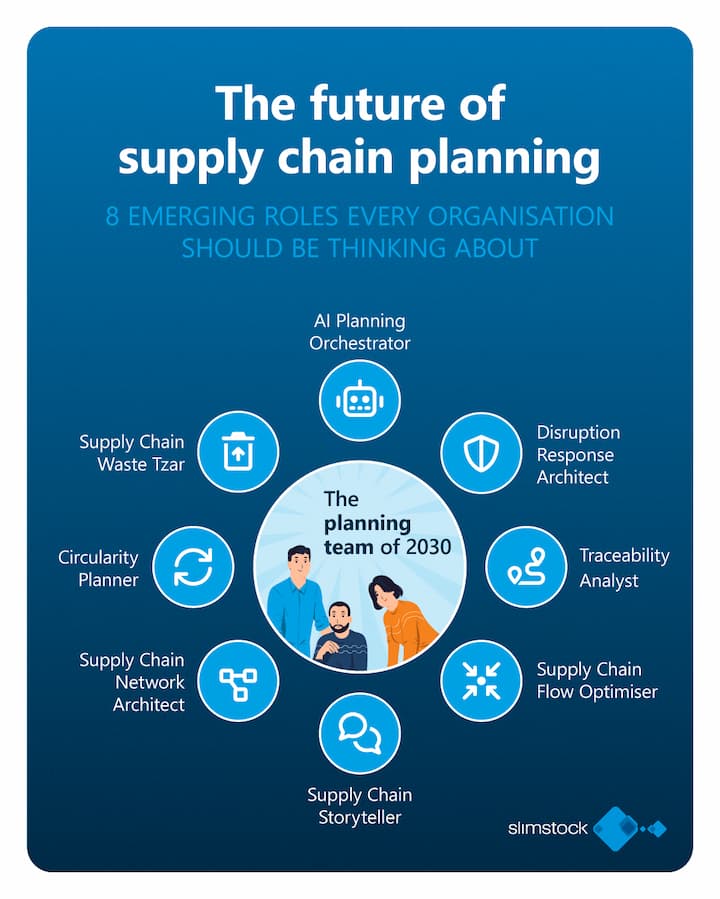
Here is my suggested manifesto for the planning team of 2030.

Traceability Analyst
For many organisations, traceability has historically been viewed as a compliance requirement or, at best, a way to strengthen brand reputation. But that mindset is rapidly becoming outdated.
Regulations such as the EU Digital Product Passport, alongside growing legislation around deforestation, sustainability reporting and forced labour, are making visibility across the supply chain a business necessity instead of a competitive differentiator.
The Traceability Analyst would be responsible for maintaining the digital thread that connects materials, suppliers, products and end-of-life processes. Their role would involve bringing together supplier information, product genealogy data and digital records to create a transparent, reliable view of the supply chain.
These professionals will need more than analytical capabilities to succeed. Alongside expertise in data engineering, regulatory compliance and standards such as GS1, they will need the ability to work across complex supplier networks and uncover information that is often difficult to obtain.
Supply Chain Network Architect
For decades, many organisations approached network design as an occasional project. A major review would take place every few years, recommendations would be implemented, and the network would remain largely unchanged until the next redesign exercise. That approach is becoming increasingly difficult to sustain.
Supply chain networks must now respond to shifting tariffs, changing sourcing strategies, carbon-related costs, evolving customer expectations and fragmented demand patterns. The Supply Chain Network Architect would treat the network as a living system rather than a fixed structure. They would continuously evaluate where products should be sourced, manufactured, stored and distributed, using digital twins, optimisation models and scenario planning techniques.
Technical modelling skills will be important, but perhaps even more important will be the ability to align network decisions with broader business strategy. The role is not simply about reducing costs. It’s about designing a network capable of supporting long-term competitiveness.
Supply Chain Waste Tzar
Waste remains one of the largest untapped opportunities in modern supply chains. Obsolete inventory, excess production, expedited transport, unnecessary packaging and energy inefficiencies all represent value that has been lost before it reaches the customer. They also contribute directly to an organisation’s environmental footprint.
The role of the Supply Chain Waste Tzar would be to identify and eliminate waste wherever it exists across the end-to-end value chain. This position goes beyond traditional continuous improvement initiatives. It requires a combination of lean thinking, circular economy principles and carbon accounting expertise, supported by the authority to challenge established ways of working.
In many organisations, reducing waste is still viewed primarily as a cost-saving exercise. The planning teams of the future may increasingly recognise it as a strategic lever that improves both profitability and sustainability outcomes.
Disruption Response Architect
Resilience is often discussed as a project but the organisations that outperform during disruption tend to view it differently: they treat resilience as a capability.
The Disruption Response Architect would be responsible for building that capability. Instead of reacting to events once they occur, this role would focus on designing the playbooks, governance structures and stress-testing processes that enable organisations to absorb shocks and recover more quickly than their competitors.
Whether the threat comes from geopolitical instability, cyberattacks, climate-related events or supplier failures, the objective remains the same: ensuring the business can continue operating under pressure.
Perhaps most importantly, this role recognises that resilience is not purely a technical challenge. During a crisis, human decision-making matters as much as systems and data. That’s why expertise in risk management, systems thinking and behavioural science will become increasingly valuable.
Supply Chain Flow Optimiser
Forecast accuracy has been one of the dominant measures of planning performance for years, but does a better forecast always lead to a better supply chain?
The Supply Chain Flow Optimiser challenges that assumption because instead of focusing primarily on prediction, this role would focus on improving the flow of materials, products and information throughout the value chain.
The objective is to synchronise supply with actual consumption, create meaningful product segmentation strategies and develop planning approaches that recognise the differences between products, customers and demand patterns. In practice, this means combining advanced analytical capabilities with a deep understanding of operational realities.
The most effective Flow Optimisers will be just as comfortable analysing control tower data as they are walking through operations to understand how decisions affect performance on the ground.
Three more roles worth considering
Not every future planning role will fit neatly into a traditional organisational structure, but the following three additional profiles are becoming increasingly difficult to ignore.
AI Planning Orchestrator
As autonomous planning agents and AI-driven decision-making become more prevalent, organisations will need professionals capable of governing them effectively.
The AI Planning Orchestrator will establish guardrails, review recommendations and determine when human intervention is required.
Part planner, part systems engineer and part ethicist, their responsibility will be ensuring that technology supports better decisions rather than simply faster ones.
Circularity Planner
Circular supply chains require circular planning.
As businesses place greater emphasis on returns, repairs, refurbishment and recycled materials, dedicated expertise will be needed to manage reverse flows with the same discipline traditionally applied to forward logistics.
The Circularity Planner will ensure that products continue creating value long after their first use.
Supply Chain Storyteller
Data alone rarely changes behaviour. Even the most sophisticated analysis becomes worthless if decision-makers fail to understand its implications.
The Supply Chain Storyteller will translate complex supply chain insights into compelling narratives that drive action, whether in the boardroom or on the front line.
It may sound like an unconventional planning role today, but it could become one of the most important tomorrow.
What connects these roles?
Although the titles may differ, they share an important characteristic: none of them are purely technical positions.
Every role combines analytical expertise with broader business capabilities, including commercial awareness, sustainability literacy and the ability to influence decisions across multiple functions.
In other words, they reflect the growing need for T-shaped professionals: individuals with deep expertise in a particular area, supported by the broader skills required to collaborate, communicate and lead change.
This has implications not only for employers but also for universities, professional bodies and training providers, which will need to rethink how future planning talent is developed.
The future will be built, not discovered
Whether these exact job titles appear on LinkedIn is ultimately beside the point, what matters is the shift they represent. The pressures driving these roles already exist today: greater transparency requirements, increasing complexity, sustainability expectations, persistent disruption and the rapid advancement of AI.
The organisations that lead the next generation of supply chain planning will not wait for these roles to become standard practice. They will create them, develop them and allow them to reshape the planning function from within.
The future of supply chain planning belongs to those bold enough to start hiring for it now.