
Overview
Peak season brings both predictable patterns and unexpected disruption. For ANZ retailers, the challenge is knowing which is which. This article explores how better data, smarter inventory buffers and exception-based planning can help retailers navigate demand volatility, protect availability and avoid carrying excess stock into the new year.
Peak retail season is only weeks away. Some of it, you can forecast. Some of it, you can’t.
Most retailers treat both halves the same way: build in a buffer and hope. Then January delivers the bill in markdowns and trapped cash. Many of them also build heavy stock positions for peak, only to run short in January on lines that keep selling because the plan stopped at peak.
The fix starts with separating the predictable and unpredictable. It also needs a planning process that runs on connected data, not spreadsheets and gut feel.
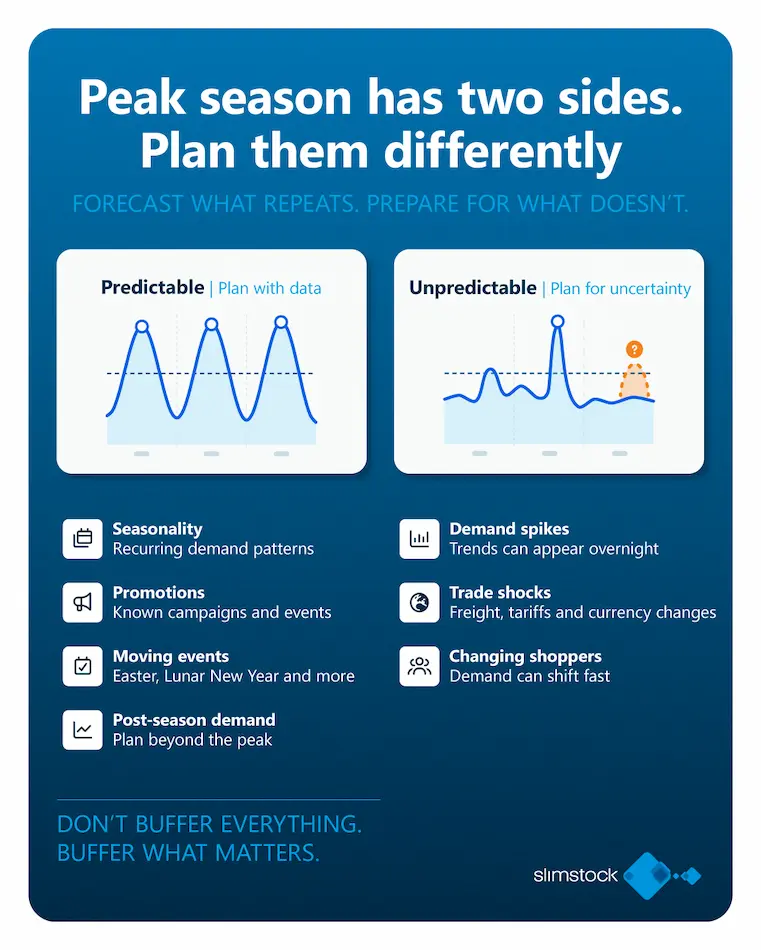
The predictable half
Seasonality, holidays and promotions usually repeat. The data can reveal the patterns, instinct alone can’t.
Here’s what often gets missed:
- Distorted history: Last year’s sales can include one-off promotions, bulk orders and stockout periods that mask real demand. If you copy that forward, you’ll carry the same errors into the next plan.
- Moving events: Easter shifts by weeks and Chinese New Year can move supplier shutdowns. A flat monthly curve misses the timing every year.
- Quiet seasons: Review at least two years of history and you may find recurring lifts that nobody planned for, such as summer renovation lines.
- New products: A new line has no sales history, so you can use the curve of a similar item or group to make sure launch stock is based on evidence, not guesswork.
- The once-a-year buy: ANZ retailers often place peak-season orders mid-year, when Asian factories and freight lanes are already under pressure from Northern Hemisphere Christmas demand. Work backwards from the date the stock needs to be on the shelf.
- Post-season demand: Peak doesn’t end on Boxing Day. January sales, gift card redemptions and back-to-school buying keep some lines moving just as Chinese New Year slows replenishment. Plan the tail of the season, not just the peak, so the lines that still sell don’t run out while the rest go to markdown.
Every item on that list is a data problem. Sales, stock, supplier lead times, and promo calendars sit in different files, owned by different people. Digital transformation in planning starts here: with a single and connected view of demand and supply.
The latest ABS data shows why a single headline forecast isn’t enough. Household spending was flat in August 2026 but 6.8% higher than a year earlier, in current prices. Underneath, categories swung. Clothing and footwear rose 1.5% in July, then fell 1.0% in August.
None of this needs a crystal ball. It needs clean data and a repeatable method.
The unpredictable half
Then there are forces that sit outside any forecast:
Demand spikes quickly, then disappears
A single influencer post can turn a niche product into a sell-out within days. In ANZ, reorders from Asia often arrive after the trend has passed. If you chase the spike, you risk being left with excess stock. But if you ignore it, you miss the sale.
Trade shocks disrupt just-in-time planning
Tariffs, freight volatility and currency movements create a difficult choice: commit early to stock that may not sell, or rely on costly late orders. The RBA’s August 2026 outlook judges inflation risks as skewed to the upside, including greater pass-through of Middle East conflict costs to consumer prices.
Shoppers are moving in different directions
Cost-of-living pressure is tightening budgets for some households, while others continue to spend on premium products. The RBA expects higher inflation to reduce household disposable income and notes that consumer sentiment remains very low. Averages hide this gap. Loyal shoppers may wait an extra day for delivery, but they will not wait for stock that is not available.
You can’t forecast these shifts with any certainty. But you can spot them early and build buffers deliberately, instead of by default.
Where instinct fails
Here’s the trap: when you can’t separate the two halves, you cover both with the same blanket buffer.
Sabco lived it. The Australian manufacturer and distributor of professional cleaning, signage and safety products supplies customers across Australia and New Zealand from multiple warehouses. Growth outpaced what its ERP’s limited forecasting and spreadsheet workarounds could handle. Stock swung between overstock that tied up capital and shortages that risked stock-outs. Planners cross-checked and calculated by hand, and fragmented data caused errors.
Too much stock in some periods. Too little in others. The same business.
The order matters
Digital transformation in planning isn’t a platform purchase. It’s deciding which calls a system should make every cycle, and which needs a planner.
Retailers who exit peak clean follow this sequence:
- Build the data foundation: Bring sales, stock, supplier and promotion data into one connected view. Clean out one-offs and stockouts from the history, let the data surface seasonal patterns, and plan events and promotions as explicit demand drivers. Work the once-a-year buy backward from the shelf date.
- Set buffers by value, not instinct: Assign service levels by margin and criticality, not one target for every SKU. Base safety stock on actual supplier lead-time variability, not the quoted lead time.
- Automate the routine, manage by exception: Let the system generate forecasts and order proposals every cycle. Planners then focus on the exceptions, such as a heatwave, a viral post or a late shipment, and act on each one early.
- Wind down fast: When peak ends, check every open and planned order against actual demand. Cut cover on peak-only lines to avoid excess stock and protect the lines that keep selling through January to avoid stock-outs.
Step 1 pays for step 2. Every unit of stock you stop holding “just in case” is cash you can put behind the risks that are real.
Spreadsheets can’t run this across thousands of SKUs. A connected, centralised process can. And it doesn’t need an ERP replacement: Sabco runs its planning alongside its existing ERP and rolled it out progressively.
What it looks like when it works
Sabco made that shift, centralising forecasting and inventory optimisation for Australia and New Zealand in one platform:
- Stockholding: down by approximately $1M.
- Stock-outs: no increase.
- Seasonal peaks: tighter control held through Chinese New Year.
- Planning errors: fewer, with faster replenishment decisions.
Lower stock levels. Stronger service. Both at the same time.
Planning got calmer too. Planners spent less time reacting and more time deciding. As Supply Chain Manager Stijn Verhofstadt puts it: “The biggest thing that really stood out was the decrease in mistakes.”
Peak season is your best chance to make a margin. Don’t hand it back in February.
Want to uncover hidden patterns, delays, and emerging risks in your supply chain? Our team can help you turn them into smarter inventory decisions and stronger operations.