
Table of contents
Table of contents- How Business Intelligence drives better inventory decisions in retail
- From reporting to decision-making
- Start with decisions, not dashboards
- Build dashboards around decisions, not data
- BI and AI: stronger together
- Trusted data is the entry ticket for AI
- Turn insight into continuous improvement
- Make smarter assortment decisions
- Decide better, not report more
Overview
Business Intelligence (BI) is key to transforming data into effective decisions that improve inventory management in the retail sector. This tool makes it possible to identify problems, prioritise actions, and optimise collaboration across departments.
A promotion launches. Demand surges exactly as expected. But the supply chain team was never informed, stock runs out and customers leave empty-handed.
Situations like this occur every day in retail. Not because organisations lack data, but because the right information doesn’t always reach the right people at the right time.
Retailers have no shortage of data. Sales, inventory, supplier performance and customer demand can all be monitored in near real time, while AI increasingly automates forecasting and replenishment decisions.
But stockouts, excess inventory and reactive firefighting remain common. So access to information is not the challenge, turning that information into better decisions is.
Business Intelligence (BI) helps bridge this gap. Instead of simply reporting what has happened, it provides the visibility and context needed to understand what requires attention, why it’s happening and what action should be taken next.
As AI takes over more routine planning tasks, this becomes even more important. Retailers still need clear priorities, effective governance and the ability to monitor whether automated decisions are delivering the desired results.
From reporting to decision-making
Many organisations associate BI with dashboards and KPI reports. But its real value lies in supporting decisions.
Effective BI should answer these two simple questions:
- What requires our attention?
- What should we do next?
To achieve this, BI combines information from merchandising, supply chain, logistics, stores and finance into a shared view of performance. It also highlights exceptions that require action, such as declining forecast accuracy, supplier issues or emerging stock risks.
This allows planners and managers to focus on preventing problems instead of reacting to them after the fact.
Start with decisions, not dashboards
Many dashboard initiatives start with the available data and work forwards. The result is usually dozens of reports filled with metrics that are interesting to observe but difficult to act upon.
A more effective approach starts with the decisions the organisation needs to make.
What determines inventory performance? Which decisions have the greatest impact on customer service, working capital and profitability? Only after answering those questions, retailers should define the KPIs that support them and build dashboards around those measures.
This creates a clear steering model that connects strategic objectives with tactical decisions and operational execution.
For most retailers, three priorities sit at the centre of inventory management:
- Product availability.
- Profitability and margin.
- Working capital efficiency.
These objectives provide the foundation for a focused set of performance indicators that guide planning decisions throughout the organisation.
Product availability
For most retailers, availability is one of the clearest measures of supply chain performance. Every stockout represents a potential lost sale, reduced customer loyalty and missed revenue opportunity.
BI helps retailers understand why availability issues occur, if they stem from forecast errors, supplier delays, safety stock policies or shifts in demand. For example, a fast-selling back-to-school product may run out weeks earlier than expected because demand accelerated faster than the forecast anticipated.
BI helps planners identify the root cause and respond before the same issue affects other products.
Forecast accuracy
Every inventory decision relies on an expectation of future demand, making forecast accuracy a critical driver of performance.
But improving forecasts requires more than comparing planned demand with actual sales. Organisations also need to understand how forecast quality is measured.
Common performance metrics include:
- MAE (Mean Absolute Error): measures the average forecasting error in actual units.
- RMSE (Root Mean Square Error): places greater emphasis on larger forecasting errors, making it useful for identifying significant deviations.
- SMAPE (Symmetric Mean Absolute Percentage Error): expresses forecast accuracy as a percentage, allowing comparisons across products with different sales volumes.
Metrics such as MAE, RMSE and SMAPE help measure forecasting effectiveness, but the real value comes from understanding why forecasts deviate. BI enables retailers to identify the impact of promotions, changing customer behaviour, supplier constraints or market disruptions, and continuously improve planning models.
Days of supply
Days of Supply (DoS) shows how long current inventory is expected to last based on forecast demand.
This metric has limitations on its own. A supermarket may have 20 days of stock for a fresh product, but if only seven days of shelf life remain, that inventory represents a waste risk rather than a service-level success.
For products with limited shelf life, such as food, cosmetics or seasonal items, DoS should be viewed alongside remaining product life. This provides a more balanced view of inventory risk and helps organisations reduce waste while maintaining service levels.
Inventory turnover and GMROI
Inventory turnover indicates how efficiently stock moves through the business, but it doesn’t reveal if that stock is generating value.
For that reason, many retailers also monitor Gross Margin Return on Inventory Investment (GMROI), which measures the profit generated from inventory investment.
For example, a product with an inventory turnover of 12 may appear highly successful because it sells quickly. However, if it’s heavily discounted and generates only a small margin, its overall contribution to profitability may be limited.
By comparison, a product with an inventory turnover of 6 may sell more slowly, but if it delivers significantly higher margins, it can generate a much stronger GMROI and create more value for the business.
Together, these metrics help answer two essential questions:
- Are we moving stock efficiently?
- Are we investing in the right products?
Supplier performance
Inventory performance is influenced by supplier reliability.
On-Time In-Full (OTIF) remains one of the most important indicators of supplier execution. By analysing OTIF trends over time, retailers can identify recurring issues, assess their commercial impact and make more informed decisions about supplier management, risk mitigation and inventory policies.
Build dashboards around decisions, not data
The effectiveness of BI depends as much on what is excluded from a dashboard as on what is included.
Many organisations create dashboards filled with dozens of KPIs because the data is available. The result is information overload rather than decision support.
A more effective approach is role-based dashboarding. Supply chain leaders require visibility into strategic trends, financial performance and cross-functional alignment. Planners, meanwhile, need prioritised operational insights that help them decide where to intervene today.
As AI increasingly automates routine planning decisions, this principle becomes more important. Human planners should spend less time reviewing normal transactions and more time resolving the exceptions where judgement adds value.
BI and AI: stronger together
AI and machine learning are rapidly changing how retail supply chains operate.
Forecasting models learn from historical demand patterns, replenishment systems generate purchasing proposals automatically and allocation decisions can be optimised across stores with minimal human intervention. More advanced organisations are beginning to adopt decision intelligence capabilities that allow routine planning decisions to be executed autonomously within predefined business rules.
This evolution doesn’t reduce the importance of BI, it changes its purpose.
As AI assumes responsibility for more routine decisions, human expertise shifts towards designing the tactical framework within which those decisions are made.
Supply chain leaders still determine questions like:
- What service levels should different product segments achieve?
- Which products justify higher inventory investment?
- What level of forecast risk is acceptable?
- When should an automated decision be escalated to a planner?
- How should conflicting objectives between availability, cost and working capital be prioritised?
These are strategic and tactical decisions that require reliable information, clear governance and continuous performance monitoring. BI provides the insight needed to evaluate whether AI-driven decisions are delivering the intended outcomes and where planning policies require refinement.
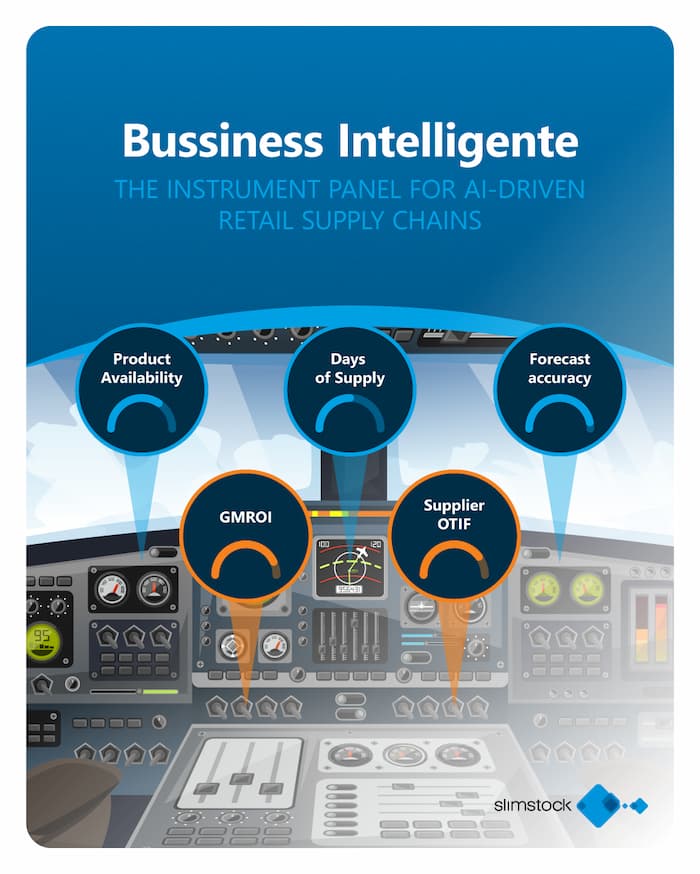
Rather than replacing BI, AI increases its importance. BI becomes the instrument panel through which organisations monitor automated decision-making, validate outcomes and continuously improve planning strategies.

Trusted data is the entry ticket for AI
No AI model can consistently produce good decisions from poor-quality data.
As retailers expand their use of machine learning and autonomous planning, data governance becomes a strategic capability rather than a technical exercise.
Strong governance is built around four fundamental principles:
| Definition | Executive question | |
|---|---|---|
| Complete | Data that contains all required information, attributes, documents, and fields needed to support business processes. | Do we have all the data? |
| Correct | Data that accurately reflects reality and has been validated against trusted sources, business rules, or supplier input. | Can we trust the data? |
| Consistent | Data follows the same standards, structures, definitions and relationships across systems and records. | Is the data used the same way everywhere? |
| Continuous | Data quality is continuously monitored, validated and maintained as data changes over time. | Will the data still be right tomorrow? |
When these four characteristics are in place, BI creates a trusted foundation for both human and AI-supported decision-making.
Without them, organisations simply automate poor decisions faster.
Turn insight into continuous improvement
Measuring performance is not the same as improving it.
Instead of treating every operational issue as an isolated event, BI enables organisations to establish a structured improvement loop:
- Detect a deviation.
- Identify its root cause.
- Improve the underlying process.
- Measure the impact of the change.
Consider a recurring stockout on a high-demand product. The immediate response might be to increase safety stock, but Business Intelligence allows teams to investigate further. The root cause may be an inaccurate demand forecast, which in turn may stem from a promotional campaign that was never shared with the supply chain team. Alternatively, repeated supplier delays or incorrect replenishment parameters may be driving the issue.
Without this level of analysis, organisations often end up treating the symptoms instead of addressing the underlying process failures.
The same applies across the supply chain. Low supplier performance, declining forecast accuracy, increasing inventory write-offs or poor availability should all trigger investigation rather than simply reporting another KPI.
So Business Intelligence serves not only as an operational monitoring tool but also as a mechanism for improving how the supply chain itself operates.
Make smarter assortment decisions
Assortment decisions are among the most influential drivers of inventory performance.
Many retailers still rely heavily on traditional ABC classifications based primarily on sales volume. While this remains a useful starting point, it no longer reflects the complexity of modern retail.
Today’s assortment decisions require a broader view of product performance.
Business Intelligence enables retailers to evaluate products across multiple dimensions, including:
- Sales performance.
- Gross Margin Return on Inventory Investment (GMROI).
- Demand variability.
- Strategic importance.
- Inventory investment.
- Shelf life for fresh and date-sensitive products.
Looking at these factors together allows organisations to build assortments that support both commercial objectives and operational efficiency.
Business Intelligence also makes it possible to analyse relationships between products rather than evaluating each SKU in isolation.
Market basket analysis, for example, reveals which products are frequently purchased together. A low-volume item may appear to underperform when viewed individually, yet it may play an important role in driving sales of higher-margin complementary products. Removing it purely on the basis of sales volume could unintentionally reduce overall basket value and customer satisfaction.
Similarly, combining GMROI with inventory turnover helps retailers distinguish between products that simply sell quickly and those that genuinely create value. This allows merchandising, finance and supply chain teams to make more balanced decisions about product introductions, range rationalisation and inventory investment.
Ultimately, effective assortment management is not about reducing complexity wherever possible. It is about managing complexity intelligently by investing in the products that contribute most to customer value and business performance.
Decide better, not report more
Business Intelligence has evolved far beyond its traditional role as a reporting tool.
As AI and machine learning take on a growing share of routine planning decisions, this role becomes even more important. Technology can automate execution, but organisations must still determine the objectives, policies and governance that guide those decisions. Trusted data and meaningful Business Intelligence remain the foundation on which successful AI initiatives are built.
The question is no longer whether your organisation has enough data.
The more important question is: are you using that data to make better decisions?