
Table of contents
Table of contents- Comparing the best inventory management software
- What is inventory management software?
- Why businesses are investing in inventory management software
- Key capabilities to look for in your new inventory management software
- Comparing the best inventory management software solutions
- FAQs about inventory management
When it comes to supply chain optimisation, the holy grail that companies are looking for is end-to-end visibility and synchronisation, a clear alignment of data that informs optimal decisions to ensure constant availability of products without overstocking.
To achieve this, a lot of focus is placed on connecting supply and demand data… each end, in that literal sense. And that makes sense, if you can see how much you need from a customer availability perspective, you can calculate how much is required from a sourcing and procurement point of view. When those two match, in theory, waste is avoided and customer loyalty is retained.
However, the elements that are often underexplored in the middle, are capacity, workflows, and network optimisation. It’s important to know what’s needed, but can you actually fulfil the calculated requirements? Do you have the labour power, the facilities, the network agility? Can you fulfil demand at a localised level, and across channels? Beyond that, are your processes able to scale or pivot at a pace that aligns with this supply and demand projection?
All of this ‘middle’ falls under the banner of inventory management. Every facility, distribution centre, depot, warehouse, worker, and machine working in harmony to ensure what’s sourced converts into what’s sold.
Effective inventory management not only keeps things moving ‘end-to-end’, but ensures stock is located optimally, positioned in a way that maximises sales opportunities, allocated to minimise waste and markdowns, and gives businesses agility to react to shifting consumer patterns or external trends.
And with this multifaceted complexity in mind, it’s simply unrealistic to try and optimise inventory management through manual means or even traditional technologies. To connect inventory to the rest of that end-to-end supply chain matrix, most companies are turning to advanced software that slots into their architecture seamlessly, or that represents a single module in a holistic supply chain solution.
In this guide, we compare the leading inventory management solutions on the market, helping you understand what to look for and how tools like Slim4 stack up against the competition.
What is inventory management software?
Inventory management software helps businesses track, control, and optimise stock levels across their entire network. This includes warehouses, distribution centres, retail outlets, or sector-specific sales locations.
While different solutions offer different capabilities, there are recurring tasks that businesses look to inventory management software to automate. These include:
- Monitoring stock movements
- Recording sales and purchase orders
- Setting replenishment parameters
- Generating purchase recommendations
- Multi-echelon inventory optimisation
- Allocation
- Network balancing
Far from completing these tasks as a standalone effort, most businesses seek an inventory management tool that connects effectively with the broader supply chain suite. This means that demand forecasting and planning, as well as supply chain planning, and business planning all feed off and into these decisions.
Advanced inventory optimisation solutions go beyond simple tracking. They use data-driven algorithms to calculate optimal stock levels, safety stock, and reorder points based on what’s possible in real time, what each company’s goals and KPIs are, and what will yield the most profit.
Why businesses are investing in inventory management software
In practice, poor inventory management means that the aforementioned alignment between supply and demand forecasting breaks down. It usually means that the company is engaging in reactive inventory management where they’re constantly firefighting across often-large networks, leading to inefficient operations, missed sales opportunities, and potentially lost customers.
Manual methods, spreadsheets, and legacy technologies open the door to:
- Human error
- Multiple sources of truth
- Fragmented data
- A continuous struggle to convert real-time information into optimised decisions
As product ranges expand, scaling ambitions play out, and supply chains become more complex, specialist software becomes essential. By contrast they can:
- Reduce excess stock and free up working capital
- Prevent stockouts and lost sales
- Improve forecast accuracy
- Gain visibility across multiple locations, echelons, and channels
- Support growth without increasing complexity
Key capabilities to look for in your new inventory management software
It is important to note that not all companies need the exact same capabilities from their inventory management software. Different starting points, maturity levels, digital architectures, and end goals must be considered when choosing the right solution. However, there are some capabilities that more broadly define the idea of an advanced inventory management tool, module, or software. These capabilities span areas of:
Forecasting capability
First and foremost, your chosen software should support strategic inventory optimisation, rather than just stock tracking. This incorporates the need for advanced statistical forecasting around what your network can expect and whether it can handle it. Simple averages based on historical analysis alone won’t meet the brief.
Scalability
If the end goal of your optimisation or transformation is to drive business growth, then you need to make sure your solution is agile enough to scale with you. An expansion of SKU volume, network, and data volume should be considered in the initial investment.
Integration
As mentioned, everyone’s starting points are different. Mass overhauls of existing tech suites are expensive, disruptive, time-consuming, and often unnecessary. They can be avoided as long as you choose software that seamlessly integrates with the parts of your digital network that are already fit for purpose.
Usability
A stark difference between different platforms and solutions comes down to simple usability. An intuitive interface for planners and supply chain teams is a must, aided by the possibility of having end-to-end supply chain data centralised through one solution.
Industry understanding
There are general solutions out there that are absolutely fit for purpose across multiple sectors. Some are generic but have sector-specific offerings. Others are more natively suited to some sectors over others. Make sure your chosen provider understands your industry’s specific challenges and requirements.
Comparing the best inventory management software solutions
There is no single “best” solution. The right choice is the one that suits your business size, your complexity and current bottlenecks, and your bespoke business objectives. Moreover, your decision relative to inventory management can’t be tunnel visioned. In this “middle ground” more than anywhere else, it’s vital to take a more holistic view of each solution’s end-to-end synchronisation and capabilities, to decide whether the whole package will have a positive impact on inventory operations specifically.
Below is a general overview and rating of several supply chain solution options that are available and successful in the market today, based on Gartner Peer InsightsTM’. Each solution’s general capabilities should be assessed as part of your attempt to augment inventory management.
| Software | Ideal for | Key capabilities | Implementation rating | Overall Gartner rating |
|---|---|---|---|---|
| Slim4 | Integrated supply chain planning | Collaboration, user experience, constraint-based planning | 4.6/5 | 4.8 |
| SAP IBP | Enterprise-wide planning | End-to-end planning, constraint-based planning, and ERP integration | 4.2/5 | 4.7 |
| Kinaxis | Complex global supply chains | Concurrent planning, and scenario analysis | 4.1/5 | 4.4 |
| o9 | AI-driven transformation | Digital twin, resource breadth, and a flexible architecture | 4.5/5 | 4.8 |
| Oracle | End-to-end cloud suite | Planning, execution, analytics | 4.3/5 | 4.8 |
| Infor | Industry-specific planning | Mult-enterprise planning | 4.3/5 | 4.5 |
| Anaplan | Connected enterprise planning | Collaborative demand planning | 4.3/5 | 4.5 |
Slim4 (Slimstock)
With an overall rating of 4.8 out of 5, Slim4 ranks among the highest-rated solutions in its category on Gartner Peer InsightsTM.
| Advantages | Lowest scoring attributes | Gartner Peer InsightsTM recommendation rating | Gartner Peer InsightsTM overall rating |
|---|---|---|---|
|
NA (no rating below 4.5/5) | 100% | 4.8/5 |
Best for: Companies looking for fast ROI and strong demand planning combined with inventory optimisation. Slimstock specialises in inventory optimisation software designed to improve service levels while maximising profit margins. Businesses using Slimstock’s Slim4 solution typically achieve higher product availability, lower excess inventory, improved forecast accuracy, faster stock turnover, elevated service levels, and greater collaboration across the supply chain.
Key features include:
- AI-powered forecasting.
- Scenario simulation and demand sensing.
- Exception-based planning.
- Seamless ERP integration.
- End-to-end visibility.
Slim4 is designed to improve service levels, reduce stockholding and handling costs, enhance visibility, and unlock greater data-driven decision-making through the use of AI. Customers report a more structured, quick, clear, automated replenishment process that capitalises on the capacity they already have. This, in turn, opens scaling and expansion opportunities to drive future growth.
Slim4 rating:
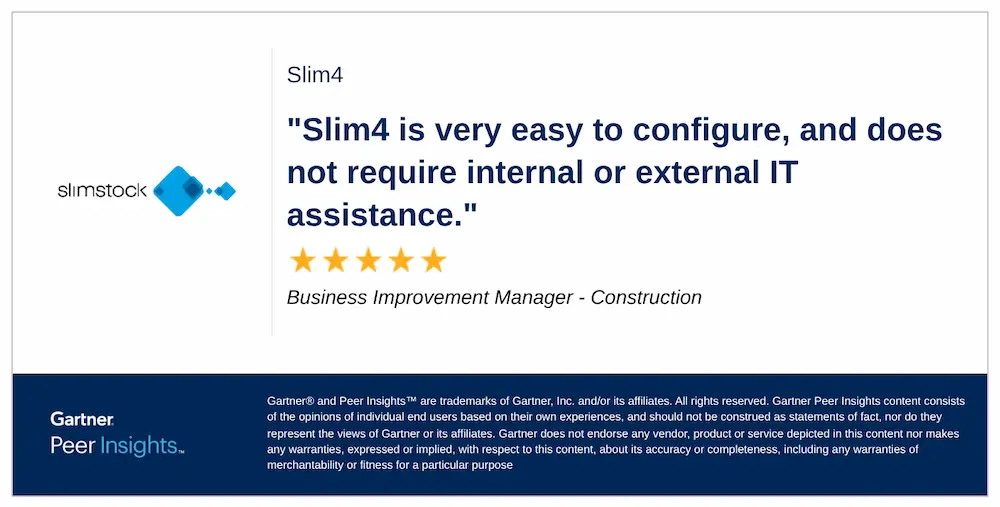
Slim4 has an average rating of 4.8/5 based on verified reviews on Gartner Peer InsightsTM’ within the Supply Chain Planning Solutions category.
User feedback highlights several consistent themes:
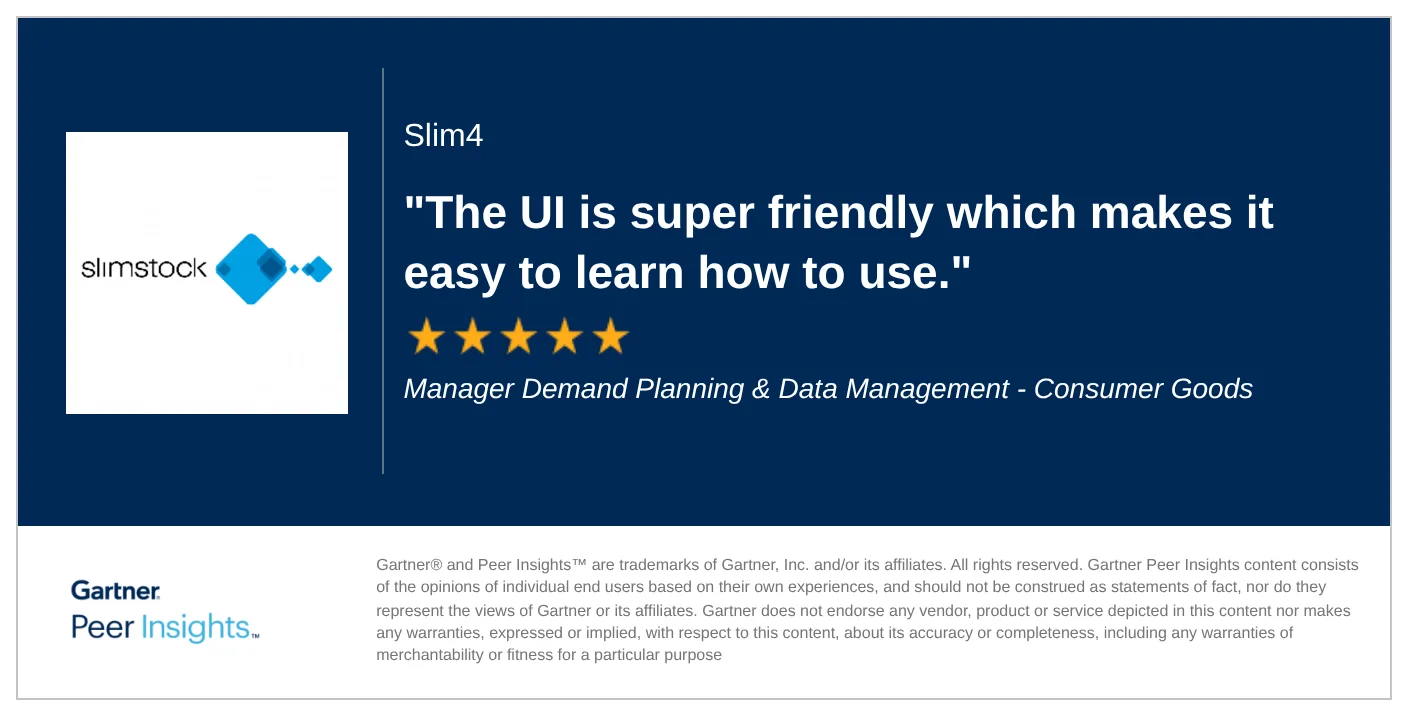
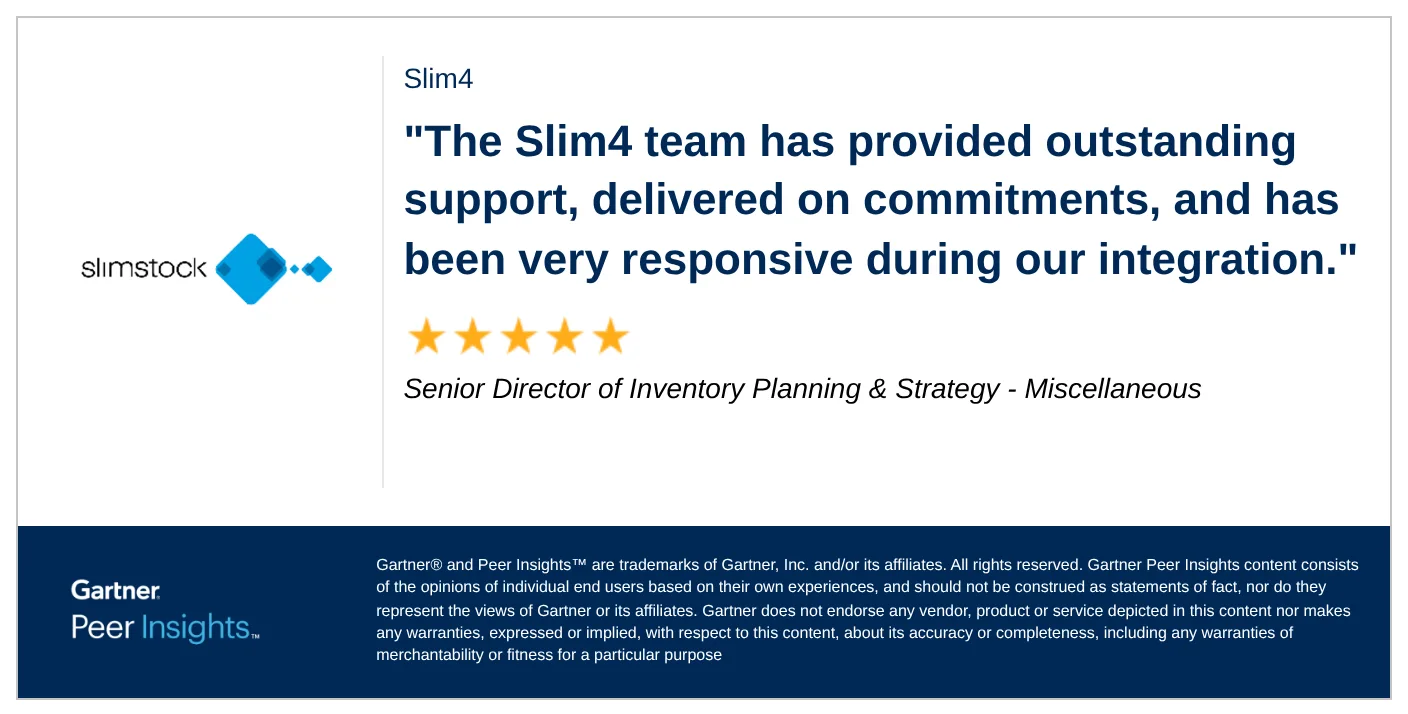
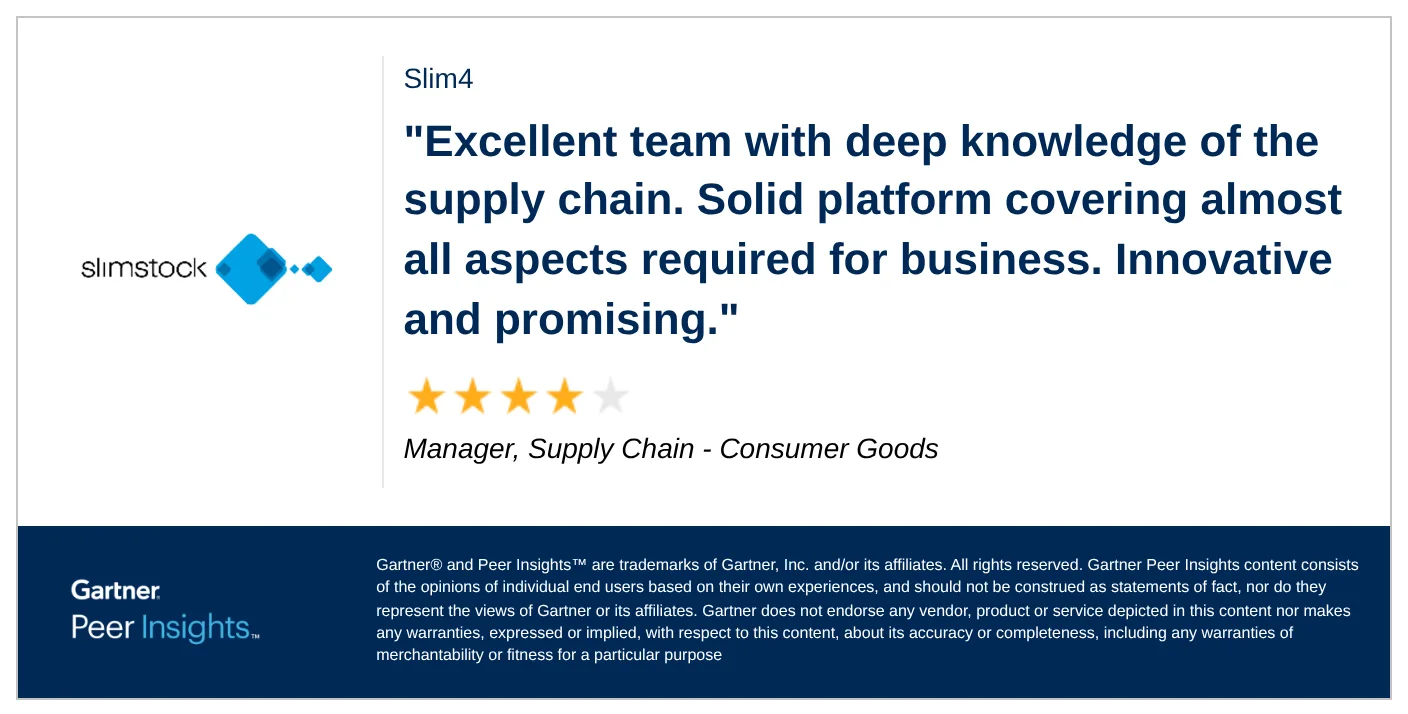
Do you need help choosing the right solution?
Our team can help you evaluate different supply chain management software options based on your business needs, your industry context, and your strategic goals.
SAP
| Advantages | Lowest scoring attributes | Gartner Peer InsightsTM recommendation rating | Gartner Peer InsightsTM overall rating |
|---|---|---|---|
|
|
77% | 4.4/5 |
Best for: Large enterprises requiring integrated inventory management within a global ERP environment.
Key features:
- Advanced statistical and AI-driven forecasting.
- Tight integration with ERP and operational processes.
- Scenario planning and simulation capabilities.
- Collaborative planning across global teams.
- End-to-end visibility across the supply chain.
SAP’s Inventory Management offering forms part of the S/4HANA family in a retail context. Leaning on the company’s large, global presence, this helps to elevate visibility while also retaining more granular insight and categorisation.
Kinaxis
Kinaxis offers a concurrent planning platform designed for real-time decision-making in complex supply chains.
| Advantages | Lowest scoring attributes | Gartner Peer InsightsTM recommendation rating | Gartner Peer InsightsTM overall rating |
|---|---|---|---|
|
|
83% | 4.4/5 |
Best for: Companies operating in fast-changing environments that require real-time planning capabilities.
Key features:
- Real-time demand and supply synchronisation.
- Scenario-based planning and simulation.
- Concurrent planning across functions.
- End-to-end visibility and analytics.
- Collaboration tools for cross-functional teams.
Kinaxis scored highly when it comes to its strength of aligning decisions across time horizons and data granularities – a key asset for inventory management sitting at the centre of those projections and decisions.
o9 Solutions
| Advantages | Lowest scoring attributes | Gartner Peer InsightsTM recommendation rating | Gartner Peer InsightsTM overall rating |
|---|---|---|---|
|
|
93% | 4.8/5 |
Best for: Enterprises seeking AI-driven, integrated inventory management.
Key features:
- AI-powered demand forecasting and demand sensing.
- Advanced analytics and scenario modelling.
- Integrated planning across demand, supply, and finance.
- Real-time data processing.
- Collaboration across commercial and operational teams.
o9 combines demand planning with a broader digital planning platform, enabling organisations to connect demand signals with inventory management decisions, all within a centralised environment.
Oracle
| Advantages | Lowest scoring attributes | Gartner Peer InsightsTM recommendation rating | Gartner Peer InsightsTM overall rating |
|---|---|---|---|
|
|
76% | 4.8/5 |
Best for: Organisations looking for enhanced inventory management within a comprehensive enterprise suite.
Key features:
- Predictive demand forecasting
- Promotion and lifecycle planning
- Integration with supply chain and ERP systems
- Scenario planning capabilities
- Centralised data management
Unified data integration and collaborative planning are two big strengths of the Oracle solution – both helpful in an inventory management context. All integrated in its broader cloud ecosystem, it allows organisations to align end-to-end processes.
Infor
| Advantages | Lowest scoring attributes | Gartner Peer InsightsTM recommendation rating | Gartner Peer InsightsTM overall rating |
|---|---|---|---|
|
|
100% (only six reviews) | 4.6/5 |
Best for: Companies seeking industry-specific inventory management solutions.
Key features:
- Statistical forecasting and demand modelling.
- Pre-configured industry templates.
- Integration with Infor ERP systems.
- Exception-based alerts and planning workflows.
- Inventory and demand alignment.
Infor focuses on delivering solutions tailored to specific industries, helping organisations accelerate implementation and adoption.
Anaplan
| Advantages | Lowest scoring attributes | Gartner Peer InsightsTM recommendation rating | Gartner Peer InsightsTM overall rating |
|---|---|---|---|
|
|
79% | 4.5/5 |
Best for: Organisations looking to connect inventory management with broader business planning.
Key features:
- AI-driven demand forecasting
- Advanced scenario modelling and what-if analysis
- Cross-functional collaboration
- Integration with financial and operational planning
- Cloud-based, scalable platform
Anaplan is another commended for its collaborative solutions, while it also ensures strong links between its supply chain modules and ultimate financial and business analysis.
FAQs about inventory management
What areas of the supply chain does inventory management span across?
Inventory management essentially covers all movement of products between those critical supply and demand elements. Inventory management software therefore helps to monitor stock movements while recording sales and purchase orders. It’s a critical arm of the replenishment process, where you can set parameters that maximise opportunities while aligning with capacity.
From a stock positioning perspective, especially in the current climate, optimised inventory management means managing multiple echelons, balancing the network to ensure stock is where the demand is or where the opportunity to avoid waste and markdowns is strongest, and allocating according to real-time omnichannel demand across physical and online channels.
What are the main challenges businesses face with their inventory management?
Organisations relying on traditional, legacy, or manual systems in the present day typically struggle with inaccurate forecasts. These lead to overstocking for fear of running out, excess safety stock for the same reason, stockouts if the pendulum swings too far the other way, and time-consuming manual calculations dragging decision makers away from strategy and planning.
This all comes from a lack of data synchronisation and visibility across businesses that often comprise multiple locations, growing SKU counts, and huge amounts of that data.
Why is advanced, AI-driven inventory management so important?
As supply chains become more complex and customer expectations rise, businesses need reliable tools to balance what’s being demanded with what’s possible.
By implementing advanced inventory management software, organisations can transform stock control from a reactive task into a proactive competitive advantage, moving products seamlessly to maximise sales opportunities and profit margins, while reducing waste or the need for unnecessary markdowns. Ultimately, areas of cost reduction, stock turnover, product availability, sustainability, and business scaling are all augmented through an enhanced, AI-driven approach to stock management.
How does inventory management software work?
Inventory management software works by collecting and analysing data from across the supply chain. The software connects to ERP systems, sales platforms, warehouse systems, and supplier data. It consolidates historical sales, current stock levels, lead times, supplier performance, and open purchase orders. Then, using statistical models, it predicts future demand, inclusive of seasonality, trends, promotions, and demand variability, to assess inventory requirements.
Replenishment then becomes a rolling activity, constantly calculating safety stock levels, reorder points, economic order quantities, and real-time demand across channels and locations.
The software continuously updates its calculations as new data becomes available, ensuring stock policies remain aligned with real-world demand, and real-time internal capacity.
How does inventory management software improve wider supply chain operations?
Being in the middle of supply and demand, inventory management has a knock-on effect on the supply chain ecosystem around it, be it positive or negative. When automated, intuitive, predictive, and even prescriptive, the seamless flow of products to where they’re needed, at the right time, has numerous beneficial impacts.
Most importantly, it helps to ensure availability, with optimal stock levels ensuring customers receive goods on time and how they want to. It also reduces working capital as you avoid overstocking and instead release cash tied up in unnecessary storage and handling. This greater efficiency leads to enhanced agility and scalability as part of business growth ambitions. And this aligns with better decision-making, with real-time dashboards and performance metrics reliable, immediate, and easy to interpret.
Can inventory management software replace human decision makers?
Yes and no. AI and automation is designed to perfect the routine, constant tasks that often lead to errors and exhaustive human hours. But, in doing so, it frees those planners up to strategise more effectively. Technology handles data processing, pattern recognition, and automation. Planners bring contextual knowledge, commercial insight, and decision-making capability.
How long does it take to implement inventory management software?
This depends on current maturity levels, existing architecture, and the solution you opt for. Large enterprise platforms can take months — or even years — to fully implement, especially with so many micro-elements of inventory management to consider.
More focused solutions designed for usability and faster adoption, however, can start delivering value much earlier.
In most cases, the time-to-value depends not only on the software itself, but also on data readiness and internal processes.
What should you look for when choosing your inventory management solution?
Forecasting capability, scalability, ease of integration, usability and the interface, and its suitability for your sector. These are the key considerations to weigh up when choosing your inventory management software.
A good word to keep in mind during this decision is ‘holistic’. The point of enhancing this area of your supply chain is to move beyond base-level processes, and instead to be more predictive and intuitive in your operations. This includes a seamless synchronisation with your broader digital architecture to ensure inventory management is feeding both off and into other key supply chain decisions. All as a continuous, seamless cycle.