
Table of contents
Table of contents- Comparing the best demand planning software: A complete guide
- What is advanced demand planning software?
- Why businesses are investing in demand planning software
- Key capabilities to look for in your new demand planning software
- Comparing the best demand planning software solutions
- FAQs about demand planning
Shifting customer behaviour, shorter product lifecycles, and growing complexity across channels has made one of the most critical supply chain capabilities an increasing, differentiating challenge. Demand planning has a direct impact on profitability, service levels, operational efficiency, and customer loyalty, leaving very little wiggle room to get it wrong.
And yet, many companies still rely on spreadsheets, legacy tech, or basic ERP modules to forecast demand. In most cases, it’s not that they think this approach is optimal. Rather, they are often overwhelmed by the prospect of a transformation… of all the software options out there… of which advanced demand planning solution to choose.
And make no mistake: advanced, intuitive, automated, data and AI-driven demand planning software is exactly what they need.
Software that combines data, automation, and advanced analytics, and that allows businesses to move from reactive forecasting to proactive, accurate, reliable, agile planning.
In this guide, we compare the leading demand planning solutions on the market, helping you understand what to look for and how tools like Slim4 stack up against the competition.
What is advanced demand planning software?
Advanced demand planning software is designed to help organisations predict future demand with greater accuracy than ever before. Utilising historic and real-time data, and deducing optimal decisions based on external forces and internal KPIs, those forecasts are the culmination of a single source of reliable data that then feeds into the rest of the end-to-end supply chain.
At its core, demand planning in the modern age should combine:
- Historical sales data.
- Statistical forecasting models.
- Business inputs (promotions, market insights, product changes).
The outcome being a more accurate, dynamic view of future demand that automatically updates in real-time as conditions change. Those conditions comprising both external factors and internal capacity at a moment in time.
Unlike traditional tools, modern platforms use AI and machine learning to analyse large data sets, detect patterns, and adjust forecasts automatically, significantly improving accuracy over time.
Advanced demand planning isn’t just about forecasting. The real value lies in enabling better decisions across the business as a result of those forecasts.
Why businesses are investing in demand planning software
In practice, poor demand planning creates a ripple effect across the organisation:
- Too much stock caused by inaccurate demand projections ties up working capital.
- Too little stock leads to lost sales and dissatisfied customers.
- Misaligned forecasts cause friction between sales, operations and finance.
Advanced demand planning software helps eliminate these issues by creating a single source the truth. More specifically, it enables companies to:
Improve forecast accuracy
By combining statistical models with business input, organisations can generate more reliable forecasts and reduce uncertainty.
Balance inventory with precision
Better forecasts translate directly into more balanced stock levels. This means reduced strain on inventory capacity and operations, without risking availability to customers.
Align teams around a single plan
Modern tools support collaborative planning, ensuring that all stakeholders work from the same demand assumptions.
React faster to change and disruption
With real-time data and scenario modelling, businesses can respond quickly to market shifts and disruptions. You can improve service levels while reducing costs, even in the face of supply shortages, industry headwinds, or customer trend shifts.
Key capabilities to look for in your new demand planning software
While the general goal of risk-resilient, agile, accurate, and data-driven forecasting is universal, not all solutions carry the same differentiating capabilities. It’s a case of choosing the solution that’s best for you, based on your current maturity level, your existing digital architecture, and your ultimate, bespoke business goals.
The art in choosing is to identify the subtle differences in how each solution supports your planners with what they really need, day-to-day.
We believe, this should almost always include:
- AI-driven forecasting and demand sensing
- Leading tools use machine learning to detect trends, seasonality, and changes in demand patterns automatically.
Scenario planning and simulation
The ability to test “what-if” scenarios is essential, allowing planners to evaluate risks and opportunities before they happen, while responding quickly when they eventually do.
Exception-based planning
Rather than reviewing every SKU manually, planners are alerted only when intervention is required, dramatically improving efficiency.
Collaboration and S&OP integration
Strong platforms connect demand planning with broader business processes, enabling alignment across departments.
Integration and data visibility
A single, unified data environment ensures that decisions are based on consistent and up-to-date information.
Comparing the best demand planning software solutions
There is no single “best” solution. The right choice is the one that suits your business size, your complexity and current bottlenecks, and your bespoke business objectives. Moreover, your decision relative to demand planning can’t be tunnel visioned. It’s vital to take a more holistic view of each solution’s end-to-end synchronisation and capabilities, to decide whether the whole package will have a positive impact on demand planning specifically.
Below is a general overview and rating of several supply chain solution options that are available and successful in the market today, based on Gartner Peer InsightsTM’ assessment of key criteria such as functionality, implementation timeframes, and overall ratings.
| Software | Ideal for | Key capabilities | Implementation rating | Overall Gartner rating |
|---|---|---|---|---|
| Slim4 | Integrated supply chain planning | Collaboration, user experience, constraint-based planning | 4.6/5 | 4.8 |
| SAP IBP | Enterprise-wide planning | End-to-end planning, constraint-based planning, and ERP integration | 4.2/5 | 4.4 |
| Kinaxis | Complex global supply chains | Concurrent planning, and scenario analysis | 4.1/5 | 4.4 |
| o9 | AI-driven transformation | Digital twin, resource breadth, and a flexible architecture | 4.5/5 | 4.8 |
| Oracle | End-to-end cloud suite | Planning, execution, analytics | 4.3/5 | 4.8 |
| Infor | Industry-specific planning | Multi-enterprise planning | 4.3/5 | 4.6 |
| Anaplan | Connected enterprise planning | Collaborative demand planning | 4.3/5 | 4.5 |
Slim4 (Slimstock)
With an overall rating of 4.8 out of 5, Slim4 ranks among the highest-rated solutions in its category on Gartner Peer InsightsTM.
| Advantages | Lowest scoring attributes | Gartner Peer InsightsTM recommendation rating | Gartner Peer InsightsTM overall rating |
|---|---|---|---|
|
NA (no rating below 4.5/5) | 93% | 4.8/5 |
Developed by Slimstock, Slim4 is a dedicated supply chain planning platform designed to help organisations improve forecast accuracy, optimise inventory levels and streamline replenishment processes.
Unlike broader enterprise solutions, Slim4 focuses exclusively on supply chain planning, enabling businesses to achieve tangible improvements in service levels, working capital, profitability and operational efficiency.
By combining advanced analytics with an intuitive user experience, the platform empowers planning teams to make informed decisions without the need for complex configurations or lengthy implementation projects. Slim4 is widely used across the retail, wholesale, manufacturing and distribution sectors.
Key features
Slim4 offers a comprehensive suite of capabilities tailored to supply chain planning, including:
- AI-driven demand forecasting supported by advanced statistical models.
- Inventory optimisation across both single- and multi-echelon networks.
- Automated replenishment and intelligent order recommendations.
- Sales and Operations Planning (S&OP) functionality.
- Scenario modelling and simulation tools.
- Exception-based planning with proactive alerts.
These capabilities support both operational and strategic planning, helping organisations maintain optimal stock levels while responding quickly and effectively to changes in demand and supply conditions.
Strengths
One of Slim4’s key advantages is its ability to combine advanced functionality with ease of use.
Customers particularly value:
- Rapid user adoption enabled by an intuitive interface.
- Strong capabilities in demand planning and inventory optimisation.
- Faster time to value compared with broader enterprise platforms.
- High levels of customer satisfaction and responsive support.
In addition to the software itself, Slimstock complements its technology offering with expert consultancy services, helping organisations embed best practices and maximise the value of their supply chain planning processes.
Slim4 rating
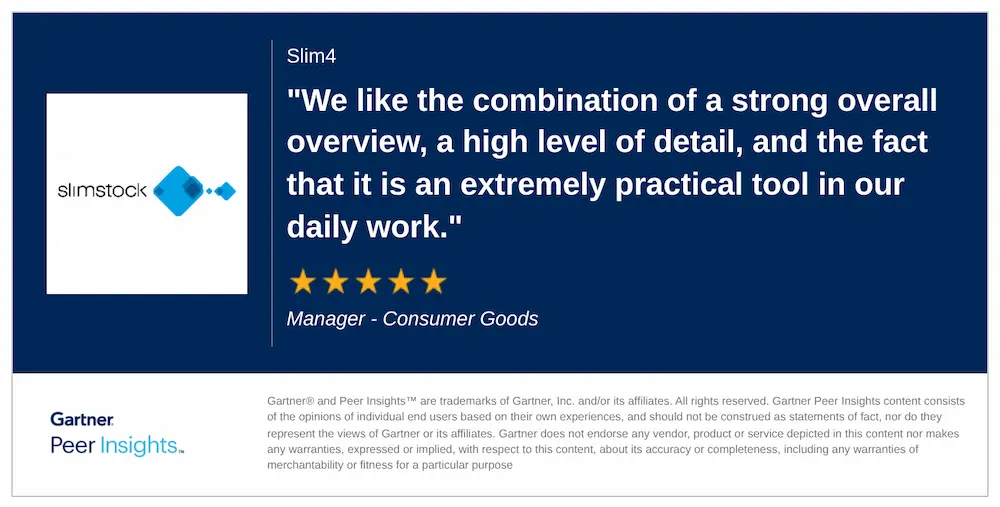
Slim4 has an overall rating of 4.8 out of 5, based on verified reviews on Gartner Peer InsightsTM within the Supply Chain Planning Solutions category.
The following excerpts are taken from verified Gartner Peer InsightsTM reviews:
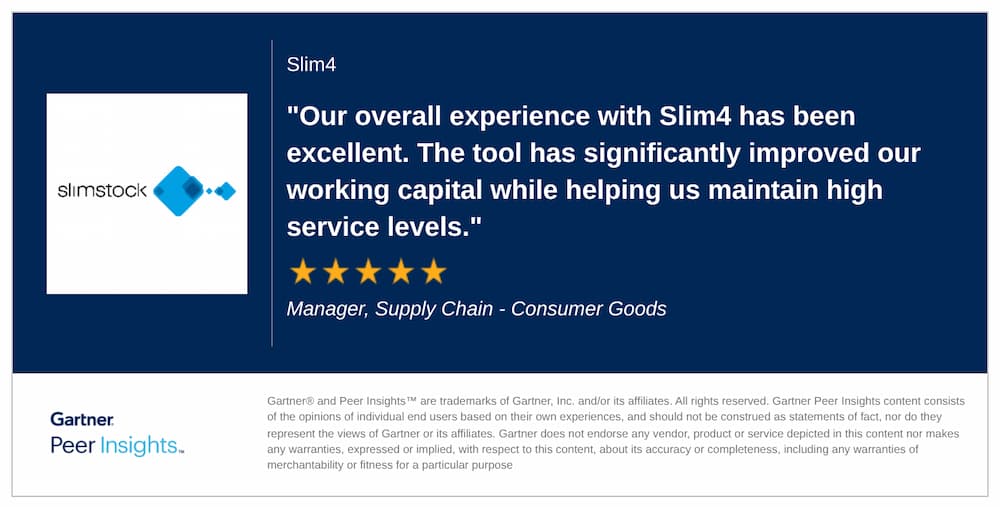
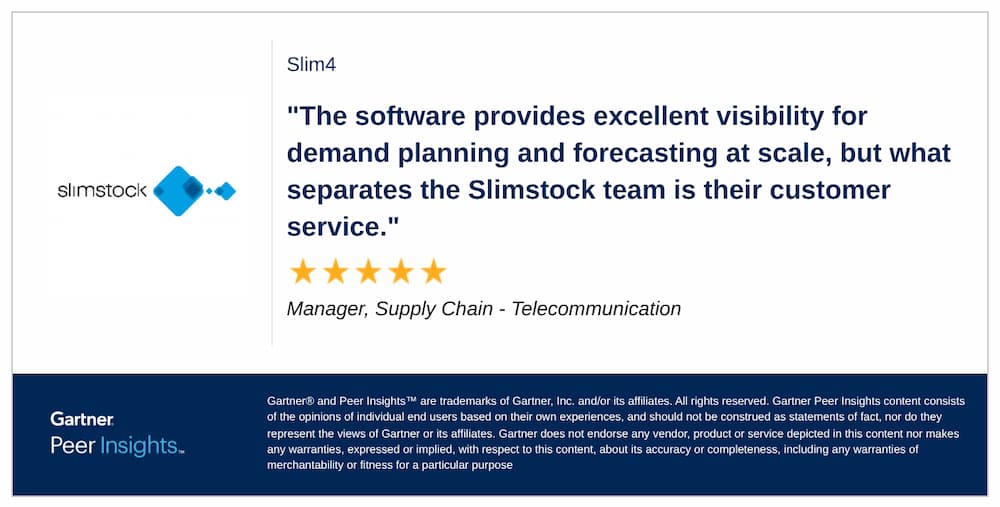
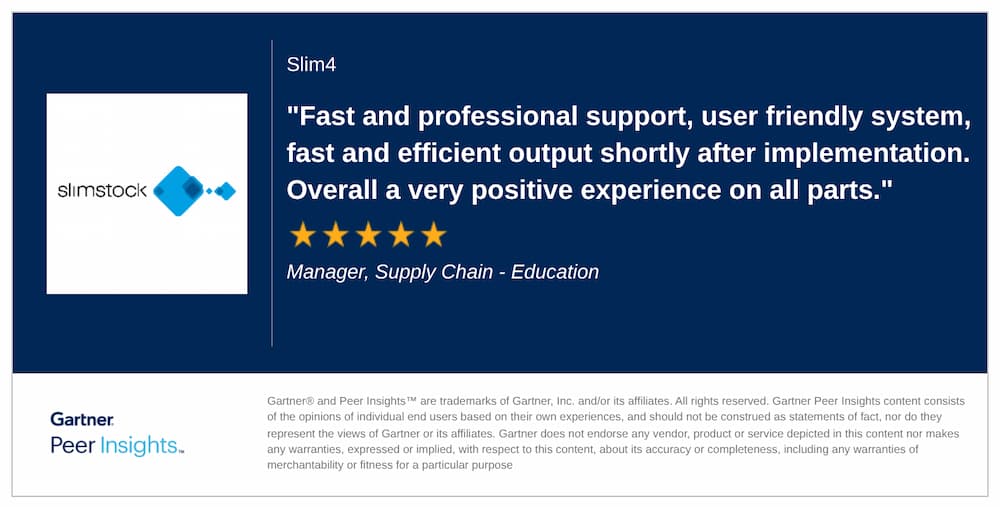
Overall, Slim4 is particularly valued by organisations looking to:
- Improve demand and inventory planning.
- Reduce operational complexity.
- Work with a specialised supply chain provider.
- Receive strong support during implementation.
SAP
SAP Integrated Business Planning (IBP) is an end-to-end supply chain planning solution designed for large enterprises seeking seamless integration with ERP systems.
| Advantages | Lowest scoring attributes | Gartner Peer InsightsTM recommendation rating | Gartner Peer InsightsTM overall rating |
|---|---|---|---|
|
|
77% | 4.4/5 |
Kinaxis
Kinaxis provides a concurrent planning platform that enables real-time decision-making across complex supply chains.
| Advantages | Lowest scoring attributes | Gartner Peer InsightsTM recommendation rating | Gartner Peer InsightsTM overall rating |
|---|---|---|---|
|
|
83% | 4.4/5 |
o9 Solutions
o9 Solutions offers an AI-powered planning platform featuring advanced modelling capabilities and digital twin technology.
| Advantages | Lowest scoring attributes | Gartner Peer InsightsTM recommendation rating | Gartner Peer InsightsTM overall rating |
|---|---|---|---|
|
|
93% | 4.8/5 |
Oracle
Oracle provides a comprehensive cloud-based suite that spans planning, execution, and analytics.
| Advantages | Lowest scoring attributes | Gartner Peer InsightsTM recommendation rating | Gartner Peer InsightsTM overall rating |
|---|---|---|---|
|
|
76% | 4.8/5 |
Infor
Infor delivers industry-specific supply chain solutions tailored primarily to the manufacturing and distribution sectors.
| Advantages | Lowest scoring attributes | Gartner Peer InsightsTM recommendation rating | Gartner Peer InsightsTM overall rating |
|---|---|---|---|
|
|
100% (only six reviews) | 4.6/5 |
Anaplan
Anaplan is a flexible planning platform that supports multiple business functions, including supply chain operations.
| Advantages | Lowest scoring attributes | Gartner Peer InsightsTM recommendation rating | Gartner Peer InsightsTM overall rating |
|---|---|---|---|
|
|
79% | 4.5/5 |
Do you need help choosing the right solution?
Our team can help you evaluate different supply chain management software options based on your business needs, your industry context, and your strategic goals.
FAQs about demand planning
What is the difference between demand planning and forecasting?
Although the terms are often used interchangeably, and they should both factor into demand solution decisions, they are not exactly the same.
Forecasting focuses on predicting future demand based on historical data and statistical models.
Demand planning, on the other hand, goes a step further. It combines forecasts with business input, such as promotions, market trends, and product changes, to create a realistic and actionable demand plan.
In essence, forecasting gives you the numbers, while demand planning helps you decide what to do with them.
How does demand sensing enter the equation?
Demand sensing is an advanced capability within modern demand planning tools.
Instead of relying only on historical data, demand sensing uses real-time signals, such as recent sales patterns or market changes, to adjust forecasts dynamically.
This allows organisations to react faster to short-term shifts in demand, improving responsiveness and reducing forecasting errors.
Why is demand planning so important?
Demand planning has a direct impact on some of the most critical supply chain outcomes and business fundamentals:
- Product availability.
- Customer satisfaction.
- Inventory levels.
- Working capital.
Without an effective planning process, businesses often end up either overstocked or constantly firefighting stockouts. A structured demand planning approach helps to optimise the balance in-between the two, ensuring that the right products are available at the right time, without unnecessary costs.
What are the main challenges businesses face with their demand planning?
The challenge landscape is usually a familiar and recurring scene of inaccuracy and tail-chasing, driven by a lack of consolidated data, and spreading into all other areas of the end-to-end supply chain. Common bottlenecks include, or are caused by:
- Poor data quality or fragmented data sources.
- An overreliance on spreadsheets.
- A lack of alignment between teams.
- No single source of truth to help navigate volatility and uncertainty.
These challenges make it difficult to generate reliable forecasts and can lead to reactive decision-making instead of proactive planning.
How does demand planning software improve forecast accuracy?
Demand planning software improves accuracy in direct terms with clear insight into projected customer needs, but also more broadly into how this demand impacts supply, inventory, pricing, labour, and much more. It does so by:
- Applying advanced statistical models and AI to large datasets.
- Incorporating external factors such as seasonality and trends into ongoing analytics.
- Enabling planners to adjust forecasts based on real-time business insights, and in line with bespoke KPIs and objectives.
Over time, the combination of automated forecasting and human input leads to more reliable and consistent results relative to what your business wants to achieve.
Can demand planning software replace human planners?
No, and it shouldn’t.
The goal of demand planning software is not to replace planners, but to support them.
Technology handles data processing, pattern recognition, and automation. Planners bring contextual knowledge, commercial insight, and decision-making capability. Ideally, these planners are relieved from manual inputs, to instead focus on high-level strategy that then informs what your solution is filtering and striving towards. It becomes a cyclic relationship which gets the best out of both.
How long does it take to implement demand planning software?
It all depends on your current maturity levels, existing architecture, and the solution you opt for.
Large enterprise platforms can take months, or even years, to fully implement.
More focused solutions designed for usability and faster adoption can start delivering value much earlier.
In most cases, the time-to-value depends not only on the software itself, but also on data readiness and internal processes.
What should you look for when choosing your demand planning solution?
Some of the most important criteria include:
- Accuracy and reliability of forecasting.
- Ease of use for planners.
- Resilience, agility, and the ability to handle complexity.
- Integration with existing systems.
- Speed of implementation.
Ultimately, the best solution is not the one with the most features, but the one that best fits your organisation’s needs and helps your team make better decisions.