
Table of contents
Table of contents- Supply chain data management: the backbone of supply chain performance
- What is supply chain data management?
- The importance of supply chain data management
- How is supply chain data collected?
- Steps of a supply chain data management strategy
- Business benefits of effective supply chain data management
- The role of big data analytics in supply chain management
- Building a data-driven supply chain strategy
- Supply chain data management software
- The time to build a data-driven supply chain strategy
Overview
Effective supply chain data management provides organisations with a single, reliable foundation to drive faster, smarter and more resilient decisions. By connecting, standardising and governing data across the end-to-end supply chain, it transforms fragmented information into actionable insight, improving visibility, coordination and performance while enabling advanced analytics, automation and AI at scale.
Next-level supply chain data management is now the heart of organisations’ ability to make faster, smarter and more accurate decisions in increasingly volatile business environments.
Seamless access to reliable, consistent, synchronised and actionable data, brought together from a truly connected, end-to-end supply chain, is the holy grail.
Those who find and unlock its full benefits are the ones that can quickly convert big data into big profits.
What is supply chain data management?
Supply chain data management is the end-to-end process of collecting, validating, integrating, governing and analysing data generated across the supply chain network. This includes structured and unstructured data from suppliers, internal systems, customers, logistics providers and external market sources. And, pivotally, for it to be reliable and effective in a supply chain environment, that data must be representative of the full chain: supply, demand, inventory, sustainability, transport, distribution, assortment, allocation, and much, much more.
All present, all accessible in an instant, all working in harmony to produce optimal decisions by weighing up the entire, real-time situation.
What organisations need in this regard is a single, reliable version of the truth.
Closely related is supply chain master data management, which focuses specifically on core business entities such as products, suppliers, customers, and locations. This discipline ensures consistency across systems and prevents duplication or fragmentation of critical data.
Together, these practices form the foundation of a data-driven supply chain.

The importance of supply chain data management
Poor data quality leads directly to poor business outcomes. Common challenges caused by weak data management include:
- Inaccurate demand forecasting.
- Excess safety stock or chronic stockouts.
- Inefficient supply decisions.
- Misaligned production planning.
- A lack of end-to-end visibility.
By contrast, effective supply chain data management ensures that product-level data, such as volumes, lead times and costs, is consistent across all systems and teams, with everyone reading the same information through the same centralised portal. This inherently improves coordination between planning, procurement and logistics teams.
Ultimately, strong data management transforms supply chains from reactive systems into proactive, intelligence-led networks.
How is supply chain data collected?
Modern supply chains generate vast volumes of data every second across all aforementioned phases of the supply chain, from across the store and online network, and from across the partner ecosystem, too. This data is collected through multiple channels, including:
- Enterprise Resource Planning (ERP) systems.
- Warehouse Management Systems (WMS).
- Transportation Management Systems (TMS).
- Supplier collaboration platforms.
- Internet of Things (IoT) sensors and RFID tracking.
- Point-of-sale (POS) systems.
- External data sources such as market trends and weather data.
- Each of these contributes to a complex and constantly evolving data ecosystem.
The challenge is not simply collecting data, but ensuring it is structured, standardised, validated, and usable across the organisation. Without strong governance, organisations risk creating data silos that undermine decision-making.
Steps of a supply chain data management strategy
A successful supply chain data management strategy requires both technological capability and, usually, an organisational disciplineand cultural restructuring. The key steps include:
1. Data discovery and mapping
Identify all data sources across the supply chain and understand how data flows between systems, departments and partners.
2. Data standardisation and cleansing
Ensure consistency in formats, definitions and naming conventions. Remove duplicates, correct errors and align datasets. With automation and AI in mind, the cleaner the initial data, the more effective these more advanced solutions will be further down the line.
3. Data integration
Unify disparate systems into a connected ecosystem, enabling seamless data exchange across functions. If possible, opt for a platform that brings all chains of the supply network, and all associated data, under one roof for seamless trade-offs, visibility and collaboration.
4. Master data governance
Establish ownership, rules, and accountability structures to maintain high-quality supply chain master data management over time.
5. Data enrichment
Enhance internal datasets with external information such as market intelligence, supplier risk scores, or macroeconomic indicators. Again, try and choose a platform and suite of solutions that allow for simple integration of these data sets.
6. Advanced analytics and modelling
Apply big data analytics in supply chain management to uncover trends, predict outcomes and optimise decision-making.
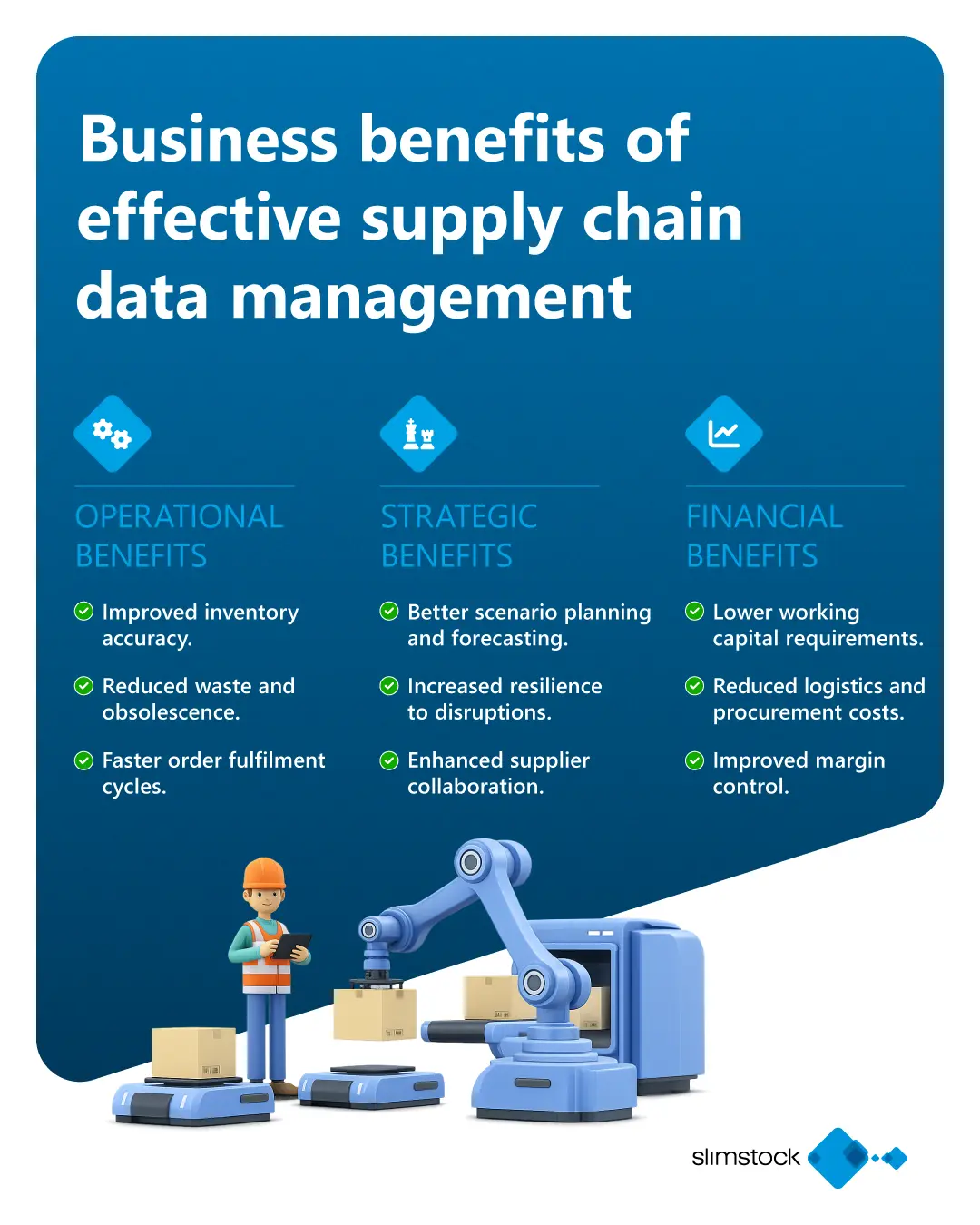
Business benefits of effective supply chain data management
When organisations invest in more robust-yet-agile supply chain data management software and processes, the benefits extend across the entire value chain:
Operational benefits
- Improved inventory accuracy.
- Reduced waste and obsolescence.
- Faster order fulfilment cycles.
Financial benefits
- Lower working capital requirements.
- Reduced logistics and procurement costs.
- Improved margin control.
Strategic benefits
- Better scenario planning and forecasting.
- Increased resilience to disruptions.
- Enhanced supplier collaboration.
In essence, strong data management enables supply chains to operate with greater speed, precision and confidence.
The role of big data analytics in supply chain management
The role of data analytics in supply chain management has evolved from descriptive reporting to predictive and prescriptive intelligence.
Today, organisations use analytics to:
- Anticipate demand fluctuations before they occur.
- Simulate supply chain disruptions and scaling scenarios, and test responses.
- Optimise multi-echelon inventory strategies.
- Identify inefficiencies in transport routes and supplier networks.
- Improve sustainability and emissions tracking.
With big data analytics in supply chain management, businesses can process massive datasets in real time, enabling decisions that are both faster and more accurate than before.
Building a data-driven supply chain strategy
A mature, data-driven supply chain strategy integrates governance, technology and analytics into a unified framework.
It requires organisations to treat data not as a by-product of operations, but as a strategic asset.
Key principles include:
- Centralised data governance.
- Real-time visibility across all supply chain nodes.
- Automation of data validation and cleansing.
- Continuous improvement of data quality.
- Integration of advanced analytics into daily planning processes.
Supply chain data management software
Advanced, automation-driven supply chain data management software is essential to enabling such a transformation at scale, no matter the size of the organisation or operation.
Without fit-for-purpose tools, organisations are likely to struggle with fragmented systems, inconsistent data and limited visibility. The right software addresses these challenges by providing:
- Scalability: handling growing volumes of transactional and master data.
- Data quality management: ensuring accuracy, consistency and single source of truth.
- Governance frameworks: supporting ownership, compliance and auditability.
- Real-time insights: enabling instant access to reliable information for decision-making.
Slimstock’s Slim4 platform ticks all of the above boxes as an initial gateway to also elevate levels of forecasting, inventory optimisation and overall supply chain decisions. The platform strengthens supply chain data management by ensuring that planning processes are built on clean, structured and reliable data.
The time to build a data-driven supply chain strategy
Modern supply chains are no longer driven solely by operational execution. They are driven by data intelligence. Data – clean, validated, synchronised, accessible data – is not only the key to unlocking the true potential of your supply chain, but it’s also a non-negotiable prerequisite for the artificial intelligence and automation solutions you’re undoubtedly exploring right now. Without an optimal supply chain data management strategy, those investments will fail to hit their mark or maximise ROI.
Organisations that invest in master data management in supply chain processes, combined with advanced analytics and strong governance, are better equipped to respond to uncertainty, optimise performance and drive sustainable growth, as markets and environments continue to evolve at pace, and often with unpredictability.
As these supply chains become more complex and interconnected, the ability to manage, interpret and act on data will define competitive advantage.
By adopting the right strategy and establishing the right data foundations now, your supply chain can remain agile, resilient and scalable no matter the headwind, no matter the opportunity.