

Table of contents
Table of contents- PPWR is just the beginning: why product data is becoming the new compliance challenge
- From document-driven to data-driven compliance
- The impact on data management
- When product data is incomplete, the consequences go beyond mere compliance risks
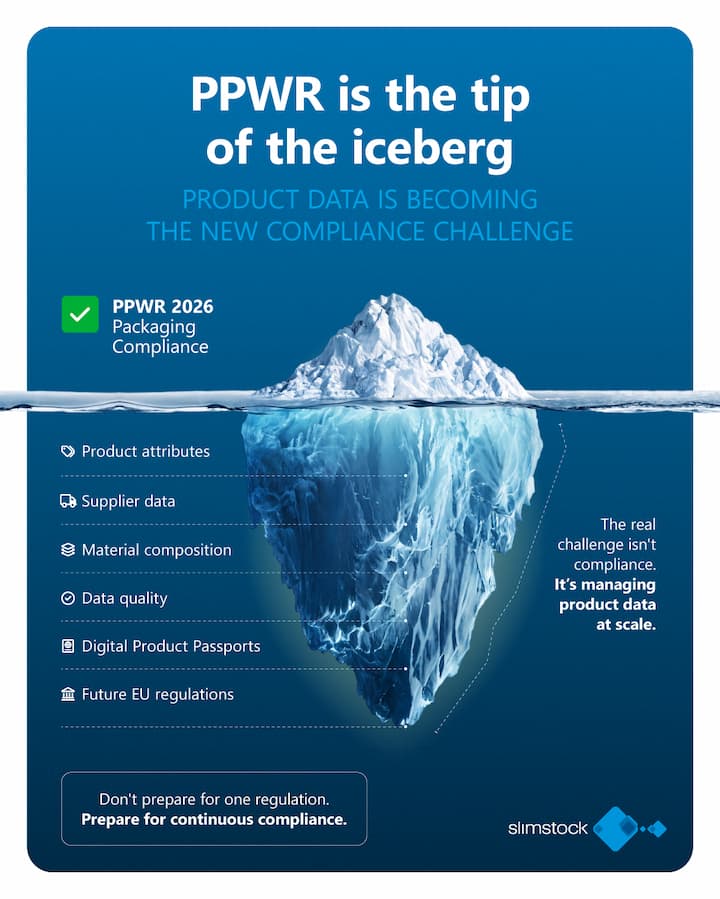
- PPWR is just the beginning
- The role of AI in future-proof data management
- Is your organisation ready for data-driven compliance?
Overview
The Packaging and Packaging Waste Regulation (PPWR) is a European regulation designed to reduce the amount of packaging waste and to encourage reuse and recycling. The regulation sets out requirements concerning, amongst other things, the design and composition of packaging, the use of recycled materials and the recyclability of packaging. For businesses, this means they must increasingly collect, manage and be able to demonstrate information about their packaging and the materials used.
Following a transition period of just over a year and a half, the first provisions of the new European legislation on packaging began to apply on 12 August 2026. This new legislation, known as the ‘Packaging and Packaging Waste Regulation’ (PPWR), came into force on 11 February 2025 and applies to all businesses in the EU Member States.
Over the past few months, companies have been preparing for this upcoming legislation, and most organisations view the PPWR as a new compliance project. In reality, this legislation signals something much bigger: the European Union is increasingly shifting from regulations centred on documents and declarations to regulations that rely on reliable, up-to-date product data.
Compliance is therefore no longer merely an administrative exercise, but an ongoing data process. For organisations, this represents a fundamental change. Not only does more product data need to be collected, but the way in which this data is managed, validated and maintained is also changing.
And the PPWR is just the beginning.

From document-driven to data-driven compliance
Traditionally, organisations were often able to demonstrate regulatory compliance through certificates, declarations or technical documentation. This information was collected and stored periodically for audit purposes. That approach is changing with the introduction of the PPWR. New European regulations are increasingly requiring structured, up-to-date and traceable product data. Organisations must not only be able to demonstrate that a product meets certain requirements, but also have access to the underlying information that proves this.
The PPWR highlights this development. To comply with the regulation, companies must, for example, collect information on packaging materials, composition, recycled content and the origin of materials. Take, for instance, the bill of materials for a packaging item. This is often unstructured data that has to be requested from all the various suppliers, with each supplier providing the information in a slightly different format.
The impact on data management
This development has direct consequences for the way in which organisations handle product data. Whereas data was previously managed primarily to meet commercial and operational needs, data management is now also becoming an essential part of compliance.
The challenge lies not only in collecting new information, ut in keeping it accurate and up to date over time. Suppliers change packaging materials, certificates expire, product specifications change and new items are introduced. Without a structured process, this information quickly becomes ourdated.
Therefore, the question is not only whether the required PPWR data is complete today, but whether the process is set up to keep that information up to date in the future as well.
Organisations would do well to ask themselves the following questions:
- Was the PPWR data collection a one-off request, or has a structured process been put in place?
- How is missing product information collected from suppliers?
- Who is responsible for maintaining this data?
- How is the quality of the information provided checked?
- Is there sufficient capacity to continue carrying out this process manually?
When product data is incomplete, the consequences go beyond mere compliance risks
Failure to comply with the new regulations has consequences that extend beyond a missing document or an administrative irregularity. When mandatory product information is missing, incomplete or cannot be substantiated, this can have a direct impact on business operations. Consider, for example, products that may be temporarily barred from the market, delays in product launches, additional checks by customers or regulators, and suppliers who must be contacted again to provide missing information. Internally, this often leads to manual checks, urgent measures and additional coordination between departments.
The biggest challenge here lies not in any one specific piece of legislation, but in the fact that these situations will occur with increasing frequency as regulations become increasingly digitised. Without a structured process for managing product data, the pressure on the organisation will only increase.
PPWR is just the beginning
PPWR is therefore not the end of the story. From 2027, new obligations will come into force for various product groups, such as the Digital Battery Passport under the EU Battery Regulation. For certain batteries, companies must be able to provide a digital passport from 18 February 2027 containing information on, amongst other things, materials, performance, sustainability and recycling.
Furthermore, within the broader Digital Product Passport framework, an increasing number of product groups will be required to make comprehensive product information available digitally from 2027 onwards. This involves making product information available digitally throughout a product’s entire life cycle, so that this information can be easily shared and verified within the supply chain.

Although these regulations have different objectives, the challenge for organisations is often the same: an ever-increasing amount of product information must be collected, managed and demonstrably kept accurate. Organisations that build a scalable data management process for this today will be better prepared for future changes. This means that not every new regulation will necessarily lead to another major manual data collection project.
The role of AI in future-proof data management
The volume of product data continues to grow, and this will make manual processes increasingly difficult to scale. Not because staff are not doing their jobs properly, but because the volume of checks, changes and communication is simply becoming too great.
Our AI-driven solution, Slimstock Data Management, can help make this challenge manageable. For example, this solution can automatically identify missing attributes, determine what information is missing, contact suppliers for additional data, and check the information received for completeness and quality.
This also changes the role of the employee. Whereas staff previously spent a great deal of time on the operational collection of information and chasing up suppliers, their focus now shifts to the tactical management of the data process. They determine what information is required, which quality standards apply, how data should be validated, and how this information creates value within the organisation.
AI does not, therefore, take over responsibility for product data, but supports staff in focusing on the decisions that add the most value. This makes data management not only more efficient, but also more future-proof.
Is your organisation ready for data-driven compliance?
The PPWR is a significant step towards greater transparency and sustainability within the European market. But the biggest change lies not only in the regulations themselves. It demonstrates that reliable product data is becoming increasingly important for meeting legal requirements. Organisations that structure their data management processes to meet future requirements are not only better prepared for new regulations, but also lay the foundations for more efficient processes, better collaboration across the supply chain and higher data quality.
The question is therefore not whether organisations need to manage more product data. That trend is already underway. The real question is whether the data management process is ready for a future in which every new piece of legislation will once again require reliable, up-to-date and verifiable product information.