

Table of contents
Table of contents- Lean manufacturing: principles, benefits and best practices
- Lean manufacturing explained: definition and key concepts
- The origins of lean manufacturing: from Toyota to global adoption
- The core principle of lean manufacturing: maximise value, minimise waste
- The 5 principles of lean manufacturing
- The 7 wastes that lean manufacturing eliminates
- Lean manufacturing tools and techniques
- How to implement lean manufacturing today
- Benefits of lean manufacturing (and what to measure)
- Lean manufacturing in practice
- Lean Manufacturing vs Just-in-Time vs Six Sigma: what is the difference?
- How Slimstock helps companies apply the principles of lean manufacturing
- Lean manufacturing: a philosophy that continues to evolve
Overview
Lean manufacturing is a methodology that helps organisations maximise customer value by eliminating waste and continuously improving processes. This blog post explores its principles, key tools, benefits and practical applications, as well as how modern technologies are extending Lean across the entire supply chain.
In a market characterised by fluctuations in demand, rising operating costs and increasingly complex supply chains, companies need to produce more effectively. This means delivering exactly what the customer needs, at the right time, using as few resources as possible and eliminating waste throughout the entire operation.
This is precisely the aim of lean manufacturing, which represents a philosophy of continuous improvement that seeks to create more value for the customer whilst eliminating activities that don’t contribute to this objective.
Although it originated in manufacturing, its principles have extended beyond the factory floor and are now widely used in logistics, distribution, production planning and supply chain management. In a landscape driven by data, automation and artificial intelligence, Lean remains more relevant than ever.
Lean manufacturing explained: definition and key concepts
Lean manufacturing is a management approach that seeks to maximise the value delivered to the customer through the systematic elimination of waste. Its focus is on making processes simpler, more efficient and capable of responding quickly to market needs.
To this end, the methodology encourages companies to question their operations constantly:
- Which activities actually add value?
- Which steps exist simply because ‘they’ve always been done that way’?
- Where is the waste that consumes time, resources and capital without generating benefits for the customer?
In lean, waste is known as ‘muda’, a Japanese word used to describe any activity that uses resources but doesn’t add value to the product or service. Reducing this waste means freeing up production capacity, increasing productivity and improving quality without necessarily increasing investment in equipment or labour.
Lean aims to create smarter and more flexible operations geared towards continuous improvement.
The origins of lean manufacturing: from Toyota to global adoption
Lean manufacturing originated in Japan shortly after the II World War, when Japanese industry needed to compete with American manufacturers despite having more limited resources.
In this context, Toyota developed the Toyota Production System (TPS), an operational philosophy based on the elimination of waste, demand-driven production and the constant pursuit of continuous improvement.
Unlike the mass production model prevalent at the time, the system developed by Toyota prioritised smaller batches, reduced stock levels, standardised processes and rapid adaptation to customer needs. The result was a more efficient, flexible and resilient operation.
Decades later, researchers began to study this model and coined the term ‘lean manufacturing’ to describe this new way of organising production. Since then, its principles have been adopted by companies across a wide range of sectors, far beyond the automotive industry.
The core principle of lean manufacturing: maximise value, minimise waste
Every lean initiative starts with a simple question: what actually creates value for the customer?
If an activity helps to deliver a better, faster or higher-quality product, it adds value. Otherwise, it must be analysed and eliminated or simplified wherever possible.
This logic means that Lean no longer views waste only as an excess of raw materials or products sitting in stock. Delays between processes, unnecessary movements, rework, excessive transport and even inaccurate forecasts can all represent forms of waste that compromise operational efficiency.
That’s why Lean seeks to create continuous workflows, reducing interruptions and allowing materials, information and products to move through the chain in a synchronised manner.
Today, this concept also extends to supply chain planning. After all, an inadequate demand forecast can have exactly the same impacts as an inefficient production process: excess stock, stock-outs, wasted resources and a decline in service levels.
The 5 principles of lean manufacturing
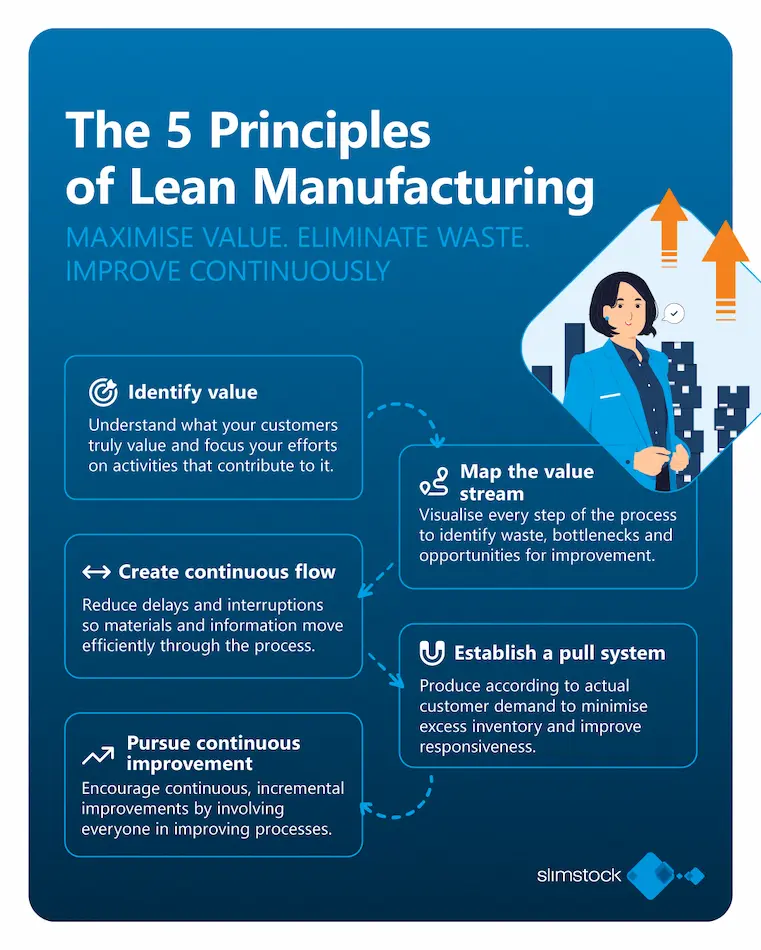
Despite the methodology’s evolution over recent decades, lean continues to be underpinned by five principles that serve as a guide to inform decisions and foster a culture of continuous improvement within any organisation.
1. Identify value
The first step is to understand what really matters to the customer. Not every activity carried out within a company adds value to the final product.
By identifying what the customer is willing to pay for, it becomes possible to eliminate unnecessary efforts and direct resources towards activities that really make a difference.
2. Map the value stream
Once you understand what generates value, you need to analyse how that value is created. Mapping the value stream allows you to visualise every stage of the process, from the receipt of raw materials to delivery to the customer, identifying bottlenecks, waste and opportunities for improvement.
This end-to-end view facilitates decision-making and prevents isolated optimisations that end up shifting problems to other stages of the operation.
3. Creating a continuous flow
Interruptions, queues and intermediate stock reduce operational efficiency. That’s why one of the objectives of Lean is to create a continuous flow, in which materials and information move forward without unnecessary delays. The more fluid the process, the lower production times, operational costs and the risk of errors tend to be.
4. Establish a pull system
Rather than producing to build up stock, lean manufacturing proposes that production should be driven by actual customer demand. Known as a pull system, this principle reduces excess stock, improves stock turnover and minimises the risk of obsolescence, whilst making the operation more responsive to market changes.
5. Strive for continuous improvement
Continuous improvement, or Kaizen, is perhaps the best-known principle of lean manufacturing. Rather than waiting for major transformation projects, the methodology encourages small improvements carried out continuously throughout the organisation.
This means involving staff from different departments in identifying problems, proposing solutions and building increasingly efficient processes. More than just a tool, Kaizen represents a cultural shift that makes improvement part of the company’s daily routine.
The 7 wastes that lean manufacturing eliminates
Eliminating waste is the main objective of this methodology. But to eliminate it, you must first identify it.
Traditionally, the methodology identifies seven types of waste (known as the ‘7 mudas’) that may be present in virtually any operation.
| Overproduction |
Producing more than demand requires or before it is needed, leading to excessive stock and increased storage costs. |
| Waiting |
Periods of inactivity caused by delays, bottlenecks, unavailability of materials or poor synchronisation between processes. |
| Transport | Unnecessary movement of materials between departments, production lines or distribution centres. |
| Unnecessary processing | Steps that consume time and resources but do not add value for the customer. |
| Excessive stock |
The accumulation of raw materials, work-in-progress or finished goods in excess of what is necessary, tying up capital and increasing the risk of losses and obsolescence. |
| Movement |
Unnecessary movements made by operators whilst carrying out their tasks, reducing productivity and increasing operational effort. |
| Defects | Quality faults that lead to rework, material scrap, delays and increased production costs. |
In practice, these forms of waste rarely occur in isolation. A bottleneck in production can lead to queues, increase work-in-progress stocks and cause delivery delays. Similarly, inaccurate demand forecasts can trigger both excess stock and stock-outs.
Therefore, implementing lean means viewing the operation holistically, identifying how each form of waste impacts the performance of the supply chain as a whole.
Lean manufacturing tools and techniques
The principles of lean manufacturing provide the direction. The tools, in turn, translate this philosophy into concrete actions in day-to-day operations.
It’s important to note that there is no ‘mandatory toolkit’. Every organisation faces different challenges and must select the methodologies best suited to its processes. The objective, in all cases, is the same: to eliminate waste, improve operational flow and create a culture of continuous improvement.
Among the main tools of lean manufacturing are:
SMED (Single-Minute Exchange of Die)
One of the main obstacles to smaller-batch production is the time required to change tools or set up machines to manufacture a new product. The longer this set-up time, the larger the batch produced tends to be, increasing stock levels, reducing flexibility and making it difficult to respond to changes in demand.
SMED was developed precisely to address this challenge. The methodology aims to simplify and standardise set-up activities, reducing changeover time from minutes or hours to just a few minutes.
In practice, this enables the production of smaller batches, reduces lead times, increases equipment utilisation and allows for a more agile response to market needs.
Kanban
Kanban is a visual system used to control the flow of materials and information throughout the operation. Rather than producing continuously, each stage begins its activities only when it receives a signal indicating that the next stage requires replenishment.
This model, known as a pull system, prevents overproduction, considered one of the main forms of waste in lean manufacturing, and helps maintain appropriate levels of work-in-progress (WIP).
As well as improving synchronisation between the different stages of production, Kanban increases operational visibility, reduces waiting times and makes it easier to identify bottlenecks.
Value Stream Mapping (VSM)
Value Stream Mapping allows you to visualise all the stages required to transform raw materials into finished products, including both the physical flow of materials and the flow of information.
This integrated view helps to identify waste, bottlenecks, rework and activities that do not add value, serving as a basis for prioritising improvement initiatives.
Bottleneck Analysis
In any operation, there is a resource whose capacity limits the performance of the entire process. This point is known as the bottleneck.
Bottleneck analysis involves identifying where this constraint occurs and focusing improvement efforts precisely on that point. After all, increasing the efficiency of stages that already have sufficient capacity is unlikely to have a significant impact on the operation as a whole.
By acting directly on the bottleneck, it is possible to increase production flow, reduce queues, minimise waiting times and improve the performance of the entire chain.
5S
Much more than just an organisation programme, 5S represents one of the cultural foundations of Lean Manufacturing.
Its name derives from five Japanese words: Seiri (sorting), Seiton (organising), Seisō (cleaning), Seiketsu (standardisation) and Shitsuke (discipline).
By creating more organised, clean and standardised environments, 5S reduces waste, improves operational safety and makes it easier to identify problems before they affect productivity.
Just-in-Time (JIT)
Just-in-Time is one of the best-known philosophies of the Toyota Production System. Its principle is simple: produce only what is needed, in the required quantity and at the required time.
By aligning production, supply and actual demand, JIT reduces stock levels, lowers storage costs and increases operational efficiency. However, its implementation requires stable processes, good demand forecasting and strong integration between suppliers, production and logistics.
Total Productive Maintenance (TPM)
Total Productive Maintenance (TPM) aims to maximise machine availability through preventive and predictive practices, reducing unexpected breakdowns and increasing operational reliability.
In addition to the maintenance team, the methodology involves operators and other staff in equipment maintenance, helping to boost productivity and reduce corrective maintenance costs.
Although these tools originated in the industrial sector, they are increasingly being applied in other areas of the supply chain.
Concepts such as continuous flow, waste reduction and continuous improvement guide decisions relating to demand planning, stock management, procurement, warehousing and distribution.
With the support of artificial intelligence and data analysis, Lean principles are now being applied well before production begins, enabling the elimination of waste throughout the value chain.

How to implement lean manufacturing today
Implementing lean manufacturing doesn’t mean applying all the tools at once. The transformation usually takes place gradually, starting with an understanding of the current operation and evolving into a culture of continuous improvement.
The first step is to map out processes and identify waste. This involves analysing the flow of materials and information, locating bottlenecks, measuring waiting times, identifying rework and understanding where the main opportunities for improvement lie.
Next, it is important to standardise operations. Standardised processes reduce variability, make it easier to identify problems and create a solid foundation for implementing new management practices.
Introducing tools such as Kanban, SMED, VSM or TPM only makes sense after this diagnosis. The aim should not be to ‘implement lean’, but to solve specific problems using the most appropriate methodologies for each situation.
Another important factor is to develop a culture of continuous improvement, particularly amongst staff. When employees are encouraged to identify problems, propose improvements and share knowledge, the evolution of the operation becomes part of the company’s routine.
Finally, implementing Lean in 2026 also means using technology to maximise results. Today, waste doesn’t arise solely on the shop floor. Inaccurate demand forecasting, poorly managed stock levels or procurement that is out of step with market needs also generate significant losses. Planning platforms, artificial intelligence and analytics help organisations identify these inefficiencies even before they impact production, making Lean a strategy for the entire supply chain.
Benefits of lean manufacturing (and what to measure)
Cost reduction is just one of the advantages of Lean. By eliminating waste and continuously improving their processes, companies make their operations more efficient, predictable and capable of responding quickly to market changes.
In practice, this translates into gains such as reduced production times, lower stock levels, better use of resources, increased productivity, improved quality and greater product availability for customers.
Another important benefit is increased operational flexibility. Lean processes are able to adapt more quickly to fluctuations in demand, reducing the risk of both excess stock and stock-outs.
To track these results, it is essential to monitor KPIs such as:
- Lead time: measures the time taken for a product to pass through the entire process, from order to delivery.
- Set-up time: indicates how much time is spent on tool changes or machine set-ups.
- Inventory turnover: shows the efficiency of stock utilisation over time.
- Service level: assesses the company’s ability to meet customer demand;
- OEE (Overall Equipment Effectiveness): measures the overall efficiency of equipment, taking into account availability, performance and quality.
- Defect and rework rate: tracks quality-related losses.
- OTIF (On Time In Full): assesses the percentage of orders delivered in full and within the agreed timeframe.
Improving one KPI at the expense of another is unlikely to represent a real gain. The true objective is to create processes capable of consistently generating value across the entire supply chain. It is therefore essential to recognise that lean is a systemic production methodology.
Lean manufacturing in practice
Although lean manufacturing is often associated with the automotive industry, its principles can be applied to virtually any operation. After all, waste exists in different processes, regardless of the sector. What changes is the way in which it manifests itself and the tools used to eliminate it.
In the automotive industry, for example, lean remains the foundation of production. Systems such as Kanban and Just-in-Time synchronise the supply to the assembly and lines, reducing intermediate stock and ensuring that components are produced or delivered only when needed.
In the food industry, meanwhile, companies use SMED to reduce set-up times between different product lines. With faster changeovers, it becomes possible to produce smaller batches, respond better to fluctuations in demand and reduce losses related to product expiry dates.
In distribution centres, lean principles are also being widely adopted. Reorganising layouts, standardising processes and eliminating unnecessary movements increase team productivity, reduce order picking times and improve service levels.
But perhaps one of the most significant applications today lies in supply chain planning. By using more accurate demand forecasts, optimised stock policies and smarter replenishment processes, companies are able to eliminate waste even before production begins. The result is a more synchronised supply chain, with less excess stock, a lower risk of stock-outs and decisions that are much more closely aligned with actual market demand.
Lean Manufacturing vs Just-in-Time vs Six Sigma: what is the difference?
It’s common for lean manufacturing, Just-in-Time (JIT) and Six Sigma to feature together in discussions about operational excellence. Although they are complementary, each has a specific focus.
- Lean manufacturing is a management philosophy aimed at eliminating waste and maximising the value delivered to the customer. Its main objective is to create more efficient flows, reduce activities that do not add value and promote a culture of continuous improvement.
- Just-in-Time (JIT), on the other hand, is one of the best-known practices within lean. Its principle is to produce or supply only the necessary quantity, at the right time and in the right place. In other words, JIT is a tool used to put one of the principles of lean into practice: producing in line with actual demand, thereby avoiding excessive stock.
- Six Sigma, on the other hand, serves a different purpose. Whilst Lean seeks to eliminate waste, Six Sigma focuses its efforts on reducing process variability and minimising defects through statistical methods and rigorous quality control.
In practice, many organisations combine the two approaches. Lean makes processes faster and more efficient, whilst Six Sigma ensures greater stability, predictability and quality. Together, these methodologies enable the creation of more productive, reliable operations geared towards continuous improvement.
How Slimstock helps companies apply the principles of lean manufacturing
Although the principles of lean manufacturing originated on the shop floor, today they increasingly depend on the quality of decisions made even before production begins.
Planning purchases without considering actual demand, maintaining higher-than-necessary stock levels or producing on the basis of inaccurate forecasts are forms of waste that can hardly be eliminated through operational improvements alone. This is why the Lean transformation has come to encompass planning, data analysis and technology as well.
In this context, Slimstock helps companies extend lean principles across the entire supply chain. The platform combines AI-powered demand forecasting, stock optimisation, procurement planning, smart replenishment and end-to-end visibility to support faster and more accurate decision-making.
With an integrated view of operations, organisations are able to balance product availability and stock levels, reduce waste, minimise stock-outs and respond more agilely to market changes. The result is a leaner, more resilient and data-driven supply chain, capable of transforming the principles of lean manufacturing into tangible gains in efficiency and competitiveness.
Lean manufacturing: a philosophy that continues to evolve
More than seven decades after its emergence, Lean Manufacturing remains highly relevant. This is because its principles are not tied to a specific technology or production model, but to the ability to eliminate waste, generate value for the customer and promote continuous improvement.
What has changed is the way this philosophy is applied. Whereas the focus used to be on the shop floor, today opportunities for improvement extend throughout the entire supply chain. Demand planning, stock management, procurement, production and distribution have all become part of the same operational efficiency strategy.
By combining the fundamentals of Lean with artificial intelligence, data analytics and advanced planning platforms, companies move beyond simply reacting to waste and start to prevent it. More than just a manufacturing methodology, Lean has established itself as a way of thinking about operations in an integrated manner, making supply chains more agile, resilient and better prepared for the challenges of a constantly changing market.