
Table of contents
Table of contents- Electronic shelf labels: a step forward in retail digitalisation
- What is an electronic shelf label?
- How does electronic labelling work?
- Advantages of electronic shelf labels over traditional systems
- Challenges in adopting electronic shelf labels
- Adoption of digital labels in Spain
- What is the cost of implementing a digital labelling system?
- Conclusion: A high initial investment that calls for a case-by-case analysis
Overview
Electronic Shelf Labels (ESLs) are digital devices that replace paper price tags in retail, enabling instant, centralized and remote price updates via a store’s computer system. The main advantages include increased efficiency, reduced errors, greater agility for promotions and cost savings from reduced manual labor and paper use, leading to higher staff productivity. The main obstacle to widespread adoption is the high initial investment and the need for seamless technological integration with existing ERP systems.
Digitisation is advancing unstoppably in the retail sector. However, there are aspects of retail that have hardly evolved at all in recent decades. Take, for example, supermarket shelves and the labels that mark their prices. The system used has probably changed little or nothing in the last 30 years: prices are displayed on paper labels that employees print and place manually when there is a price change or a promotion.
However, although printed labels remain the predominant system in most businesses, there are more innovative methods available. We are talking about what is known as electronic or digital labelling.
This system has many advantages over traditional systems, although it also faces numerous challenges when it comes to widespread adoption. In this article, we take an in-depth look at the pros and cons of electronic shelf labels, review some cases of companies that are already using them and estimate the cost of implementation.
But first…
What is an electronic shelf label?
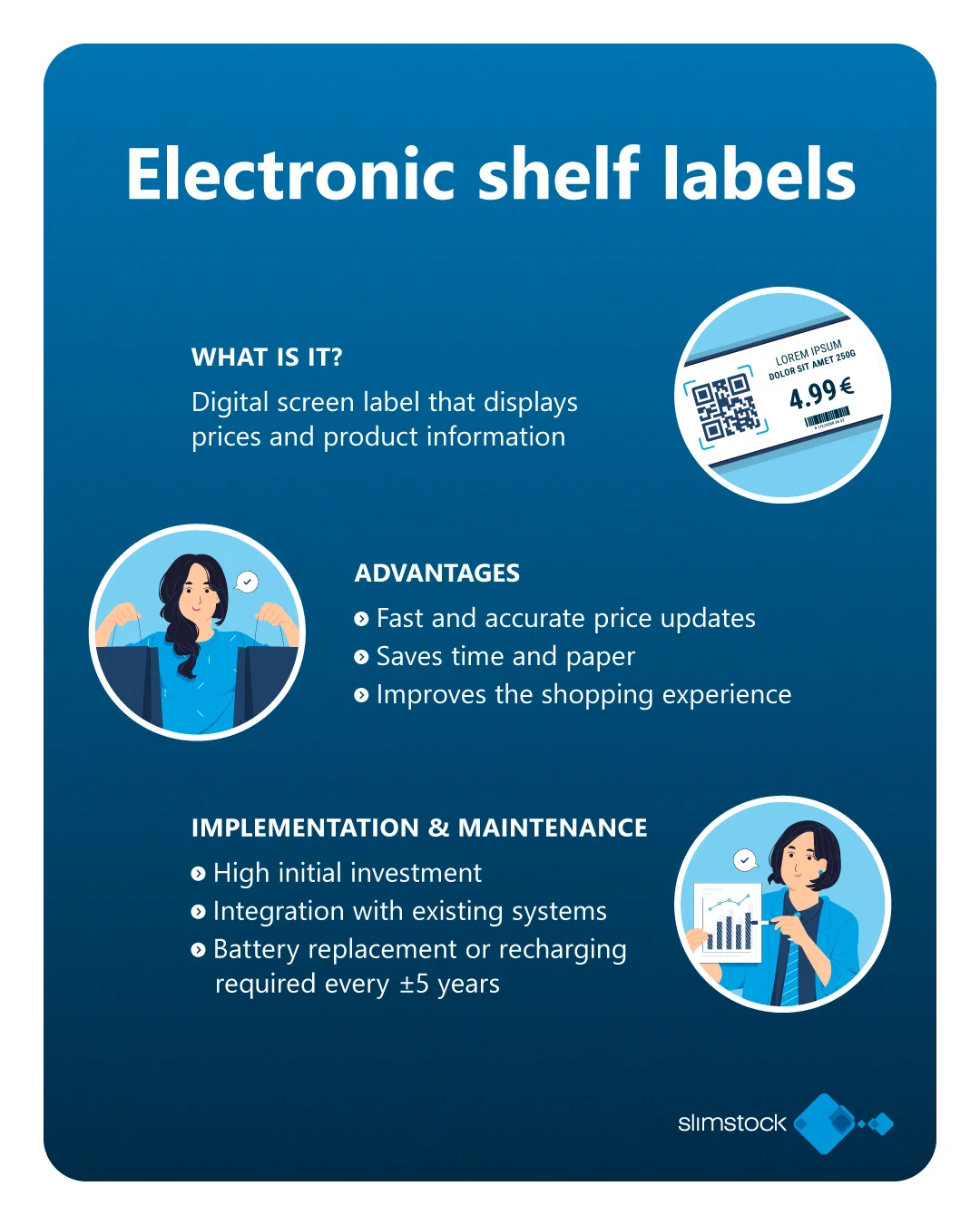
An electronic shelf label (ESL), also known as a digital label, is a small digital device that displays price and product information on store shelves, replacing traditional paper labels. Its screen usually uses low-power electronic ink or LCD, which allows it to display text (price, name, codes) clearly and in a similar way to paper, but can be updated instantly and remotely.
Each electronic shelf label is linked to a reference in the store’s computer system, so that any price change or promotion in the database is transmitted to the label to automatically update its display. In short, it is a technology that allows price management at the point of sale to be digitised, providing greater agility and accuracy than conventional labelling.
How does electronic labelling work?
Electronic shelf labels are relatively simple to use. The device includes a wireless communication module—radio frequency, WiFi or other technology—and a long-life battery that usually lasts for several years.
They are installed on shelves using special rails or brackets, and replace the traditional paper labels placed on price holders. The information displayed on the labels is controlled centrally and, when staff at the head office or in the store need to change a price or product information, they enter the new data into the ERP system for immediate updating.
These are the most basic features. However, some digital labels incorporate additional technologies such as indicator LEDs or NFC/QR connectivity, which enable advanced functions, such as flashing a light to help find a product or allowing the customer to scan a QR/NFC code with their mobile phone to obtain additional information about the product.

Advantages of electronic shelf labels over traditional systems
The main advantage is clear: the system is more efficient. With the traditional method of printed paper labels, price lists must be reviewed periodically, labels must be cut or perforated, and staff must move around the store to replace them one by one, often outside of business hours. With electronic labels, however, the process is much faster and more reliable.
1. Remote and rapid updating
Electronic labels can be updated centrally and automatically without the need to physically walk around the store. The result is a reduction of approximately 60 per cent in the time spent on price changes.
2. Elimination of human error
By eliminating manual handling, labelling errors are minimised and you can be sure that the price on the shelf always matches the price at the checkout.
3. Agility for promotions and pricing strategy
With digital labels, prices can be adjusted more flexibly and even enabled for real-time dynamic pricing (although this can be a double-edged sword, as we will see later). For example, a retailer can automatically lower the price of a fresh product as its expiry date approaches to encourage sales. It also allows flash offers or discounts to be launched by time slot simply by programming them into the system.
4. Cost savings and increased productivity
Although the initial investment is high, electronic shelf labels are much more efficient than the traditional method. By not having to constantly print and replace labels, store staff can focus on other tasks, such as customer service or restocking products. This improves overall store productivity. In addition, paper and material costs are reduced, also contributing to the company’s sustainability.
Want to see how better inventory management can save you time and money? Explore Slimstock’s Inventory Management Software solution today!
Challenges in adopting electronic shelf labels
Despite its benefits, the adoption of electronic labels comes with challenges, and there are significant obstacles that companies must overcome to complete their adoption.
High initial investment
This is undoubtedly the main obstacle. Each device costs between €5 and €6, and considering that a medium-sized supermarket needs thousands of them, this puts the implementation cost at tens of thousands of pounds. Mercadona estimated that implementing electronic labels per store would cost around €100,000, which is a significant barrier despite the benefits mentioned above.
Uncertain return on investment
Related to this, some chains have been cautious because the time frame for ROI is still unclear. For years, enthusiasm for this technology contrasted with its limited deployment, precisely because of the lack of evidence of tangible returns compared to the high costs.
The lack of documented success stories has made many retailers wary of this technology, although, as we will see later, there are already a significant number of companies using it.
Technological integration and system adaptation
Implementing electronic shelf labels is not just a matter of hanging them on the shelves, it involves integrating them with the company’s systems. ESLs need to be connected to price management software so that changes are reflected, and custom development may be necessary to carry out this integration. All of this requires IT effort and technical testing to ensure that the system works without fail. In this sense, the traditional method of price management is obviously simpler.
Maintenance and technical aspects
Although electronic labels require little daily maintenance, there are considerations to take into account such as battery life (normally around 5 years, after which they need to be replaced, or recharged if they are fixed batteries) and incident management (possible desynchronisation or malfunctions).
In addition, a protocol must be established to monitor that all labels are operational and up to date, although it is true that many systems send alerts in the event of an incident. In any case, it is a new technological element in the store that must be managed.
On the other hand, certain sections may present specific challenges. For example, in extreme temperature environments (frozen foods), special labels are needed that can withstand the cold, or in humid areas (fishmongers), they must be protected from condensation. These are technical details that the retailer must coordinate with the system supplier.
Pricing strategy and customer perception
Although technology allows for dynamic pricing, many supermarkets fear that constant changes (e.g., price variations throughout the day) may generate mistrust among customers, as consumers value transparency and price stability.
While it is feasible, for example, to gradually lower the price of a tray of meat as the evening approaches (to sell it before it expires), this must be done tactfully and communicated well.
Adoption of digital labels in Spain
Although electronic labels are emerging as a transformative technology in retail, in Spain their adoption has been limited and confined to pilot projects or partial implementations.
Let’s look at some milestones and notable cases in the Spanish market:
Condis, a pioneering pilot project
The Condis supermarket chain was a pioneer in Spain, launching an ESL project in 2018. The company carried out a pilot test in a newly opened store on Rambla de Badal in Barcelona, and in another store in Madrid. However, the use of this technology has not become widespread in the stores of the supermarket chain founded by the Condal family.
Bon Preu digitises prices in all its stores
The Catalan retail group (Bonpreu/Esclat) announced in March 2023 that it would be implementing electronic shelf labels in all its stores. It is one of the first Spanish chains to commit to large-scale adoption.
Consum trials in the Mediterranean
In 2019, the Consum cooperative launched a pilot programme with digital shelf labels in five of its supermarkets (spread across Valencia, Alicante and Tarragona). Its approach was to implement ESL in all sections (including fresh produce and bakery) of these pilot stores to assess the impact. In addition, Consum equipped the labels with advanced features, such as QR codes to access recipes and product photos.
Eroski and its alliance with VusionGroup
By 2025, one of the most decisive steps has been taken by Eroski. The Basque cooperative announced an alliance with the technology company VusionGroup to digitise its stores, including the gradual implementation of smart electronic shelf labels in all its hypermarkets and large stores, although the implementation will be carried out progressively.
Alcampo, the latest to show interest in ESL
Alcampo has launched a national pilot programme for electronic labels, starting in its store on Calle Alcalá in Madrid, and expanding to ten other local stores under the Mi Alcampo brand. The aim is to drastically reduce the time required to update prices, improve staff productivity and eliminate the use of paper as part of its commitment to operational digitalisation.
What is the cost of implementing a digital labelling system?
Implementing an electronic labelling system requires a considerable investment, the size of which depends on the size of the business and the characteristics of the solution chosen. The main items into which the investment is broken down are:
- Labels, between €5 and €6 per unit: Each unit has a price that varies depending on the supplier, the size of the screen and the features (monochrome or colour, with LED, with NFC, etc.). To give you an idea, the labels used by Consum cost between €5 and €6 per unit in the standard format (black and white with a ~2.7-inch screen).
- Infrastructure and software: In addition to the tags, antennas or base stations are required to send the signal to the ESLs within the store. The number depends on the surface area. A small store may need 1 or 2 antennas, a large hypermarket may need several distributed throughout the area.
In addition, the ESL provider usually supplies software that integrates with the retailer’s ERP. The cost of this platform can be a one-time licence or a SaaS subscription, depending on the business model. In total, the infrastructure plus software can add up to several thousand or tens of thousands of pounds.
- Maintenance and renewal: Electronic shelf labels work with long-life batteries (typically around 5 years). After this period, the batteries must be changed or the ESL replaced if they are not rechargeable. It is advisable to factor this cost into future budgets. Some labels may also be damaged and need to be replaced (if a customer accidentally breaks one, for example). These maintenance costs are lower than the initial investment, but they do exist.
On the other hand, there is technical support: sometimes contracted with the supplier, ensuring software updates and assistance if any components fail. This usually translates into an annual maintenance cost (a percentage of the investment, similar to any computer system).
Conclusion: A high initial investment that calls for a case-by-case analysis
Taking all this into account, and if we want to think of a rough figure, the investment can be around €85,000 per store (although the figure varies greatly depending on the establishment where the technology is to be implemented), as we saw at the beginning of the article.
The challenge, therefore, is to shorten the payback period by taking advantage of the technology. Where does the return come from? Mainly from reduced labour and operating costs (fewer hours spent by employees managing prices, fewer errors that can lead to losses, etc.) and improved sales through more agile price/promotion management.