

Overview
To effectively manage broad product ranges and expanding inventory points, retailers should implement ten key inventory tips: align strategy with execution, leverage data for accurate forecasting and buffer stock, use ABC analysis for prioritization, apply a ‘to stock or not to stock’ framework, optimize sales channels, manage the product life cycle, use management by exception, collaborate internally and externally, professionalize the supply chain in steps and provide continuous training for staff.
Retailers are increasingly faced with multiple sales channels and large product ranges. But which stock should be held where in order to offer the best level of customer service? Peter Bocken, a retail expert from Slimstock, shares ten inventory tips for taking control of an ever-expanding product range and keeping a tight rein on costs.
Why is it difficult to manage large product ranges?
Inventory management is in essence very simple. It revolves around two questions: how much should you order, and when? What makes inventory management so complex is that everyone views it differently. A financial director looks at the capital costs and obsolete stock, for example, whereas a logistics manager often thinks in terms of the number of pallet locations and order lines. For a sales director, however, inventory means more revenue, more profit and more satisfied customers. Adding to the complexity is the fact that the ‘traditional’ supply chain no longer exists. Rather than all goods going from manufacturer to wholesaler to retailer and then on the consumer, many of today’s supply chains have become hybrids.
So where should you hold your stock in order to off er the best customer service? With expanding product ranges, more sales channels and more inventory points, The reality of inventory management has become far more challenging. Based on our experience of working with over 750 businesses around the world who use our inventory optimisation software, we have prepared these top tips:
Top 10 inventory management tips for large product ranges
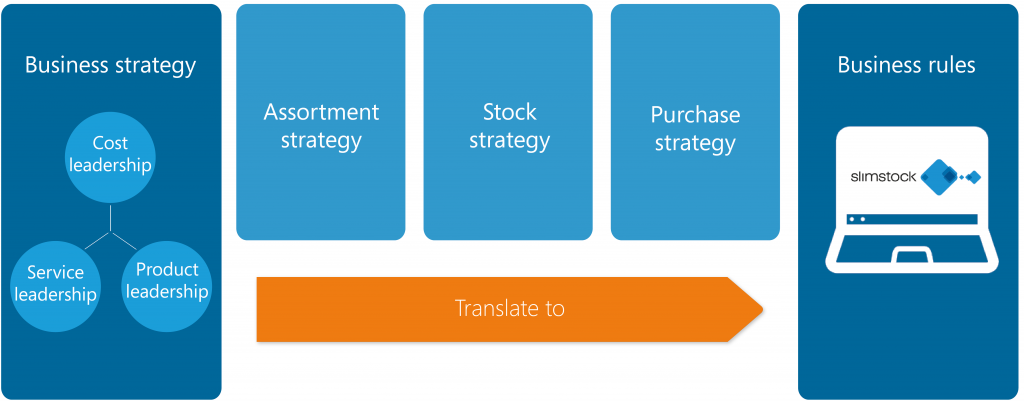
Tip 1: from strategy to execution
Translate your company strategy into appropriate business rules and associated automatic scenarios. For example, a high-end department store such as Harrods and a fashion discounter such as Primark both sell white T-shirts. However, they pursue very different inventory and procurement strategies.
Tip 2: Leverage data for accurate forecasting
Utilise (big) data! This enables you to use statistically reliable models to arrive at an accurate forecast and (often even more importantly) to calculate the appropriate level of buff er stock on a daily basis, even in the case of extremely large product ranges.
Tip 3: ABC analysis for priorization
In a large long-tail assortment it is impossible to pay equal attention to each and every product. Sharpen your focus by frequently performing a thorough forecast-based ABC/ XY analysis. Which products add the most value in terms of profit, revenue and/or numbers of customers?
Tip 4: To stock or not to stock?
Bear the three-step model in mind. Does the item fit in the product range? Do you need to keep the item in stock? If so, how many units? The second step is the most important one. Much depends on the customer’s willingness to wait and the supplier’s back-office setup.
Tip 5: Optimise channels for maximum profitability
Physical stores, web shops, online platforms – retailers have to manage ever-more sales channels. With expanding product ranges comes fragmentation of demand. Optimise your profit margins by allocating the right products to the right channels.
When managing large product ranges across multiple channels, understanding how different customer segments interact with various products becomes crucial. Advanced customer and channel forecasting software can segment demand patterns by customer type, channel preference, and product category, enabling more precise inventory planning. This sophisticated approach allows businesses to tailor their product mix and stock levels to specific customer behaviours and channel characteristics, significantly improving inventory efficiency and customer satisfaction.
By aligning stock decisions with customer demand and channel dynamics, you can avoid overstocks and understocks—regardless of how broad your product range becomes.
Tip 6: Product life cycle management
Keep a close eye on the life cycle of each product. Each phase requires a different owner within the organisation and a different product management mechanism. Align your inventory and procurement strategies accordingly.
Tip 7: Management by exception
It is impossible to check every individual SKU manually every day. How many exceptions are you willing and able to manage? What do you want to automate, and which decisions could/should a planner still be able to make? Make sure you achieve the right trade-off between efficiency and effectiveness.
Tip 8: Collaborate with suppliers and teams
Collaboration is key, both internally and externally. Share information with your suppliers to improve performance, and don’t wait too long to share information with Marketing in order to resolve inventory-related issues and potential stock shortages as effectively as possible.
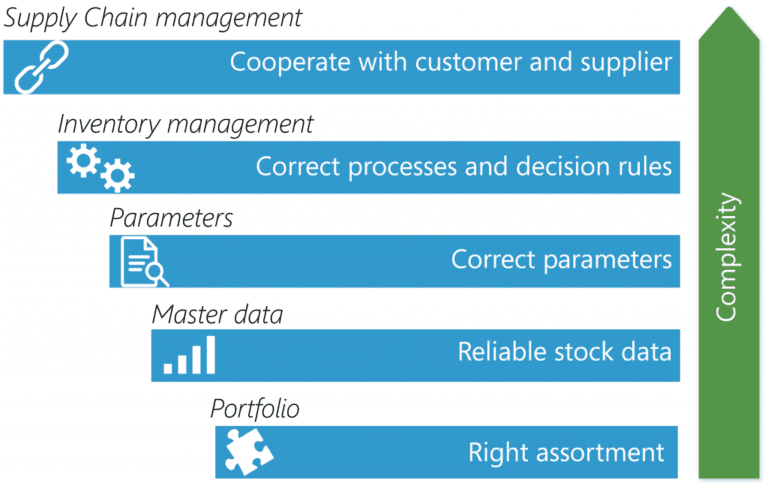
Tip 9: Step-by-step model
Professionalise your supply chain one step at a time, ensuring you lay down a firm foundation. The Slimstock modular model supports a structured approach.
Tip 10: Provide continuous training
Inventory management is like A top-flight sport. Our final inventory tip is to continually invest in your people to improve their competencies and keep them at your company for longer!