
Overview
Sales and marketing must actively participate in the Sales & Operations Planning (S&OP) process, as it is a critical driver of profitable growth, customer satisfaction and competitive advantage. Their market intelligence is vital for accurate demand plans and their involvement ensures alignment between promotional campaigns and inventory, leading to fewer stockouts, better service and increased revenue.
In today’s fast-paced, customer-centric world, aligning supply with demand is no longer just a supply chain challenge, it’s a broader task which involves many departments. Yet many sales and marketing leaders still perceive Sales & Operations Planning (S&OP) as a back-office function. That view needs to change.
S&OP is not just about forecasting and logistics. It’s about driving profitable growth, enhancing customer satisfaction, and gaining competitive advantage, all of which are core to sales and marketing. In this article, we will explain why Sales & Marketing’s contribution is critical in the S&OP process.
The why: what’s in it for sales and marketing?
The benefits of S&OP participation may not always be immediately obvious to sales and marketing. But in truth, the process will offers a structured way of discussing plans, resolving issues, and making informed decisions.
There are a couple of strong reasons why sales and marketing should be proactive during S&OP meetings:
1. Better market knowledge will create better demand plans
Sales and marketing teams hold valuable knowledge of market trends, customer behaviours, and promotional calendars. These are essential to building accurate demand forecasts. Contributing to S&OP, will help shape a demand plan that reflects real market dynamics, not just historical data.
2. Improved product availability will increase customer service
Ever launched a campaign only to find the product wasn’t available? Active S&OP participation ensures alignment between promotional activities and inventory readiness. This means fewer stockouts, better service levels, and more successful launches.
3. Stronger cross-functional alignment
S&OP is the bridge between commercial and operational teams. Sales and marketing involvement fosters better collaboration, breaks down silos, and ensures everyone is working toward the same goals. Additionally, it gives Salesand marketing a seat at the table when key decisions are made about product mix, pricing, and market prioritisation.
4. Revenue growth and better margins
By proactively aligning demand with supply, S&OP will reduce costly last-minute changes, expedite fees, and markdowns. It enables demand to be channelled towards more profitable products, accounts or channels, ultimately improving both top- and bottom-line performance.
The how: making sales and marketing a driving force in S&OP
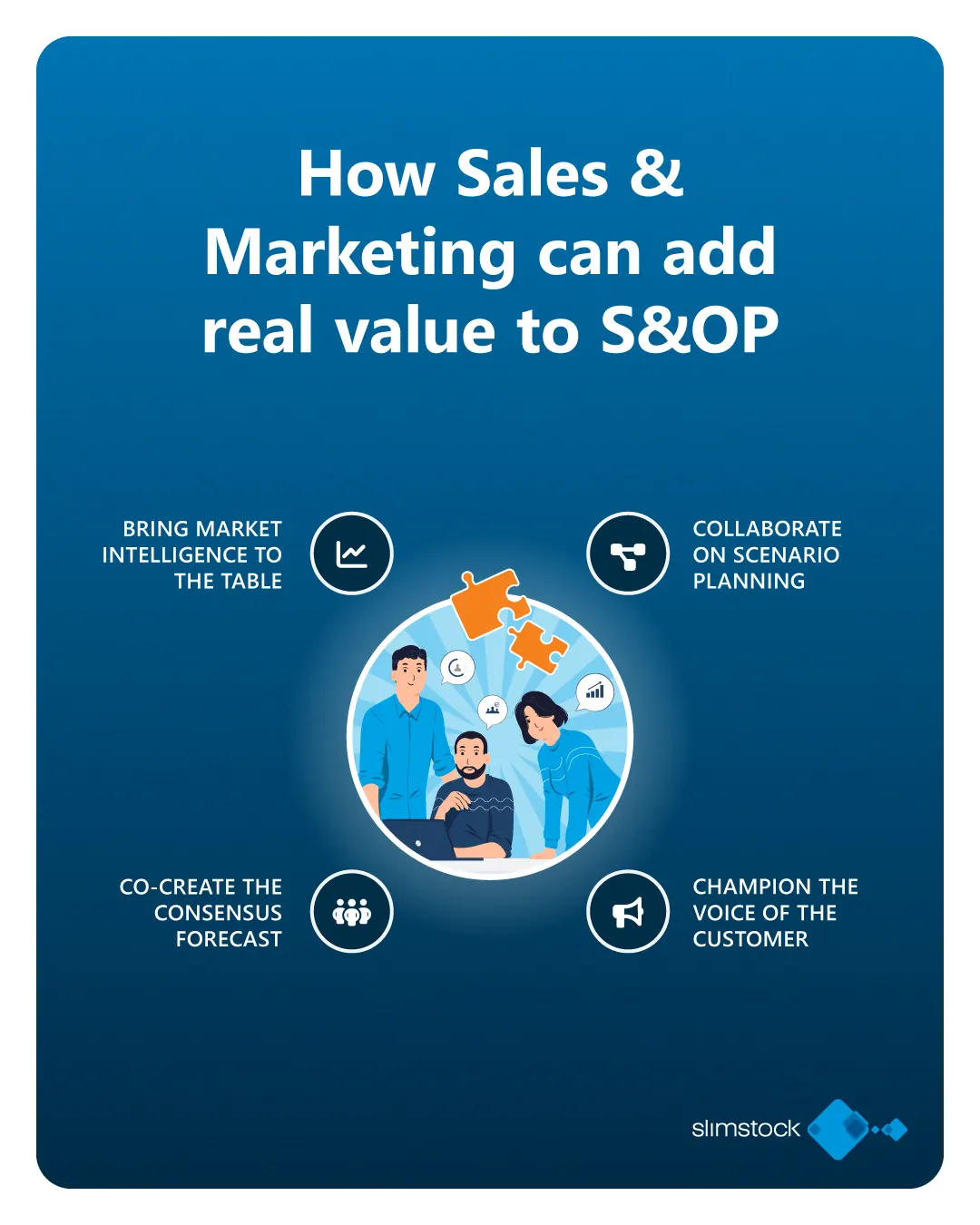
We want to make sure S&OP is not only about issues of the past. The key to S&OP is highlighting things that are not necessarily visible in the data: qualitative input and information. It’s also about sharing insights such as price changes and other factors that supply chain systems and forecasting models do not (yet) account for. Below is a summary of the contribution expected from sales and marketing:
1. Bring market intelligence to the table
Share insights from customer conversations, competitor moves, and upcoming promotions. Use CRM data, campaign results, and market research to enrich the demand plan with actionable intelligence.
2. Collaborate on scenario planning
Help evaluate “what-if” scenarios: What if a campaign overperforms? What if a competitor launches early? This will help supply chain and operations prepare for alternate scenarios and remain agile in the face of change.
3. Own the consensus forecast
Don’t simply review the forecast, be a co-creator. Challenge assumptions, validate numbers, and ensure alignment it with your commercial strategy.
4. Champion the customer voice
Ensure that customer needs and expectations are central to planning decisions. Advocate for service levels, lead times, and product availability that support your brand promise. This will help reach goals within operational constraints.
The payoff for sales and marketing
No business can operate without sales to their customers, neither does any business have the resources for unlimited inventory or shipping capacity. In the end, by contributing to the S&OP process you will get what you need to have happier customers without blowing up costs to the business.
The benefits? It will help increase campaign effectiveness, reduce supply surprises, allow you to respond faster to market changes, influence strategic decisions, and improve sales and promotion performance.
Final thoughts
S&OP is no longer a “nice to have”, and sales and marketing leaders are not just participants; they are key drivers of its success. By stepping into the S&OP process with purpose and insight, you don’t just help the business plan better, you help it perform better.
So, the next time you’re invited to an S&OP meeting, don’t just attend: lead.