Table of contents
Table of contents- What is supply chain visibility?
- Understanding supply chain visibility
- The importance of supply chain visibility
- Advantages and benefits of supply chain visibility
- Common supply chain visibility challenges
- How to improve supply chain visibility
- Supply chain visibility software and control towers
- Your future supply chain
Overview
Supply chain visibility is the ability to track and understand every stage of the supply chain, from raw materials to final delivery, in near real time. It combines order, inventory, shipment and production visibility to give businesses a connected view of operations. This end-to-end transparency enables faster decision-making, better risk management, regulatory compliance and improved customer satisfaction. While challenges such as data siloes, legacy systems and partner integration remain, companies can improve visibility by adopting integrated software platforms, IoT, AI-driven analytics and control towers that centralise data and enable collaboration. In today’s complex global environment, supply chain visibility is no longer optional, but essential for resilience, efficiency and long-term profitability.
Businesses across almost all sectors are under intense pressure to create a more unified and transparent view of their end-to-end supply chain, in order to monitor and manage their operations more effectively. It’s why one of the key buzzwords of 2025, building on the influence and impact of data and AI, is ‘visibility’. And, more specifically, supply chain visibility.
Supply chain visibility reflects a company’s ability to see and track every component of their supply chain, from raw materials to finished products, in near real time. This means having insight into inventory levels, shipments, production, warehousing and distribution as items move from supply, through production and logistics, and ultimately across the last mile to customers and end users.
Connecting the dots in a way that is immediately visible, understandable and actionable is the holy grail for all supply chains. And it’s one of the critical deciding factors when determining levels of efficiency, sustainability, cost effectiveness, job satisfaction, and ultimately profit margins.
Understanding supply chain visibility
Supply chain visibility isn’t a single metric. Rather, it’s the collective consolidation and overview of order visibility, inventory visibility, shipment visibility and production visibility.
- Order visibility: tracking sales orders from placement to fulfilment.
- Inventory visibility: knowing what stock you have, where it is situated at any given time, and plotting the handling, movement and distribution of each item at a granular level.
- Shipment visibility: monitoring shipments’ status and locations as goods move through transport and logistics networks.
- Production visibility: overview of manufacturing processes: when and how items are produced, in what quantities and their respective production flows.
More than just seeing these respective statuses across the chain, true ‘visibility’ also means having immediate, real-time insight into the impacts of a disruption, dialling up, or shortfall in any of those areas. How would a late shipment of raw materials impact the production schedule? What will this do to ultimate fulfilment lead times? Do you have the capacity to ramp up and catch up at a later date?
All of these answers derive from clear, connected visibility.
The importance of supply chain visibility
Supply chain visibility matters because modern supply chains are immensely complex. Global sourcing, multiple suppliers, outsourced manufacturing, long transit times and regulatory requirements make businesses vulnerable to numerous risks and disruptions, all of which are exacerbated by a lack of visibility into how those risks impact the entire supply chain in real time.
This end-to-end visibility is vital, because:
- It gives companies control and oversight over the entire flow of goods, which helps prevent disruptions, stockouts, or overstocking.
- It enables faster, data-driven decisions. With real-time data, businesses can respond quickly when something goes wrong. For example, if a shipment is delayed or demand suddenly spikes.
- It supports compliance, traceability and ethical sourcing. As regulations around sustainability, labour standards and environmental impacts become stricter, being able to trace the origins and journey of materials is increasingly important.
- It fosters collaboration across partners (suppliers, manufacturers, logistics providers) enabling all stakeholders to share information and act cohesively rather than in siloes.
Advantages and benefits of supply chain visibility
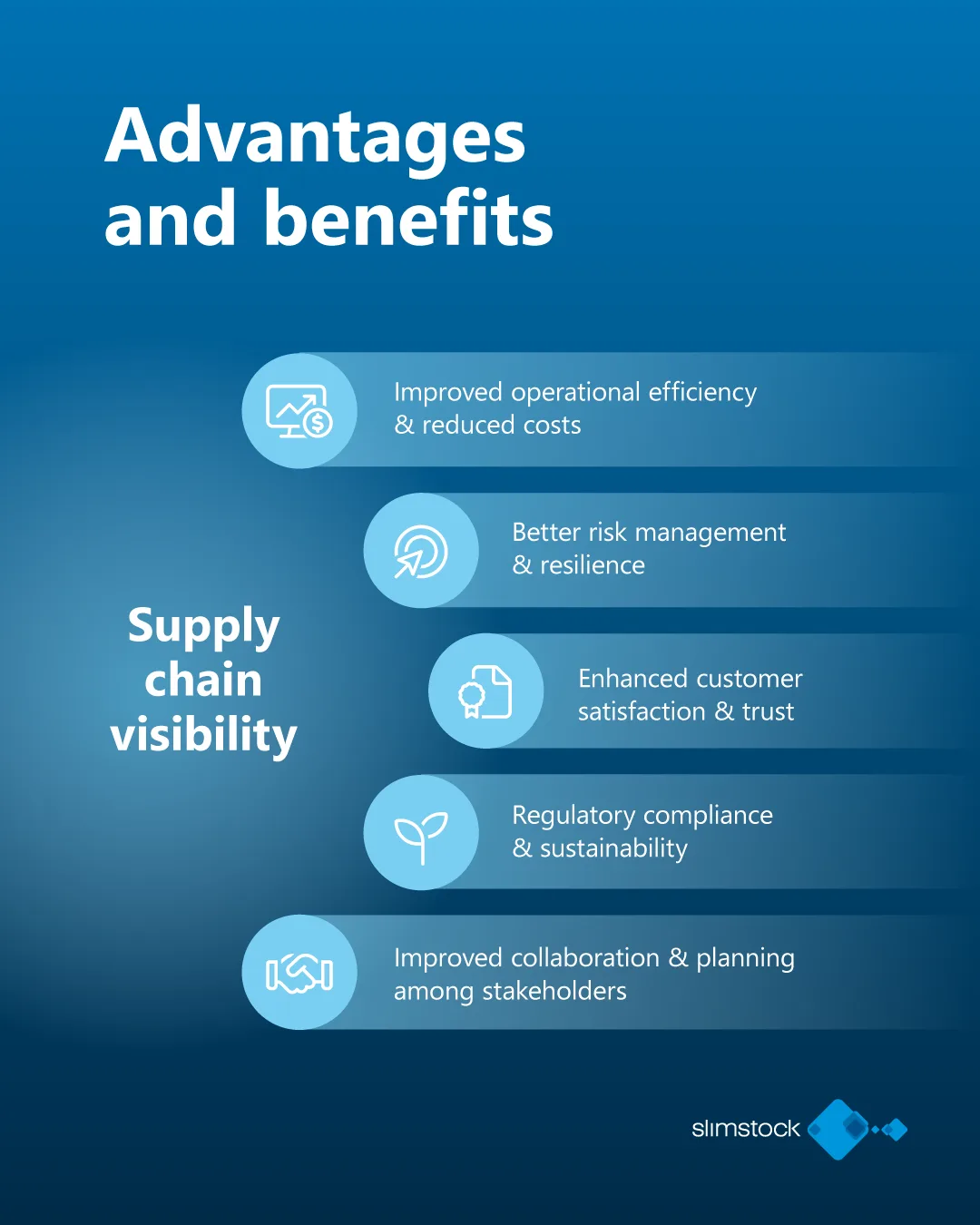
When businesses achieve true supply chain visibility, they can unlock more than just immediate supply chain benefits. Broader business advantages include:
Improved operational efficiency and reduced costs
With visibility into inventory and shipments, companies can avoid overstocking, reduce redundancies, optimise transportation and cut waste. All of which elevate end profit margins.
Better risk management and resilience
Visibility helps identify supply chain disruptions early (delays, shortages, supplier bottlenecks, logistical issues) enabling pre-emptive mitigation, and more aligned planning across departments.
Enhanced customer satisfaction and trust
Customers increasingly expect transparency, agility and predictability with their orders. Being able to track those orders and provide accurate status updates helps build loyalty and reduce returns or complaints.
Regulatory compliance and sustainability
Visibility allows companies to trace materials back to original suppliers, ensuring adherence to labour, environmental and ethical regulations, essential both for compliance and for brand reputation.
Improved collaboration and planning among stakeholders
With shared data across suppliers, logistics, manufacturing and sales, companies can synchronise plans more effectively.
Common supply chain visibility challenges
However, achieving optimised, resilient supply chain visibility is not always easy. Many businesses struggle to reach this desired destination due to their current architectures, business structures and data management processes.
Data siloes, legacy tech and disparate systems works against the ideal ‘single source of truth’ goal, leading to miscommunications, duplicated data sets and conflicts across teams. This situation also isn’t helped if the data is outdated or unreliable, another issue faced by many. Manual updates and inflexible systems don’t suit today’s business requirements, and are then exposed to the sheer complexity and scale of many global supply networks. Simply, the structures in place can’t cope, let alone unlock new value or avenues for improved profits.
Many companies have identified this issue but then struggle with the integration itself. This might come from a lack of trust among the C-suite, although this resistance is thankfully becoming a rarer hurdle in the era of AI and automation. The bigger problem for most is knowing how and where to start, and how new systems could either dovetail with, or replace, existing systems.
That integration must also include the wider partner network, and a final challenge when it comes to achieving optimal supply chain visibility, is bringing these partners along on the journey. After all, the full end-to-end chain reaches from the primary supplier to the end consumer. Everyone needs to be reading from the same clear picture of information, in real time.
How to improve supply chain visibility
To that end, where should companies start, in facilitating a more connected, data-driven, visibility-inducing supply chain?
- Implement integrated systems and data-sharing platforms: centralise inventory, logistics, procurement and shipment data to break down siloes. Use ERP, warehouse management, logistics tracking and supply-chain management systems that communicate with each other.
- Leverage modern technologies including IoT, sensors, tracking devices and automation: embed tracking (RFID, GPS, IoT sensors) to follow items in transit or in storage, enabling near real-time monitoring of shipments and inventory.
- Adopt analytics and AI-driven tools: advanced analytics and AI can help to process large volumes of supply chain data, forecast demand or detect anomalies, helping companies anticipate problems before they occur.
- Foster collaboration across all supply chain partners: encourage information sharing, transparency and alignment across suppliers, logistics providers, manufacturers, and retailers. This often means setting up common platforms for data exchange and communication.
- Ensure robust governance, compliance and traceability frameworks: most businesses are operating across multiple countries, have numerous suppliers and need to remain compliant with a number of regulatory standards. Document sourcing, manufacturing practices and supplier credentials to ensure traceability and compliance.
Supply chain visibility software and control towers
Job one before any of the above, however, is to find a supply chain partner who can help guide you through each and every phase of this transformation, at a scaling pace that suits you, your current setup and your future objectives.
Finding a software provider that naturally aligns with the notion of connected data for true supply chain visibility, is the biggest step to take. It facilitates the integration, the monitoring, the management, the scenario planning, the collaboration and the planning that is made immediately easier through this clearer insight. Moreover, this seamless bringing together of reliable, trusted data should be complemented by the use of a control tower, a centralised dashboard or command centre powered by cloud, IoT and analytics to monitor supply chain operations end-to-end.
These control towers can alert teams to delays, inventory shortages, risks or inefficiencies, enabling faster responses… all thanks to your newfound visibility of the whole situation at one single glance.
Your chosen supply chain software should include real-time tracking of shipments and inventory, automated data collection and integration, collaboration tools for all stakeholders, analytics and forecasting and compliance modules to meet regulatory or sustainability requirements. Through this single platform, you’ll be augmenting your supply chain operations from the minute you begin your transformation, and exponentially from that point on.
Your future supply chain
In today’s global and increasingly complex business environment, supply chain visibility is not a luxury, it’s a necessity. It empowers organisations to track every step of their supply chain in near real time, enabling transparency, better decision-making, risk management, regulatory compliance and improved customer satisfaction.
While achieving full supply chain visibility can be challenging, the benefits are substantial and business-critical. By leveraging an integrated software platform, IoT, AI and analytics, and by promoting data sharing and collaboration across all partners, you can finally get a clear view of a more resilient, efficient and agile future for your supply chain.