
Table of contents
Table of contents- Trends that will define the supply chain in 2026: technology, resilience and sustainability
- Why it is important to keep up with supply chain trends
- 1. Operational resilience: the new competitive advantage
- 2. Technology and digital transformation: AI in the supply chain is here to stay
- 3. The new geopolitics of trade reshapes global operations
- 4. Control towers take centre stage
- 5. From click to door: the pressure of e-commerce on inventories
- 6. From global to local: the advance of nearshoring
- 7. Automation and robotics drive productivity and logistical precision
- 8. Real ESG: traceability and impact verification as a competitive requirement
- Supply chain software trends for 2026
- Supply chain challenges and risks for 2026
- Conclusion
Overview
The article examines how global supply chains, after a turbulent 2025 marked by geopolitical conflicts, high logistics costs and fragmented trade routes, are entering 2026 with a focus on technology, resilience and sustainability. It outlines eight key trends—from the rise of operational resilience and the rapid adoption of AI, to the restructuring of global networks, growing reliance on control towers, e-commerce pressures on inventories, accelerated nearshoring, automation at scale and expanding ESG traceability requirements. It also highlights how supply chain software is evolving into integrated, intelligent systems powered by generative AI, predictive automation, digital twins and embedded sustainability metrics. In a landscape of volatility, labour shortages and tighter regulations, the article stresses that anticipating risks, aligning flows and building agile, data-driven operations will be essential for competitiveness, with robust technology and organised planning processes becoming critical tools for the years ahead
During 2025, supply chains around the world faced a rare combination of tensions: geopolitical conflicts, cross-tariffs, congested international routes and growing pressure to redesign logistics networks. The crisis in the Red Sea kept freight rates high between Europe and Asia, forcing companies to rethink routes, inventories and service levels.
Now, on the cusp of 2026, the sector is preparing for a year marked by complexity, digital transformation and structural changes. According to Forbes, 75% of companies’ priority investments globally are now focused on artificial intelligence, a clear indication of where planning and operations are heading.
Why it is important to keep up with supply chain trends
Supply chains have become more interdependent and vulnerable, impacted by geopolitical risks, regulatory changes and economic fluctuations. Anticipating trends is essential to quickly adjust inventory strategies, logistics networks and sourcing decisions.
In an environment where volatility, automation and regionalisation intersect, staying ahead of these changes is fundamental to ensuring efficiency, resilience and operational continuity.
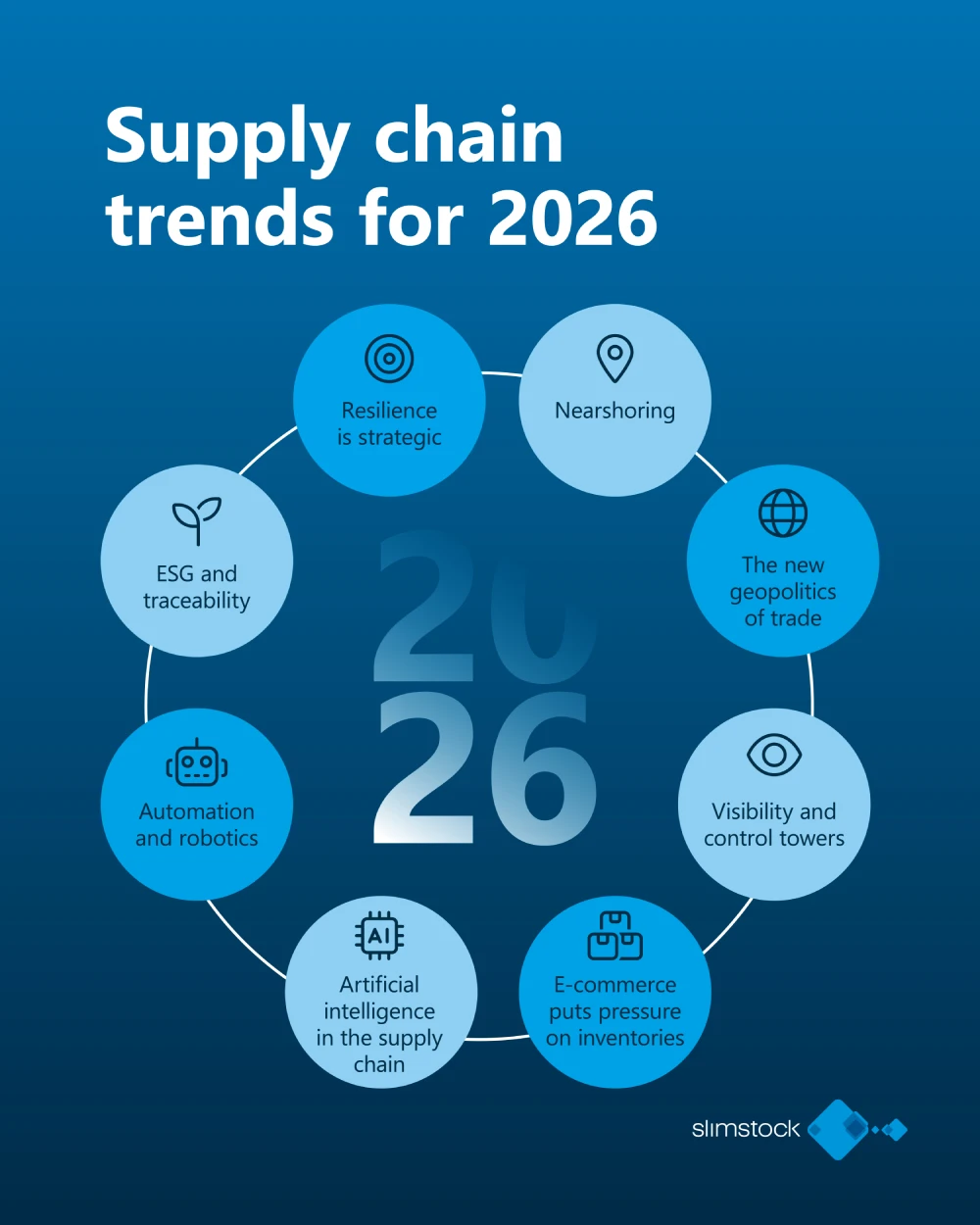
The following eight trends are expected to shape the global supply chain in the coming year:
1. Operational resilience: the new competitive advantage
Resilience is becoming a central priority in 2026. Beyond simply responding to disruptions, supply chains must anticipate them. More accurate forecasting, risk monitoring and continuous scenario simulation enable rapid adjustments to inventory policies, portfolio mix and routes. Multi-sourcing and geographic diversification strategies reduce structural vulnerabilities and strengthen operational continuity in the face of tariffs, logistical disruptions and demand shocks.
2. Technology and digital transformation: AI in the supply chain is here to stay
Artificial intelligence is taking centre stage. Generative models and conversational assistants accelerate S&OP processes, generate reports, identify exceptions, anticipate disruptions and improve forecast accuracy, even for new product launches with no historical data. Integrated with advanced planning platforms, AI adjusts inventory policies, prioritises exceptions and frees teams to focus on important strategic decisions. In a volatile environment, AI becomes essential for agility and resilience.
3. The new geopolitics of trade reshapes global operations
With rising tariffs, trade barriers and shifting regional agreements, global commerce is becoming increasingly fragmented. Companies must reassess their global footprints, recalculate total cost of ownership, diversify suppliers and redesign routes and inventory levels to minimise risks and costs in 2026.
4. Control towers take centre stage
End-to-end visibility is no longer optional. In fragmented and distributed networks, control towers take centre stage by integrating data from across the chain, automating alerts and monitoring critical events. These platforms provide the granularity needed for rapid decision-making, from supplier delays to route performance, strengthening end-to-end coordination and reducing costs.
5. From click to door: the pressure of e-commerce on inventories
The promise of fast deliveries has reshaped the design of logistics networks. Dark stores, micro-warehouses and urban logistics hubs are becoming more widespread to bring products closer to consumers. This fragmentation increases planning complexity and raises the importance of visibility and network balancing. With increasingly narrow margins, the challenge is not just to deliver quickly, but to deliver quickly and efficiently.
6. From global to local: the advance of nearshoring
Global supply chains are shifting from cost-driven strategies to risk-mitigation strategies. Supplier diversification and regionalisation of operations are accelerating. By 2026, nearshoring models are expected to consolidate, creating opportunities for regions to develop autonomous, resilient productive ecosystems supported by industrial clusters. Shorter networks provide agility, stability and greater ability to respond to global disruptions.
7. Automation and robotics drive productivity and logistical precision
Automation is advancing at pace. Picking robots, autonomous vehicles and highly automated warehouses are redefining productivity, accuracy and space utilisation. Beyond improving operational efficiency, automation helps overcomechallenges such as labour shortages and the growing need for speed. In competitive markets, automation is no longer a differentiator, it has become the standard
8. Real ESG: traceability and impact verification as a competitive requirement
Environmental and social traceability is becoming a regulatory obligation. Standards such as LkSG and CS3D, along with pressure for Scope 3 reporting, require companies to monitor, audit and verify the origin and impact of their products. Technologies including AI, blockchain, RFID and embedded sensors ensure data integrity, transparency and governance in complex chains. Traceability now forms part of broader risk and sustainability strategy, rather than being merely an operational feature.
Supply chain software trends for 2026
By 2026, supply chain platforms will evolve into more integrated, intelligent and data-driven systems. Advances in artificial intelligence, predictive automation and end-to-end visibility are transforming planning systems, which are shifting from supporting decisions to continuously orchestrating them.
Key developments include:
- Generative and predictive AI embedded in planning, supporting analysis, reporting, inventory policy adjustments and early exception detection.
- Unified demand, supply and S&OP platforms that eliminate silos and enable synchronised, end-to-end decisions.
- Control towers integrated with ERPs, WMS and TMS, expanding real-time visibility and automation of critical alerts.
- Dedicated forecasting and risk-management modules, including variability detection, disruption alerts and geopolitical impact analysis.
- Continuous simulation tools (digital twins), essential for scenario testing, network strategy validation and inventory modelling.
- ESG features embedded into operational KPIs, enabling emissions measurement, supplier tracking and integration of sustainability data into decision-making.
Solutions capable of connecting data, anticipating events, prioritising exceptions and orchestrating end-to-end flows are becoming indispensable as decision cycles accelerate and operations grow more complex.
Supply chain challenges and risks for 2026
Supply chains enter 2026 under pressure from economic volatility, high logistics costs, stricter sustainability requirements and global disruption risks. These challenges are compounded by a shortage of skilled labour, the demand for more accurate forecasting and margins increasingly squeezed by e-commerce. According to Forbes, the most significant perceived risks include economic volatility (55%), tariffs and trade barriers (48%), geographical instability (38%) and cyber threats (38%).
To tackle this situation, companies are quickly adopting artificial intelligence. Seven out of ten executives already use AI in areas like quality control, inspection, and risk identification. According to Forbes, by 2026, AI is projected to drive capital investment in 75% of supply chain organisations. In the coming years, AI is expected to increasingly assist, and in some cases take over, decision-making in key supply chain areas, allowing for more responsive, localised and data-driven operations.
Conclusion
In a landscape where resilience, automation, regionalization, and ESG come together, 2026 promises significant changes in supply chains. Trends indicate a shift towards smarter, more connected, and data-focused operations. Anticipating risks, aligning flows, and adjusting inventories accurately will be crucial for staying competitive.
Founded in 1993, Slimstock has helped over 1,500 organisations improve their resilience and gain better control over their operations. In a world marked by uncertainty, strong technology and organised planning processes are essential tools for facing the future.