
Table of contents
Table of contents- IBP and S&OP: Understanding the key differences
- Demystifying the acronyms: IBP and S&OP
- Similarities between IBP and S&OP
- IBP vs S&OP: What is the difference?
- Practical advantages of implementing IBP and S&OP
- Considerations when choosing: IBP, S&OP or both?
Overview
IBP (Integrated Business Process) and S&OP (Sales and Operations Planning) are business planning methodologies designed to enhance efficiency and coordination. S&OP focuses on aligning supply and demand across sales and operations, with its origins in the supply chain. IBP builds upon the foundations of S&OP by strategically integrating every aspect of the organisation, including finance and long-term strategy, positioning itself at a more executive level to drive measurable and clearly defined strategic objectives.
In today’s dynamic and competitive business environment, adopting effective business methodologies has become crucial to an organisation’s success. These methodologies provide a solid foundation that enables companies to optimise their operations, improve efficiency and, ultimately, achieve their strategic objectives.
Business planning stands as a fundamental pillar in this context, driving informed decision-making and effective resource coordination. In this scenario, methodologies such as Integrated Business Process (IBP) and Sales and Operations Planning (S&OP) emerge as key approaches, offering robust structures for comprehensive operations management.
This post aims to explore in detail the differences between IBP and S&OP, providing an insightful guide for companies seeking to navigate the complex landscape of business methodologies. Throughout the following sections, we will demystify these seemingly simple acronyms and highlight how each approach can influence an organisation’s strategic and operational planning. By understanding these aspects, companies will be better equipped to choose the methodology that best suits their specific needs and long-term objectives. Join us on this journey towards a deeper understanding of IBP and S&OP.
Demystifying the acronyms: IBP and S&OP
To explore the differences between IBP (Integrated Business Planning) and S&OP (Sales and Operations Planning), it is essential to begin by clarifying the acronyms and understanding the essence of each term.
Integrated Business Planning (IBP)
IBP is distinguished by its holistic approach to business planning and execution. Unlike more traditional approaches, IBP seeks to integrate all functions and processes within an organisation into a single strategic framework. From supply chain and operations to finance and beyond, IBP encompasses the entire enterprise. It is important to note that IBP is not limited to operational planning, it extends further by incorporating business strategy as an integral part of the process.
Sales and Operations Planning (S&OP)
S&OP, or Sales and Operations Planning, has established itself as a fundamental methodology in supply chain management. Its focus lies in coordinating sales and operations activities to achieve balanced and efficient planning. Traditionally, S&OP has concentrated on aligning demand and supply, ensuring that production aligns with sales expectations.
Although both share the intention of improving business planning, the key difference lies in scope and integration. While S&OP focuses on coordinating sales and operations, IBP extends further by strategically integrating every aspect of the business into its planning framework. Let us take a closer look at these areas of convergence.
Similarities between IBP and S&OP
Despite their fundamental differences, IBP (Integrated Business Process) and S&OP (Sales and Operations Planning) share areas of convergence that underscore their common goals. Identifying these similarities is crucial to understanding how both methodologies aim to improve efficiency and coordination within the business environment.
Areas of convergence
- Improving operational efficiency: Both IBP and S&OP aim to optimise operational efficiency, ensuring that resources are used effectively and that processes align with business objectives.
- Coordination between sales and operations: Both methodologies recognise the importance of aligning sales activities with operations. Effective coordination at this intersection is essential to avoid mismatches between demand and supply.
- Use of supporting data: Both IBP and S&OP rely on robust data to support decision-making. Data availability and accuracy are fundamental to the success of both methodologies.
IBP vs S&OP: What is the difference?
The substantial difference between these two business planning methodologies is that, while both seek to unify and plan the business from sales through to operations, IBP incorporates strategy at its core.
In this sense, IBP is positioned at a more executive level, where decision-making sits higher within the chain of command.
The S&OP and IBP processes share many similarities: both require supporting data, which helps align forecasts with business functions and guides managers in making informed planning decisions.
IBP begins with the organisation’s financial forecast. As a tool for advancing the organisation, it differs significantly from S&OP, which originates within the supply chain and whose primary objective is to align production with sales.
IBP provides visibility into the strategic guidelines that the company’s board of directors aims to promote in order to achieve measurable goals.
For example, a strategic guideline may involve expanding the company’s operations into another country with the aim of increasing revenue by 25%. To achieve this, numerous activities must be undertaken (such as market research, identifying potential customers, and selecting a suitable geographical area for the facility). Through the IBP methodology, organisations can monitor progress and implement clear strategies to achieve the stated objective.
S&OP, on the other hand, is considered a process that helps manufacturers manage demand and supply by creating a single production plan in collaboration with the sales and operations departments. In turn, IBP can be viewed as a broader business planning process that extends the principles of S&OP across the supply chain, product and customer portfolio, customer needs and strategic planning, thereby delivering a transparent and integrated management process.
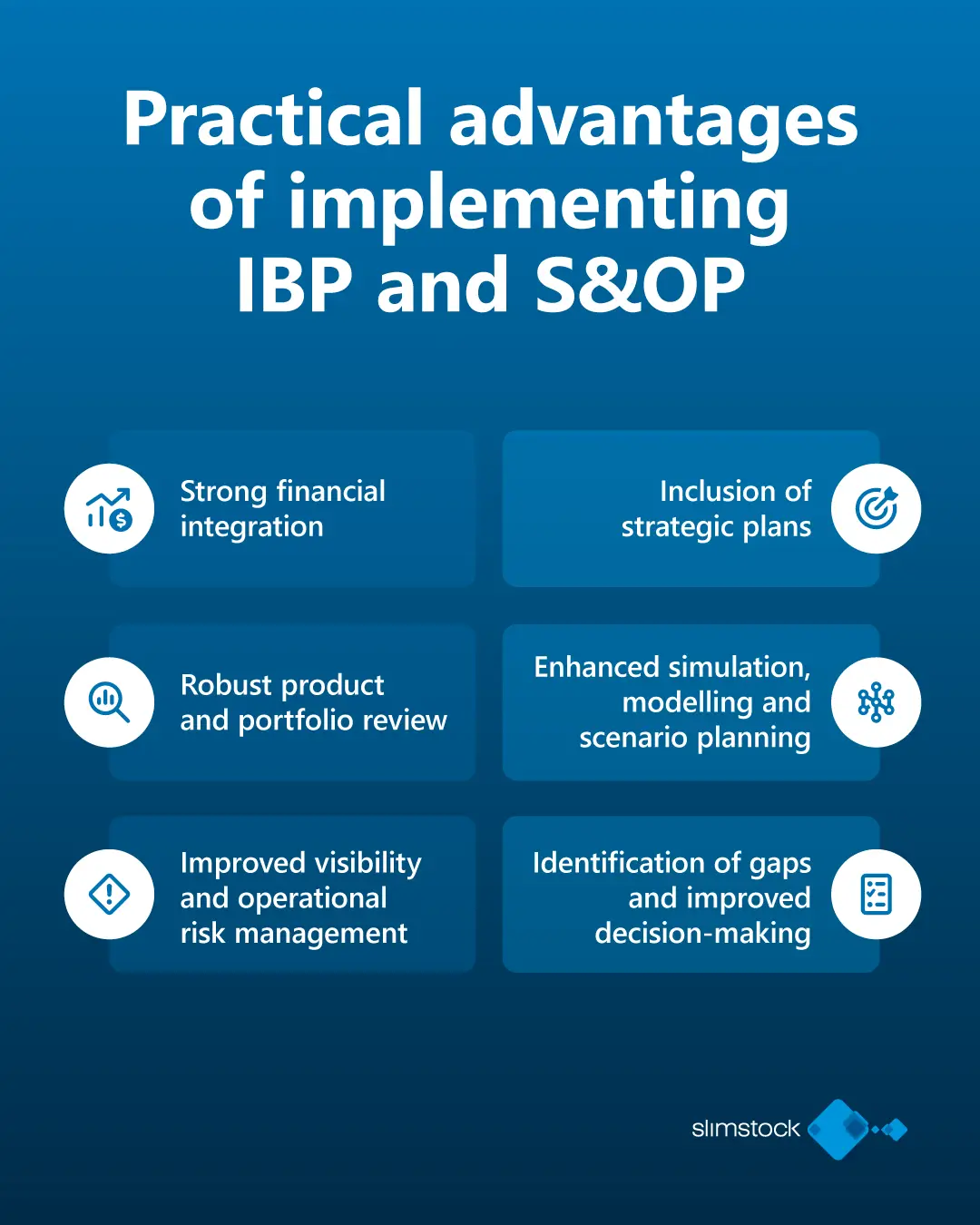
Practical advantages of implementing IBP and S&OP
The implementation of methodologies such as IBP (Integrated Business Process) and S&OP (Sales and Operations Planning) offers a range of practical benefits that positively impact business management. These advantages not only enhance operational efficiency but also contribute to the achievement of long-term strategic objectives.
Strong financial integration
Both IBP and S&OP facilitate robust financial integration by aligning operations with the company’s financial objectives. This enhances decision-making through the use of up-to-date and accurate financial data.
Inclusion of strategic plans
Both methodologies enable the inclusion of strategic plans within the planning process. This ensures that tactical actions remain aligned with the company’s long-term objectives.
Robust product and portfolio review
IBP and S&OP support detailed reviews of products and portfolios, enabling companies to identify and prioritise the most profitable and strategically important offerings.
Enhanced simulation, modelling and scenario planning
Both methodologies provide tools for simulation, modelling and scenario planning.
This enables companies to anticipate change and plan effective responses to fluctuations in demand, shifts in market conditions or other influencing factors.
Improved visibility and operational risk management
IBP and S&OP enhance visibility across the supply chain and operations, facilitating the identification and proactive management of operational risks. This is essential to ensure operational continuity and minimise disruption.
Identification of gaps and improved decision-making
Both methodologies help to identify gaps between planning and execution, leading to more informed and agile decision-making. The ability to close these gaps contributes to more efficient and profitable operations.
Considerations when choosing: IBP, S&OP or both?
When making strategic decisions about implementing business planning methodologies, companies must carefully consider their specific needs and long-term objectives. Below are some key considerations when choosing between IBP and S&OP, or when opting for a combination of both.
Factors to consider
- Business complexity: The complexity of the organisation and its operations can influence the choice. Larger, more diversified companies may derive greater benefit from implementing IBP due to its comprehensive approach.
- Strategic objectives: Alignment with the company’s strategic objectives is essential. If business strategy plays a central role in decision-making, IBP may be the preferred option.
- Available resources: The availability of human and technological resources can influence the decision. Implementing IBP may require greater investment, but it can also deliver significant long-term benefits.
- Implementation history: If the company already has a well-established S&OP process, it may be easier to evolve towards IBP. Assessing previous implementation efforts and organisational adaptability is crucial.
- Flexibility and adaptability: The ability to respond to changes in demand, the market and other external factors is essential. Evaluating the inherent flexibility and adaptability of each methodology is therefore vital.
The choice between IBP and S&OP, or a combination of both, must be strategic and aligned with the company’s vision and objectives. By considering these variables, organisations can make informed decisions that maximise the positive impact on overall business management.