
Table of contents
Table of contents- Finding the best S&OP software in 2026
- Why S&OP software has become a strategic priority
- What is S&OP software?
- Why businesses are investing in S&OP software
- Key capabilities to look for in S&OP software
- Comparing the best S&OP software solutions
- FAQs about S&OP software
The pressure on supply chains has never been greater. Demand patterns shift more rapidly, supply disruptions emerge unexpectedly, and leadership teams are expected to make faster decisions with higher levels of confidence. At the same time, businesses must balance customer service, inventory investment, operational efficiency and profitability, often across multiple functions, locations and planning horizons.
Yet many organisations still rely on fragmented spreadsheets, disconnected systems and departmental planning processes. Sales, operations, procurement and finance each build their own plans, making it difficult to identify risks, evaluate trade-offs and agree on the best course of action. This growing complexity is driving increased investment in Sales & Operations Planning (S&OP) software. By creating a single, collaborative planning environment, modern S&OP solutions help organisations align demand, supply and financial objectives, improving both day-to-day decision-making and long-term business performance.
Why S&OP software has become a strategic priority
Volatile demand, market uncertainty, supply constraints, geopolitical disruptions and increasing pressure on profitability have made effective planning more important than ever.
Most organisations no longer struggle because they lack data. They struggle because they lack alignment.
Sales teams work towards revenue targets. Operations teams focus on service levels and capacity. Procurement is concerned with supplier performance and costs. Finance is measured on margins, cash flow and profitability.
When these functions operate in silos, businesses face predictable consequences:
- Inventory excesses.
- Stock shortages.
- Capacity bottlenecks.
- Poor forecast accuracy.
- Slow decision-making.
- Conflicting priorities.
This is exactly why Sales & Operations Planning (S&OP) has become a central process for modern supply chains.
Rather than creating separate plans for each department, S&OP creates a single, agreed plan that aligns commercial ambitions with operational reality.
As S&OP maturity grows, businesses increasingly turn to specialised software to improve collaboration, automate workflows and support scenario-based decision-making.
In this guide, we compare the leading S&OP software solutions available in 2026 and analyse how Slim4 compares against the market.
What is S&OP software?
Sales & Operations Planning (S&OP) software helps organisations balance demand, supply and financial objectives through a structured planning process.
The objective is simple: create one unified plan that aligns sales, supply chain, operations and finance around the same business goals.
Modern S&OP solutions typically support:
- Demand planning.
- Supply planning.
- Inventory planning.
- Capacity planning.
- Scenario modelling.
- Financial reconciliation.
- Executive reviews.
- Collaboration workflows.
Unlike spreadsheets or disconnected planning tools, advanced S&OP software provides a single source of truth across the organisation.
This enables businesses to make faster, better-informed decisions while improving both operational and financial performance.
Why businesses are investing in S&OP software
As supply chains become more complex, manual planning methods can no longer provide the agility or visibility required.
Businesses implementing modern S&OP software typically aim to:
Improve cross-functional alignment
Ensure sales, supply chain, finance and operations all work from the same assumptions and objectives.
Increase forecast accuracy
Combine statistical forecasting with market intelligence and business knowledge.
Improve service levels
Identify potential gaps between demand and supply before they impact customers.
Reduce inventory costs
Balance stock investment with availability targets through more accurate planning.
Respond faster to disruption
Use scenario planning to evaluate alternative actions before risks become reality.
Accelerate decision-making
Provide executives with clear visibility of trade-offs and business impacts.
Key capabilities to look for in S&OP software
Not every S&OP solution delivers the same level of functionality.
When evaluating providers, organisations should assess several critical capabilities.
Cross-functional collaboration
The best S&OP platforms facilitate structured collaboration between sales, marketing, supply chain, operations, procurement and finance. The goal is not simply data sharing but decision alignment.
Scenario planning
Modern S&OP requires the ability to model demand shifts, supply disruptions, capacity constraints, pricing changes and new product introductions. Strong scenario planning enables proactive rather than reactive decision-making.
Demand and supply synchronisation
A good S&OP platform should continuously monitor the balance between expected demand and available supply. This helps identify shortages, excess inventory and capacity bottlenecks before they impact performance.
Financial integration
Leading solutions increasingly connect operational planning with financial objectives, enabling organisations to assess the profitability and cash-flow impact of planning decisions.
ERP integration
S&OP software should integrate seamlessly with ERP, forecasting and supply chain systems to ensure data consistency and avoid duplicate work.
Comparing the best S&OP software solutions
Below is a high-level comparison of the leading S&OP software providers based on Gartner Peer Insights™ ratings and implementation experiences.
| Software | Ideal for | Key capabilities | Implementation rating | Overall Gartner rating |
|---|---|---|---|---|
| Slim4 | Integrated supply chain planning | Collaboration, user experience, constraint-based planning | 4.6/5 | 4.8 |
| SAP IBP | Enterprise-wide planning | End-to-end planning, constraint-based planning, and ERP integration | 4.2/5 | 4.7 |
| Kinaxis | Complex global supply chains | Concurrent planning, and scenario analysis | 4.1/5 | 4.4 |
| o9 | AI-driven transformation | Digital twin, resource breadth, and a flexible architecture | 4.5/5 | 4.8 |
| Oracle | End-to-end cloud suite | Planning, execution, analytics | 4.3/5 | 4.8 |
| Infor | Industry-specific planning | Mult-enterprise planning | 4.3/5 | 4.5 |
| Anaplan | Connected enterprise planning | Collaborative demand planning | 4.3/5 | 4.5 |
Slim4 (Slimstock)
With an overall rating of 4.8 out of 5, Slim4 ranks among the highest-rated solutions in its category on Gartner Peer InsightsTM.
| Advantages | Lowest scoring attributes | Gartner Peer InsightsTM recommendation rating | Gartner Peer InsightsTM overall rating |
|---|---|---|---|
|
NA (no rating below 4.5/5) | 100% | 4.8/5 |
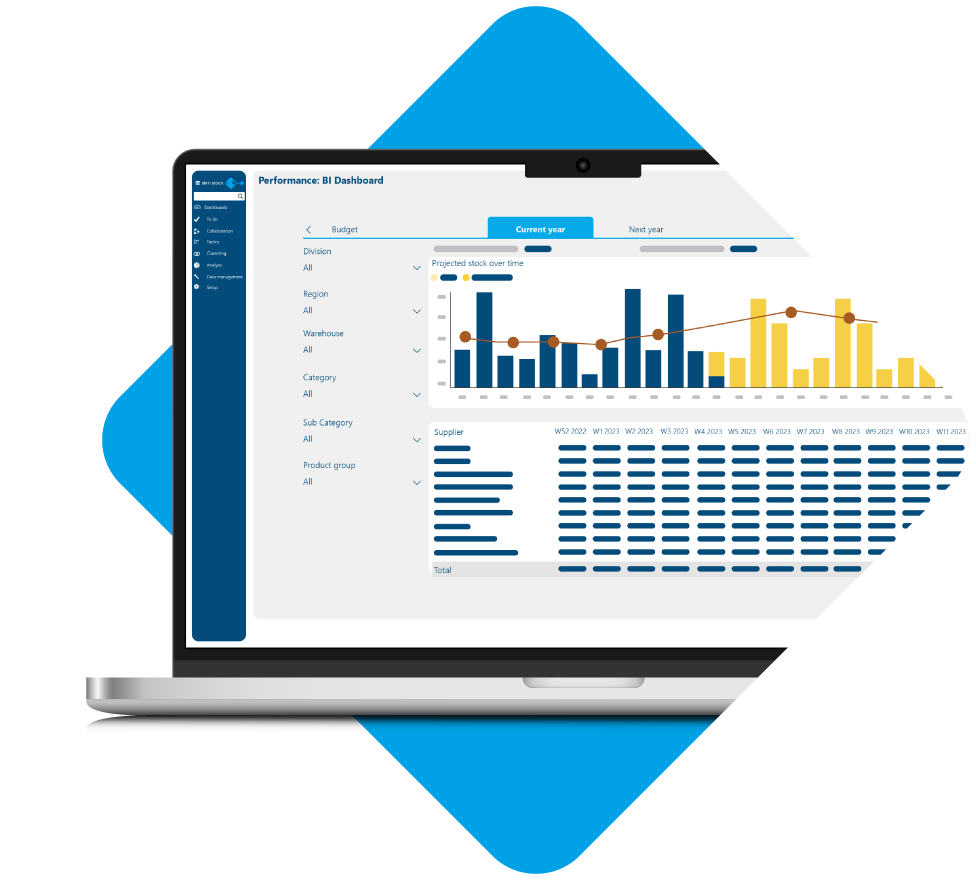
Slim4 is a supply chain planning platform that enables organisations to align demand, supply and inventory decisions through an integrated S&OP process. By centralising planning data and providing a single source of truth, it helps sales, supply chain, operations and finance teams collaborate more effectively and make faster, more informed decisions.
Key capabilities include demand and supply balancing, scenario planning, inventory optimisation, forecast collaboration, exception-based planning and seamless ERP integration. The platform is designed to improve forecast accuracy, reduce excess inventory, increase service levels and strengthen decision-making across planning horizons.
One of Slim4’s key differentiators is its ability to combine advanced planning functionality with ease of use. Organisations benefit from rapid implementation, fast user adoption, strong customer support and measurable results within a relatively short timeframe. Slimstock also complements its technology with planning expertise and consultancy services to help companies increase S&OP maturity and achieve lasting business improvements.
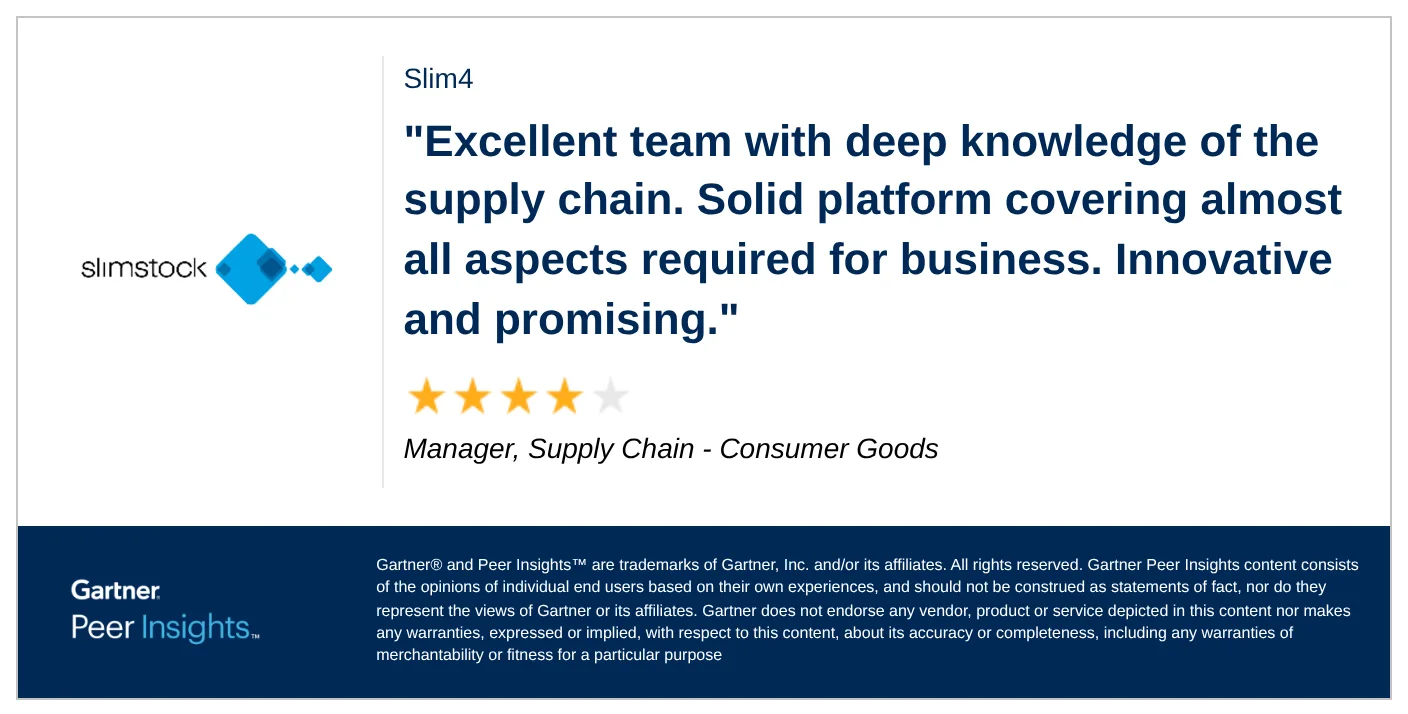
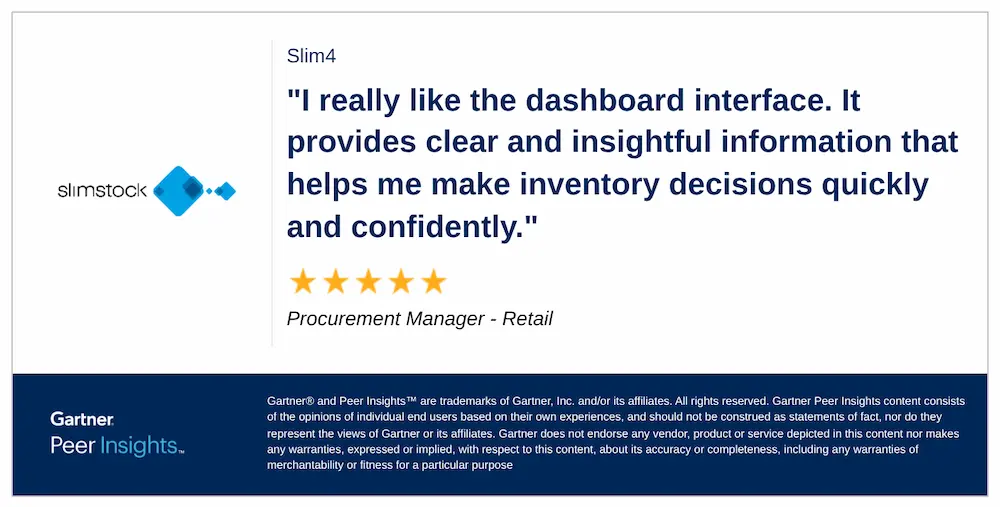
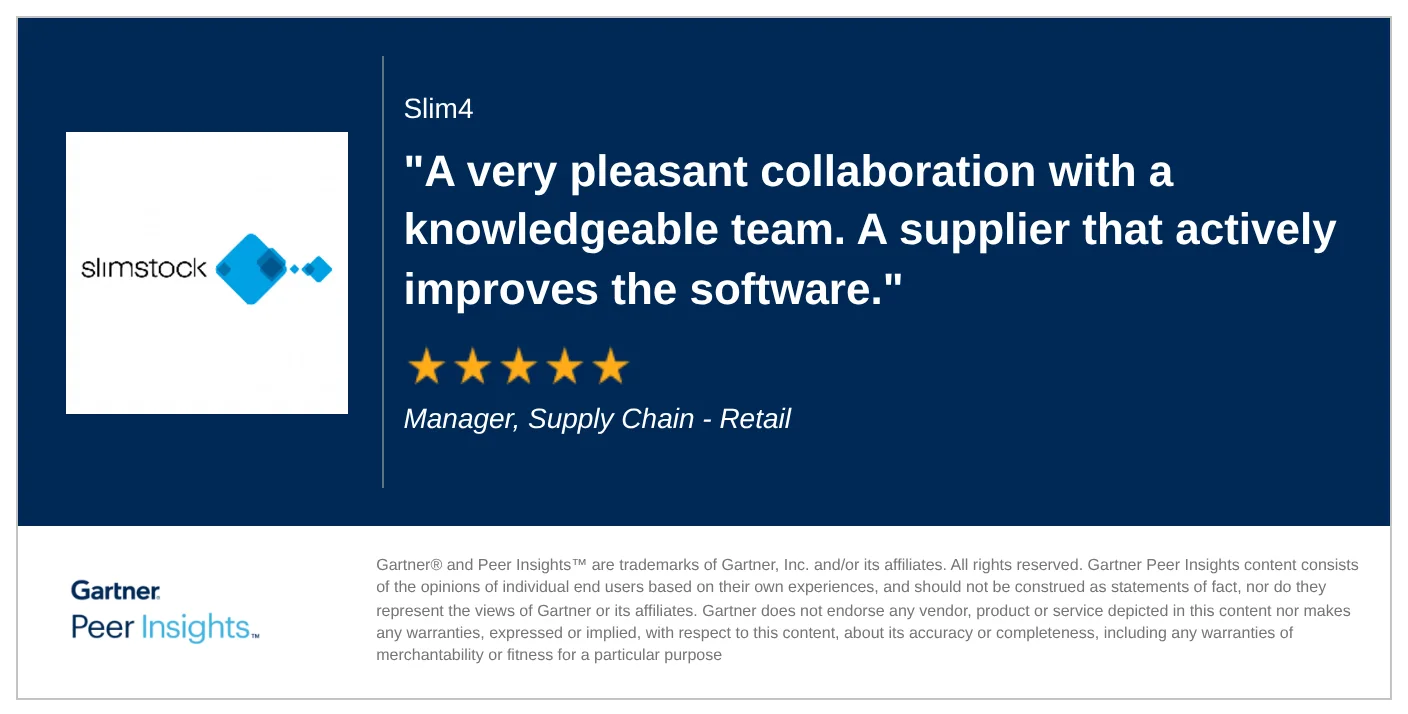
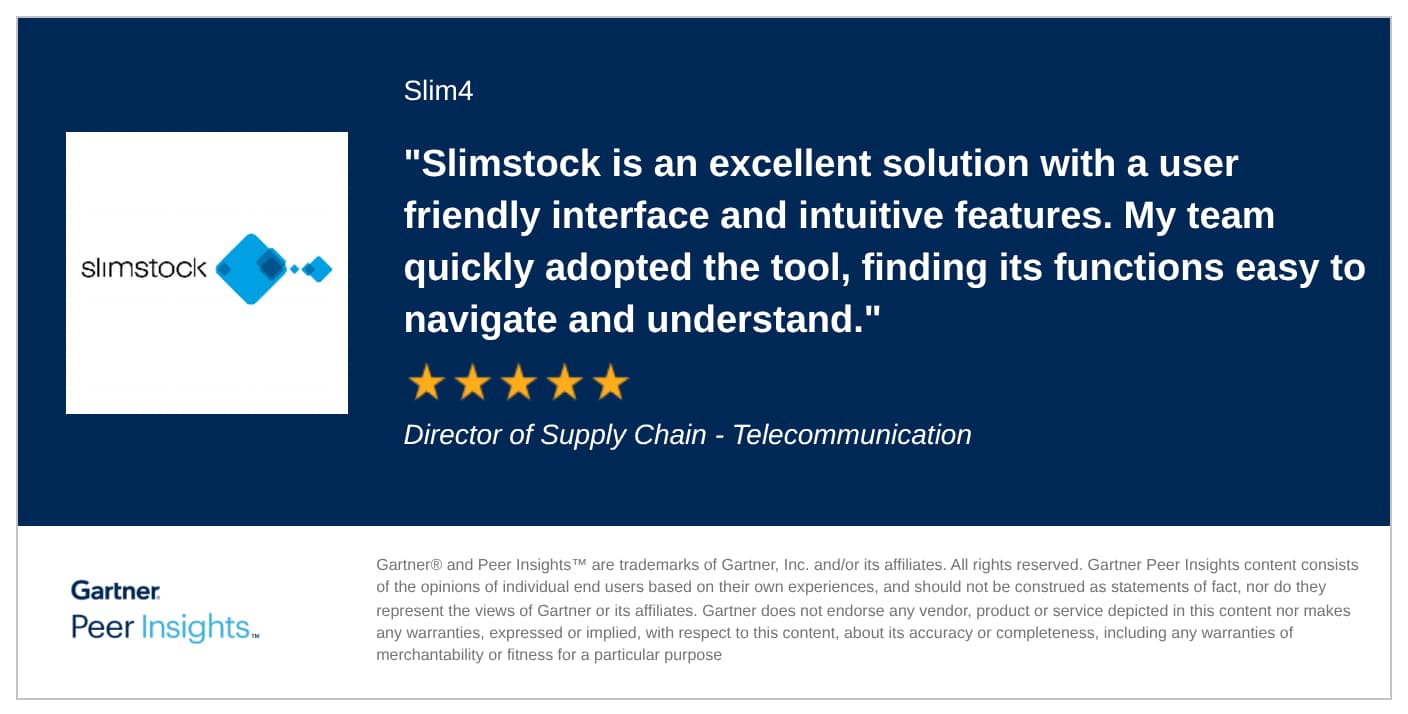
Slim4 has an average rating of 4.8/5 based on verified reviews on Gartner Peer Insights™. within the Supply Chain Planning Solutions category.
User feedback highlights several consistent themes:
Do you need help choosing the right solution?
Our team can help you evaluate different supply chain management software options based on your business needs, your industry context, and your strategic goals.
SAP
SAP Integrated Business Planning (IBP) is a comprehensive solution designed for large enterprises requiring end-to-end supply chain planning integrated with ERP systems. Its capabilities span demand planning, supply planning, inventory optimisation and integrated business planning, making it a common choice for organisations already operating within the SAP ecosystem.
| Advantages | Lowest scoring attributes | Gartner Peer InsightsTM recommendation rating | Gartner Peer InsightsTM overall rating |
|---|---|---|---|
|
|
77% | 4.4/5 |
Kinaxis
Kinaxis provides a concurrent planning platform that helps organisations synchronise planning decisions across demand, supply, inventory and capacity. It is particularly known for supporting rapid scenario analysis and real-time decision-making in complex supply chain environments.
| Advantages | Lowest scoring attributes | Gartner Peer InsightsTM recommendation rating | Gartner Peer InsightsTM overall rating |
|---|---|---|---|
|
|
83% | 4.4/5 |
o9 Solutions
o9 Solutions offers an AI-powered planning platform that combines demand, supply, inventory and business planning within a single environment. Its digital twin approach enables organisations to model scenarios and assess the impact of planning decisions across the value chain.
| Advantages | Lowest scoring attributes | Gartner Peer InsightsTM recommendation rating | Gartner Peer InsightsTM overall rating |
|---|---|---|---|
|
|
93% | 4.8/5 |
Oracle
Oracle Supply Chain Planning is part of Oracle’s broader cloud supply chain suite and supports planning activities across demand, supply, production and inventory. The platform is designed to help organisations connect planning and execution within a unified ecosystem.
| Advantages | Lowest scoring attributes | Gartner Peer InsightsTM recommendation rating | Gartner Peer InsightsTM overall rating |
|---|---|---|---|
|
|
76% | 4.8/5 |
Infor
Infor provides industry-focused planning solutions designed primarily for manufacturers and distributors. Its capabilities support supply chain planning, inventory visibility and alignment across multiple planning horizons and business functions.
| Advantages | Lowest scoring attributes | Gartner Peer InsightsTM recommendation rating | Gartner Peer InsightsTM overall rating |
|---|---|---|---|
|
|
100% (only six reviews) | 4.6/5 |
Anaplan
Anaplan is a connected planning platform that enables collaboration across supply chain, finance and commercial teams. While not exclusively focused on supply chain planning, many organisations use it to support S&OP and broader business planning processes.
| Advantages | Lowest scoring attributes | Gartner Peer InsightsTM recommendation rating | Gartner Peer InsightsTM overall rating |
|---|---|---|---|
|
|
79% | 4.5/5 |
FAQs about S&OP software
What is the difference between S&OP and IBP?
S&OP focuses on aligning demand, supply and operational execution. Integrated Business Planning (IBP) builds on S&OP by incorporating financial planning, strategic objectives and long-term business alignment.
What are the main benefits of S&OP software?
Modern S&OP software helps organisations improve collaboration, increase forecast accuracy, reduce inventory costs, improve service levels, accelerate decision-making and create alignment across departments.
This all comes from a lack of data synchronisation and visibility across businesses that often comprise multiple locations, growing SKU counts, and huge amounts of that data.
How does S&OP software improve decision-making?
By combining demand, supply and financial information within a single platform, decision-makers can evaluate trade-offs, assess risks and respond more quickly to changing market conditions.
Does S&OP software integrate with ERP systems?
Yes. Most modern S&OP solutions are designed to integrate with ERP, CRM and supply chain systems to ensure data consistency and establish a single source of truth for planning activities.
How long does it take to implement S&OP software?
Implementation timelines vary depending on business complexity, integration requirements and project scope. Specialist supply chain planning solutions can often be deployed significantly faster than broader enterprise planning platforms.
What industries benefit most from S&OP software?
S&OP software is widely used across manufacturing, wholesale, distribution, retail, food & beverage, pharmaceuticals and consumer goods sectors. Any organisation seeking to align demand, supply and business objectives can benefit from a structured S&OP process.