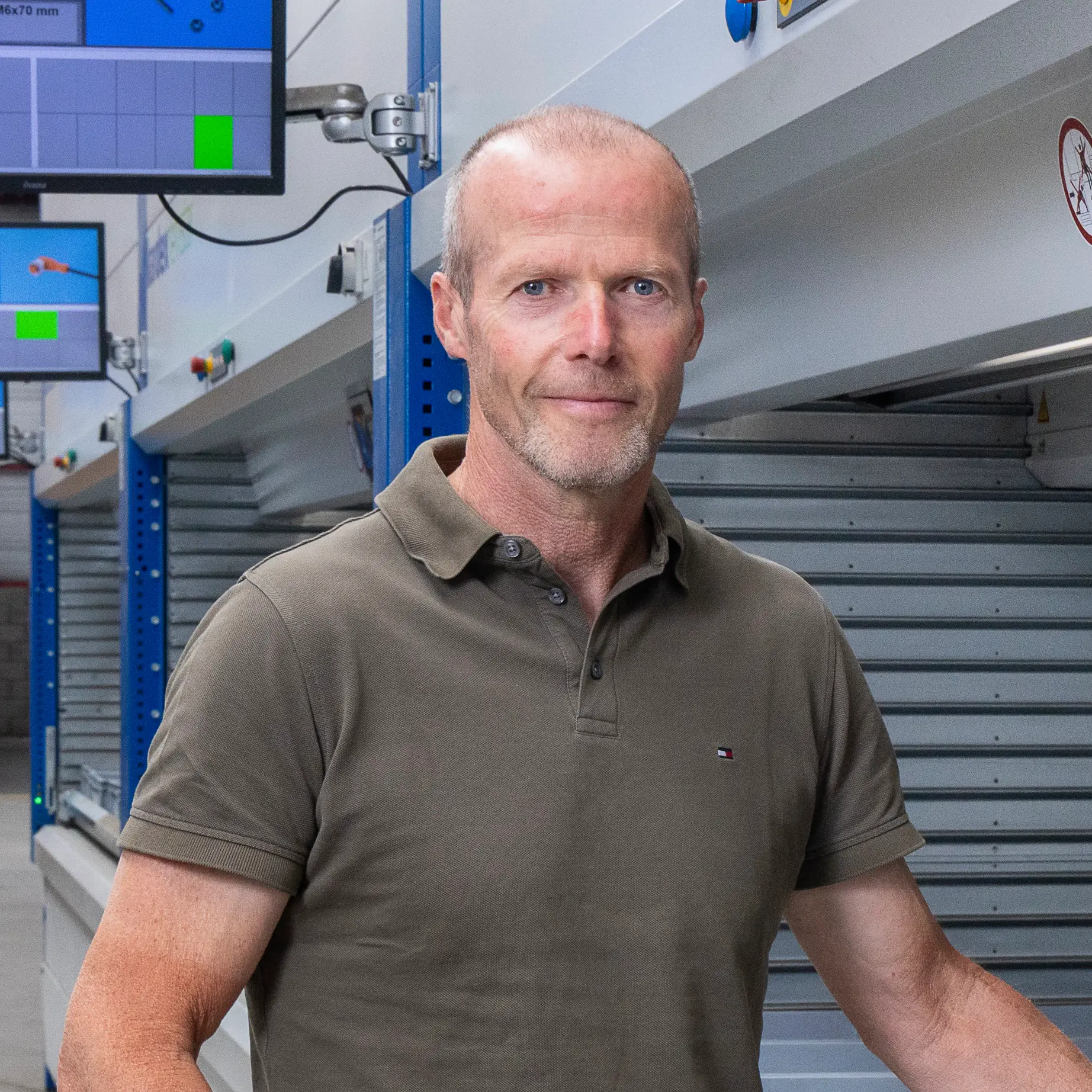
Ronald van der Tang
Operations Director | Royal Brinkman
"If you act in time, there is still a great deal you can do. People now really see the value of S&OP."
Consolidation in horticulture, different customer models and an increasingly dynamic environment presented Royal Brinkman with new supply chain challenges. With Slim4, the international supplier first professionalised its inventory planning. The company now also uses Slimstock’s S&OP software to align demand, supply and business objectives in an integrated way.
Royal Brinkman supplies everything for the modern grower: from fertilisers, crop protection products and biological pest control agents to climate installations, automation and technical services. “In addition to a broad range of around 23,000 items, we distinguish ourselves through knowledge, advice and technical support,” says Operations Director Ronald van der Tang.
As horticulture became more consolidated and international, the company grew significantly, but its supply chain also became increasingly complex. Customers vary greatly in size and in the level of service they require. Large customers need extensive support and tailored solutions, while others mainly order through e-commerce or collect products from one of the branches. The supply chain must support all these service models effectively.
From min/max to exception-based
An important step in this professionalisation was the implementation of Slim4. “Previously, we created our orders in the ERP system using min/max rules,” says Van der Tang. “That was a static way of working that no longer suited our dynamic supply chain. With Slim4, we began working by exception.”
Royal Brinkman was therefore able to manage growing turnover with the same team, while buyers had more time to focus on tactical and strategic matters. Just as important was the move to forecast-driven planning.
“With an ERP system, you look backwards and purchase based on past sales. With Slim4, we started looking ahead instead.”
This forecast-driven approach also changed discussions with suppliers. Royal Brinkman can now anticipate price and demand fluctuations much more effectively, allowing it to reserve production capacity or volumes earlier. Buyers became confident enough to purchase larger volumes and put contracts out to tender. To reduce reliance on individual suppliers, dual sourcing was introduced.
Balancing departmental interests
Forecast-driven working brought Royal Brinkman many benefits, but it did not resolve every issue, including conflicting departmental priorities. Inventory decisions affect not only Purchasing, but also Sales, Logistics and Finance. What is optimal for one department may not be optimal for the company as a whole.
“Departments have their own KPIs, but ultimately it is about serving the customer as well as possible within the company’s capabilities,” says Van der Tang. This created a need for a structured process in which the different functions share information and make decisions together.
S&OP software first, then the process
Van der Tang was tasked by the management team with setting up Sales & Operations Planning (S&OP). He deliberately chose a different sequence from that used by many other companies. Rather than organising the S&OP meetings first and initially working in Excel, he wanted to implement the right software from the outset. “It is difficult enough to get all stakeholders around the table every month. If the data is then missing or incorrect, you can forget it altogether.”
When selecting S&OP software, Slimstock was the natural choice again. Because the forecasts were already created in Slim4, the same data could serve as the basis for S&OP. “This prevents a second version of the truth from emerging in Excel alongside the planning system.”
Division directors see the value of S&OP
The transition to a divisional structure, in which each division within Royal Brinkman was given responsibility for its own profit and loss, gave fresh impetus to S&OP thinking. “Previously, many managers still saw forecasting as something for Operations,” says Van der Tang.
“Now that division directors are responsible for their own turnover, annual forecast and budget, they have a direct interest in making timely adjustments.” If the turnover forecast falls short of target, for example, Sales can try to generate additional orders or win new customers. “If you act in time, there is still a great deal you can do. People now really see the value of S&OP.”
From analysis to decision-making
Demand reviews and supply reviews are now a fixed part of the monthly planning cycle. Together with Slimstock, Van der Tang is working to refine this process further, for example by simplifying preparation and focusing the dashboards even more closely on decision-making. “I want all stakeholders to be able to see on their dashboard, a few days in advance, what is happening: where are the deviations, which actions remain outstanding and what decisions do we need to make? All attention should be focused on making decisions, with as little time as possible spent analysing data.”
Bringing S&OP and financial planning closer together
While the S&OP process is being refined further, Van der Tang is already looking to the next step: integration with financial planning. “As at many companies, our annual budgeting is still relatively separate from operational planning, even though the two should be fully aligned. Turnover forecasts should follow directly from the demand plan, and a large proportion of the expected costs can also be derived from the S&OP plan.” In this way, S&OP at Royal Brinkman is increasingly evolving from a supply chain process into the heart of tactical business management. Slimstock’s software provides the foundation for this.

Related case study