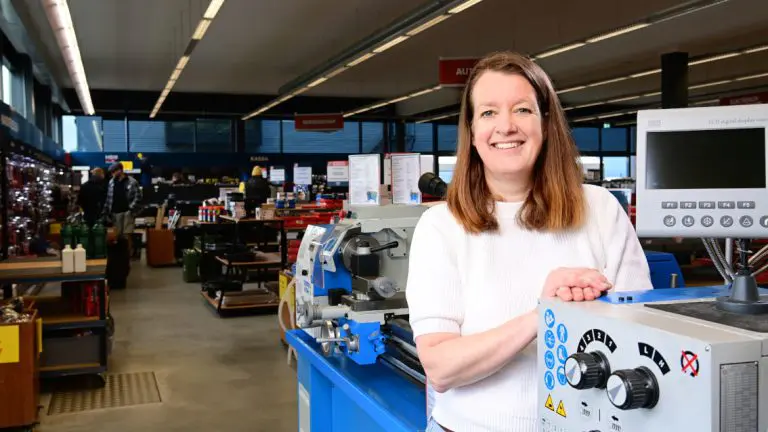

Davy Haers
Supply chain planning manager | Cebeo
"With Slim4, we keep inventory, costs and service optimally balanced, and this helps us make the right decisions. We evaluate trends, interpret seasonal patterns and filter out promotions where necessary."
Over the past 25 years, Cebeo has grown from a small organisation into a leading electrical wholesaler with a portfolio of more than 50,000 products. To provide excellent customer service, the company relies on Slimstock. Cebeo evolved from manual forecasting and reactive inventory management to a data-driven environment with proactive planning. The result? Fewer stockouts, less excess stock and more time for in-depth analysis.
As a leading distributor of electrical equipment and technical solutions for construction professionals, Cebeo differentiates itself through its extensive customer support. The wholesaler, part of the French group Sonepar, employs more than 1,100 people across 54 branches, a distribution centre and five depots.
The company generates €772 million in revenue, serves 60,000 active customers, sells 43% of its assortment online and processes a new order every three seconds. It stocks more than 50,000 products and over 20 million metres of cable in a centralised distribution centre.
To serve customers as effectively as possible, Cebeo opened a brand-new distribution centre in Blandain, The Netherlands, in September 2023. Moving from a fully manual warehouse in Mouscron to a semi-automated facility in Blandain, along with the implementation of a new warehouse management system, highlighted several weaknesses in its previous planning approach.
Planning activities were largely reactive, slow, error-prone and difficult to scale. The company relied on legacy tools and Excel spreadsheets, manual checks and planning based on intuition rather than data. The risk of both stock shortages and excess inventory was significant.
Inventory, costs and service in balance
With Slimstock, Cebeo shifted from reactive planning habits to data-driven planning. According to Davy Haers, high-quality data and forecasting are essential to understand future demand and identify shortages. Exception management, efficiency and scalability are equally important building blocks for maintaining the right stock levels and delivering a higher level of customer service. With 50,000 products in stock, maintaining the right focus is crucial.
Significant increase in service level
The most recent figures show the benefits of this approach. Whereas the service level stood at around 96.5% in 2020, it now regularly reaches and even exceeds 98%. Across an inventory of 50,000 products, an improvement of 1.5 percentage points represents a substantial achievement, meaning thousands more products are available at the right moment. This demonstrates that a data-driven approach not only provides greater control over inventory but also directly contributes to a higher and more reliable level of customer service.
Cebeo began implementing Slimstock’s solution in 2008 and now uses the solution across all its locations. The company uses multiple modules, including:
- ABC classification
- Economic Order Quantity (EOQ)
- Purchase order optimisation
- Machine learning
- Multi-echelon planning
- Service level differentiation
- Inventory policy management
The implementation of Slimstock’s solution transformed the planner’s role into that of an analyst, business partner and data-driven decision-maker. Automated forecasting helps planners make informed decisions, evaluate trends, interpret seasonal patterns and filter out promotions where required. The solution also generates automatic purchase recommendations, removing the need for planners to manually determine what to order, when to order, how much to order and from which supplier.
A different use of time
The process starts by classifying products according to demand categories. Some products rotate daily, while others rotate monthly, determining the appropriate forecasting method. The system then calculates order quantities based on parameters such as safety stock. From there, planners can optimise transport and determine shipment quantities, for example to achieve a full lorry load. Slimstock’s platform works according to exception management and Pareto principles, focusing time and effort on the 20% of products that generate 80% of turnover.
Centre of Excellence
For Cebeo, the benefits are clear. The company has reduced both overstock and stock shortages, significantly reduced manual tasks, improved forecast quality and identified issues more quickly. The role of the planner has shifted from executor to analyst, from buyer to business partner, from firefighter to process coordinator and from Excel user to data-driven decision-maker. Planners now spend more time analysing and proactively engaging suppliers to drive further optimisation.
Through its long-standing partnership with Slimstock, Sonepar has established a shared Centre of Excellence. Slimstock is active in fifteen countries, with additional global roll-outs planned. The partnership enables the sharing of best practices, training programmes, webinars and strategic projects involving supplier integration, network planning and inventory sharing across the network. It also supports the joint development of improvements and new functionality for users.
The importance of change management
According to Haers, successful implementation requires a strong focus on change management. Cebeo invested in multiple initiatives to accelerate adoption, including additional training delivered by Slimstock consultants, internal key users to support colleagues, temporary consultancy support and regular user meetings to discuss questions and share best practices.
The previous way of working was also temporarily retained alongside Slimstock to help build confidence among users. The company found that resistance mainly emerged during periods of high pressure, when employees tended to return to familiar processes. Creating additional time and space for learning helped employees integrate the new tools into their daily work in a sustainable way.
Key results
- Service level increased from approximately 96.5% to over 98%.
- Reduced stock shortages.
- Reduced excess inventory.
- Significant reduction in manual planning tasks.
- Improved forecast quality.
- More time available for analysis and supplier collaboration.
- Transition from reactive planning to proactive, data-driven decision-making.

Related case study