
Table of contents
Table of contents- Optimised supply chain management with S&OP: Four levers for improving service levels
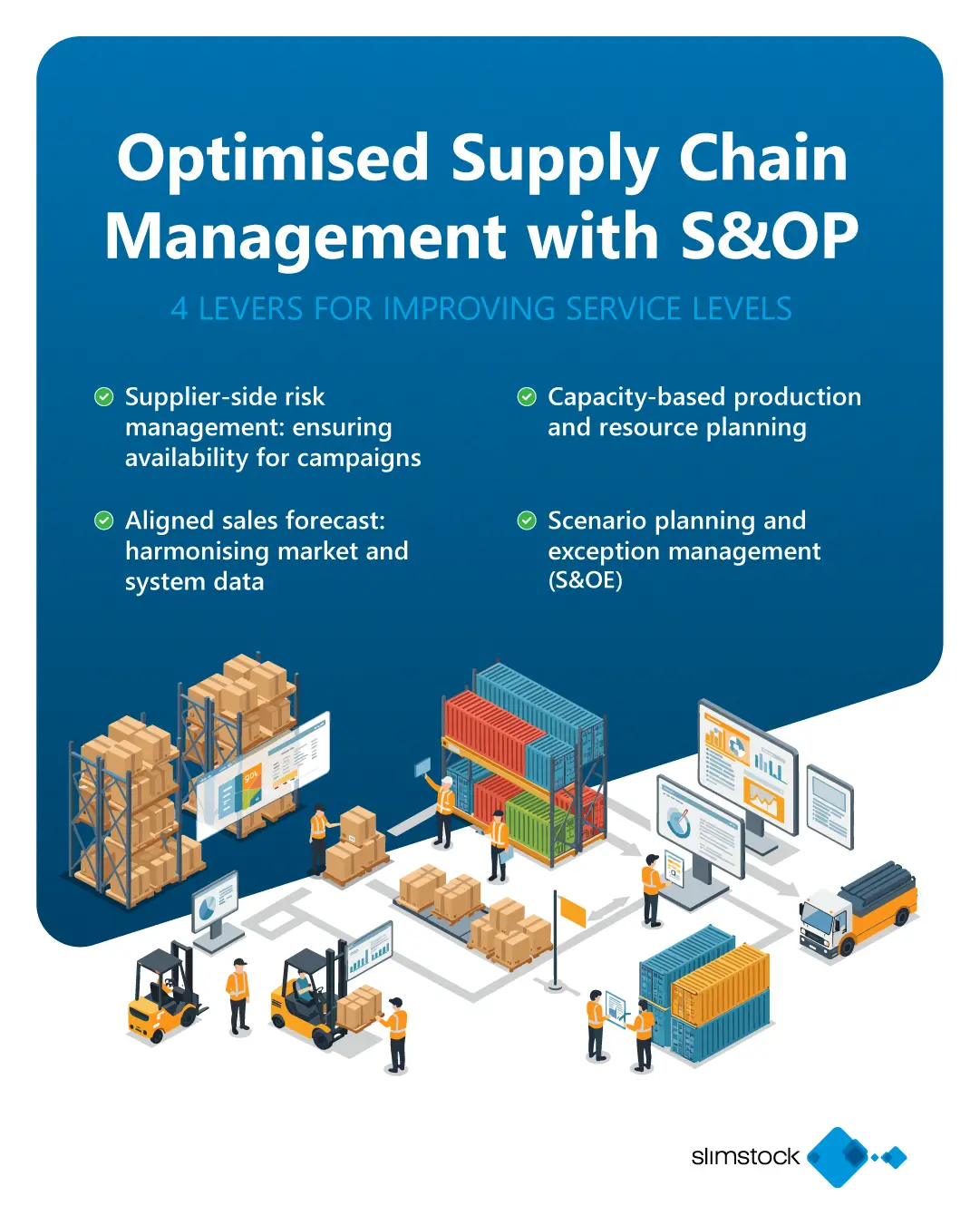
- 1. Aligned sales forecast: harmonising market and system data
- 2. Capacity-based production and resource planning
- 3. Supplier-side risk management: ensuring availability for campaigns
- 4. Scenario planning and exception management (S&OE)
- Conclusion
Overview
A structured, cross-functional Sales & Operations Planning (S&OP) process provides clear direction by bringing together sales, production and procurement planning. It enhances transparency and translates strategic objectives into concrete, executable actions.
Companies are facing increasing uncertainty: fluctuating demand, volatile procurement markets, geopolitical tensions such as the closure of the Strait of Hormuz, and constrained production capacity. These factors place significant pressure on delivery performance and increase the risk of both stock shortages and surpluses. At the same time, customers expect consistently high service levels and reliable on-time delivery.
One thing is clear: a structured S&OP process provides direction. This cross-functional approach aligns sales, production and procurement planning, improves transparency, and translates strategic goals into coordinated action. But which factors are most important when aligning supply chain management specifically to improve service levels?
Slimstock identifies four key levers that show how companies can build more resilient supply chains and achieve measurable improvements through digitally enabled S&OP.
1. Aligned sales forecast: harmonising market and system data
A cornerstone of effective S&OP is a consolidated sales forecast. Sales and marketing contribute market and customer insights, campaign plans and qualitative signals that are not visible in system data alone. Operations provide capacity and inventory data, while finance evaluates the impact on costs and margins.
By involving all relevant departments in reviewing assumptions, consolidating inputs and jointly owning the consensus forecast, organisations can significantly reduce the gap between forecast and reality. When market and customer insights are linked early with operational capacity data, inventory variances and backorders can be reduced. Service levels remain stable—even with lower safety stock.
An AI-powered platform such as Slim4 consolidates forecast data from multiple sources, automatically assesses forecast quality and highlights where manual adjustments add value. This continuously improves forecast accuracy and lays the foundation for coordinated planning across sales, marketing, operations and finance.
2. Capacity-based production and resource planning
S&OP connects sales planning with actual available capacity. Bottlenecks typically arise when sales targets, product mix and production or procurement capabilities are not properly aligned.
A structured monthly cycle, from data collection through to management review, enables systematic scenario planning and proactive resource allocation. Companies that make targeted use of scenario simulations can significantly reduce deviations between forecast and actual demand by up to 20%, according to Gartner. In terms of service levels, this translates into greater delivery reliability and more stable lead times.
The Slim4 solution, for example, simulates increases or decreases in demand and shows the impact on capacity, inventory and service levels—providing a sound basis for timely resource adjustments.
3. Supplier-side risk management: ensuring availability for campaigns
Delays, quality issues and geopolitical factors are among the most significant sources of supply chain uncertainty. An S&OP process that closely integrates procurement with sales and marketing planning improves visibility of lead times, capacity constraints and risks, and helps ensure that marketing campaigns do not result in empty shelves.
Through cross-functional collaboration, including regular procurement participation in S&OP meetings, bottlenecks can be identified early. Alternatives, such as diversifying critical suppliers, can be evaluated and binding commitments coordinated across the supply chain.
Companies that maintain reliable forecast data and clear commitments typically experience fewer stockouts and less excess inventory, while service levels improve as materials are available at the start of campaigns.
To support this, the Slimstock platform continuously monitors supplier performance, including delivery reliability, as well as stock coverage. AI-driven analytics identify patterns in delays and recommend actions such as earlier ordering or alternative sourcing, enabling procurement risks to be managed in a data-driven way.
4. Scenario planning and exception management (S&OE)
Short-term disruptions, from demand spikes to industrial action, cannot be eliminated. The key is to anticipate them as far as possible within the S&OP cycle and respond quickly through S&OE processes.
Sales and marketing teams collaborate on ‘what-if’ scenarios: what happens if a campaign outperforms expectations, or a competitor launches earlier than planned? Companies that regularly simulate scenarios recover from disruptions significantly faster. According to Deloitte, up to 80% faster than those without such structured processes.
Slim4 supports this with automated exception management, highlighting deviations at an early stage. The platform prioritises issues based on their impact on service levels and provides recommended actions. This enables bottlenecks to be escalated promptly and backlogs to be avoided.
Conclusion
S&OP is not a back-office planning process, but a company-wide decision-making and coordination framework. Sales and marketing provide the ‘voice of the customer’, working closely with supply chain teams to balance service levels, inventory and cost.
Importantly, S&OP is not a one-off initiative but an ongoing journey. Success depends on management commitment, data quality and a realistic assessment of organisational maturity. Only when these foundations are in place can S&OP deliver its full value, particularly when combined with robust S&OE processes.
Digital platforms such as Slim4 integrate demand, sales and financial planning using advanced AI, making the process more transparent, manageable and controllable. They consolidate data into a single version of the truth, generate and evaluate forecasts, automate scenario planning and provide visibility of risk.
According to McKinsey, 72% of companies have increased transparency and reduced operational risk by applying AI within S&OP processes. Organisations that digitise S&OP therefore not only improve process execution, but also achieve tangible outcomes: more stable service levels, reduced inventory and higher customer satisfaction.