
Table of contents
Table of contents- Oil, shocks and shortages: Overcoming supply chain risk in 2026
- Persistent and increasing disruption
- How oil prices impact your supply chain
- Where your supply chain’s most exposed
- The secondary effects leaders often miss
- Key operational strategies to beat the volatility
- Additional strategies to consider
- Design resilience into your supply chain
Overview
Supply chain resilience is critical in 2026 due to the ongoing and increasing disruption caused by factors such as the closure of the Strait of Hormuz and oil price volatility. This document examines the impact of oil prices on logistics and material costs and outlines strategies to mitigate risks and improve responsiveness.
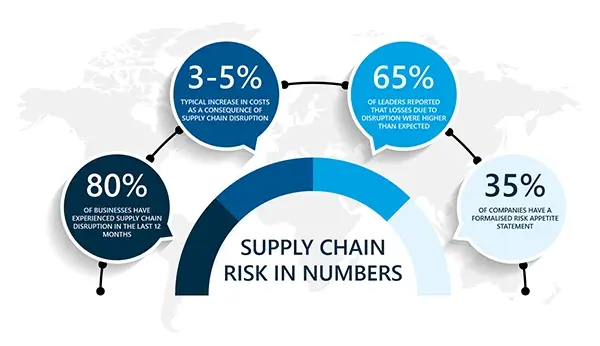
In an era of persistent disruption, supply chain resilience is more important than ever. If you work in supply chain in 2026, you’ll have one eye on the news at all times.
Tariffs. Route closures. Market shocks. The next disruption is hard to predict, but disruption itself is certain and can quickly destabilise unprepared supply chains.
How prepared is your supply chain?
Persistent and increasing disruption
If you’re not battling disruption right now, there’s likely one around the corner.
In the weeks after the Strait of Hormuz closure, the world lost nearly 500 million barrels of oil supply, worth almost $50 billion. Traffic through one of the world’s busiest oil routes stopped, reopened, then closed again.
Oil prices spiked, freight costs soared, and the disruption may continue for some time. Some expect years before normal service resumes, and many supply chains have already come unstuck.
Of course, oil price fluctuation isn’t a new problem.
Whether you’re a manufacturer, retailer, logistics provider or wholesaler, you’ve likely dealt with sudden rises and falls in shipping costs caused by oil price changes.
Absorbing these prices comes down to your ability to forecast effectively and manage supply and demand in an ever-changing economy.
According to a Gartner survey of 258 sourcing and procurement leaders, supply disruption is now the single biggest risk to procurement success.
It ranks as a higher risk than macroeconomic factors, regulatory change, and cyber threats.
When disruption is this persistent, sticking with the status quo is not a credible plan.
Speaking to concerns about supply disruptions, Gartner’s Senior Director Analyst Andrea Greenwald said “reactive measures businesses have employed over the past four years will simply not be sufficient for the next four.”
How oil prices impact your supply chain
Oil will probably underpin almost every cost in your supply chain, at every single stage.
Transport is the clearest example, because fuel moves goods, raw materials and finished products. If all three touch your supply chain, rising oil prices hit you in three ways.
The problem is that oil price rises often happen faster than you can recalculate margins or renegotiate supplier and customer pricing.
The impact on working capital can be severe, especially where customer orders are backlogged or supply is delayed.
Unfortunately, the impact probably won’t stop there.
Packaging, plastics, chemicals and other synthetic materials are oil derivatives, so when oil prices rise, their costs usually rise too.
Electricity prices can also track oil and gas prices, raising costs across the business, even for companies that run purely on electricity.
As Slimstock’s recent article covering the Strait of Hormuz crisis showed, energy-intensive sectors such as chemicals, metals, and plastics can be particularly exposed to oil price fluctuation.
But it’s rarely restricted to just these industries.
Where your supply chain’s most exposed
Understanding where you’re most exposed to the risk as a business is the first step in controlling it.
Transportation and logistics are the most obvious risks.
If you rely on freight or long-haul transport, higher fuel costs can quickly erode margins. Air freight is already expensive and becomes even more so when oil prices spike.
Businesses that source components or finished goods from areas impacted by conflict are also exposed to the geopolitical risk of the route itself.
The Strait of Hormuz for example is the path for nearly 20% of global oil transit.
When it is disrupted, shipping takes longer, capacity falls, and equipment and material imbalances spread through connected ports.
Just-in-time operations that go through such routes are particularly at risk.
Lean inventory models work well in stable conditions but leave little buffer when disruption hits.
Even short delays can trigger stockouts, missed deliveries, brand damage and costly emergency replenishment.
Manufacturers can face higher input and operating costs at the same time. In sectors such as chemicals, food processing and heavy industry, oil price spikes can quickly erode production value.
Also underestimated is the exposure created by force majeure clauses.
With disruptions becoming more frequent, more suppliers, logistics providers and commodity traders are invoking force majeure to protect themselves.
While that may settle initial problems, it also sets off renegotiations down the line of supply and failures in delivery that exist long after the original crisis.
The secondary effects leaders often miss
Oil price spikes make headlines, but the secondary effects often cause the greatest damage.
And these sometimes get missed until they show up in spreadsheets later down the line.
The rise in inflation
When energy costs rise, so does almost everything else in the economy.
Suppliers raise prices, carriers add surcharges and packaging costs climb. When all of this happens at once, it becomes much harder to manage.
Demand signal distortion
And it’s possibly one of the most damaging.
When inflation hits and consumer confidence falls, demand behaviour changes. Sometimes in ways that don’t show up in historical data.
Customers may delay purchases, switch suppliers or products, and reduce basket sizes. Sales data shows what happened, but not what it means for next month or quarter.
If forecasting relies on historical patterns that no longer reflect the market, businesses can easily overstock or come up short when demand recovers.
The bullwhip effect
Oil price disruption can trigger the bullwhip effect, where customers order more than they actually need because they do not trust the next link in the chain to supply reliably.
What begins as a small shift in buying behaviour can quickly become amplified upstream, as each tier reacts to perceived risk rather than actual demand.
These behaviours amplify volatility and can leave working capital tied up in inventory that is no longer needed.
Financing costs
When disruption drives up the cost of borrowing, the impact on working capital can be severe. It becomes more expensive to fund inventory, absorb delays and bridge gaps in cash flow, putting immediate pressure on margins and flexibility.
This is where the disconnect between finance and operations becomes especially costly, because teams may need to make fast decisions on stock, sourcing or supply while the financial impact continues to build in the background.
Research from Slimstock and Vena highlights a persistent challenge in that the financial impact of supply disruptions is often only realised weeks after the operational response.
Key operational strategies to beat the volatility
There is no simple way to avoid oil price disruption, but practical steps can reduce exposure and improve response. The priority is to improve visibility, accelerate decision-making and build flexibility into planning before volatility hits.
1. Use scenario planning and cost triggers as standard tools
Without them, disruption leads to rushed decisions, conflicting priorities and reactive trade-offs between service, stock and cost.
Cost triggers such as oil price rises, freight surcharges or supplier cost increases should prompt a review of forecasts, stock policies and sourcing plans before margin pressure becomes harder to control.
Slim4 supports what-if analysis and improves forecast visibility, helping planners test trade-offs and understand the stock, service and working capital impact of different decisions before acting.
2. Use dynamic safety stock policies
Static buffers fail in volatile markets because they are set for yesterday’s conditions. Slimstock’s inventory management software dynamically recalculates stock parameters in line with changing demand, lead times, service targets and wider operating conditions, helping planners balance availability, risk and working capital more accurately.
3. Leverage AI to accelerate response times
According to Gartner, supply chain disruptions will increasingly be resolved without human intervention as agentic AI matures. The faster you can detect, analyse and act on disruption, the less damage it will cause.
AI is becoming increasingly critical to making that possible by helping teams identify risks earlier, assess implications faster and respond with greater speed and confidence.
Slimstock’s promises to its customers include “designing software you’ll love” and “providing you with the latest innovations”. As such, users can expect an increasingly AI-enabled platform that is backed by a strategic supply chain partner focused on making innovation practical and valuable, not just a solution vendor delivering features for their own sake.
4. Review your supplier geography
Gartner’s Future of Supply Chain 2025 report identifies regionalisation as a key competitive characteristic. Businesses that have not reviewed supplier geography often see stretched lead times, shortages, higher transport costs and pressure to hold extra stock.
Slimstock’s supply chain planning software helps planners model the inventory impact of longer or less reliable lead times and assess how sourcing changes affect service levels and working capital.
5. Work with a strategic supply chain partner, not just a software vendor
Tools alone are not enough. Businesses that rely on homebrew workflows or user-managed systems are often left to configure, maintain and adapt everything themselves, which slows decisions and creates inconsistency when disruption hits.
The value of a strategic partner is not just the software itself, but the expertise, guidance and accountability that help teams respond with more confidence and less guesswork.
Slimstock’s long-term customer approach and 8 Promises reflect that broader commitment to continuous improvement, knowledge sharing and measurable results. If you want to strengthen resilience before the next disruption hits, now is the time to review your planning processes, stock policies, supplier strategy and the support structure around your planning team.
Additional strategies to consider
6. Diversify supplier and transport options
Businesses that rely too heavily on a narrow supplier base or a small number of transport routes are more exposed to delays, shortages and sudden cost increases when disruption hits.
A broader mix of suppliers and routes improves resilience by giving teams more room to respond. Where those changes affect stockholding, lead times or service risk, planning tools such as Slim4 can help teams understand the operational implications.
7. Instil reactive supplier escalation measures
When businesses do not have clear escalation measures in place, disruption often leads to confusion, delays and inconsistent decisions across procurement, operations and suppliers.
Pre-agreed alternatives, response rules and stronger supplier relationships help teams react faster and with less uncertainty when conditions change.
Discover how the Slimstock platform improves supply chain resillience, helping organisations navigate increasingly frequent disruptive events.
Design resilience into your supply chain
Disruption is no longer episodic. It’s structural.
As analysis from The Conversation noted about the Strait of Hormuz crisis, the challenge ahead in supply chain is to redesign for a world in which geopolitical risk is structural.
And this means reassessing several parts of your supply chain.
Supply chains built purely for efficiency are increasingly exposed when routes close, costs spike or demand shifts faster than historical data can explain. The question is no longer if disruption will happen, but how prepared you are when it does.
You cannot predict the next disruption. But you can build a supply chain that reads signals early, adapts quickly and responds with confidence.
If strengthening resilience is a priority, now is the time to explore how Slimstock and Slim4 can help your organisation move from reactive firefighting to proactive, data-driven decision-making. Book a demo or explore our supply chain planning solutions.