
Table of contents
Table of contents- The Potential of LLMs and Foundation Models in the Supply Chain
- What are Large Language Models (LLMs)?
- Benefits of AI applied to the supply chain
- Risks of applying AI to the supply chain
- The impact of LLMs on the supply chain team
- Conclusion: When planning is understood, it begins to generate real value
Overview
This article explores how these foundational AI technologies can be applied within the supply chain, from simplifying access to complex planning platforms to supporting forecasting and scenario analysis. It also examines the benefits, risks, and practical role of LLMs as an intelligent interface that helps supply chain teams better understand data, explore decisions and improve day-to-day planning.
Writing and adapting texts, helping to summarise information, and generating new approaches and innovative ideas—professionally speaking, these are the three most common requests users make to ChatGPT. The source is quite reliable: OpenAI’s own platform.
Beyond these “generalist” tasks, any of us has probably used these prompts at some point in our work, the truth is that ChatGPT and other similar systems can also be applied to more specific tasks. The supply chain is obviously no exception. In this article, we will review the applications of foundational AI systems, including Large Language Models (LLMs) such as ChatGPT, in the supply chain.
What are Large Language Models (LLMs)?
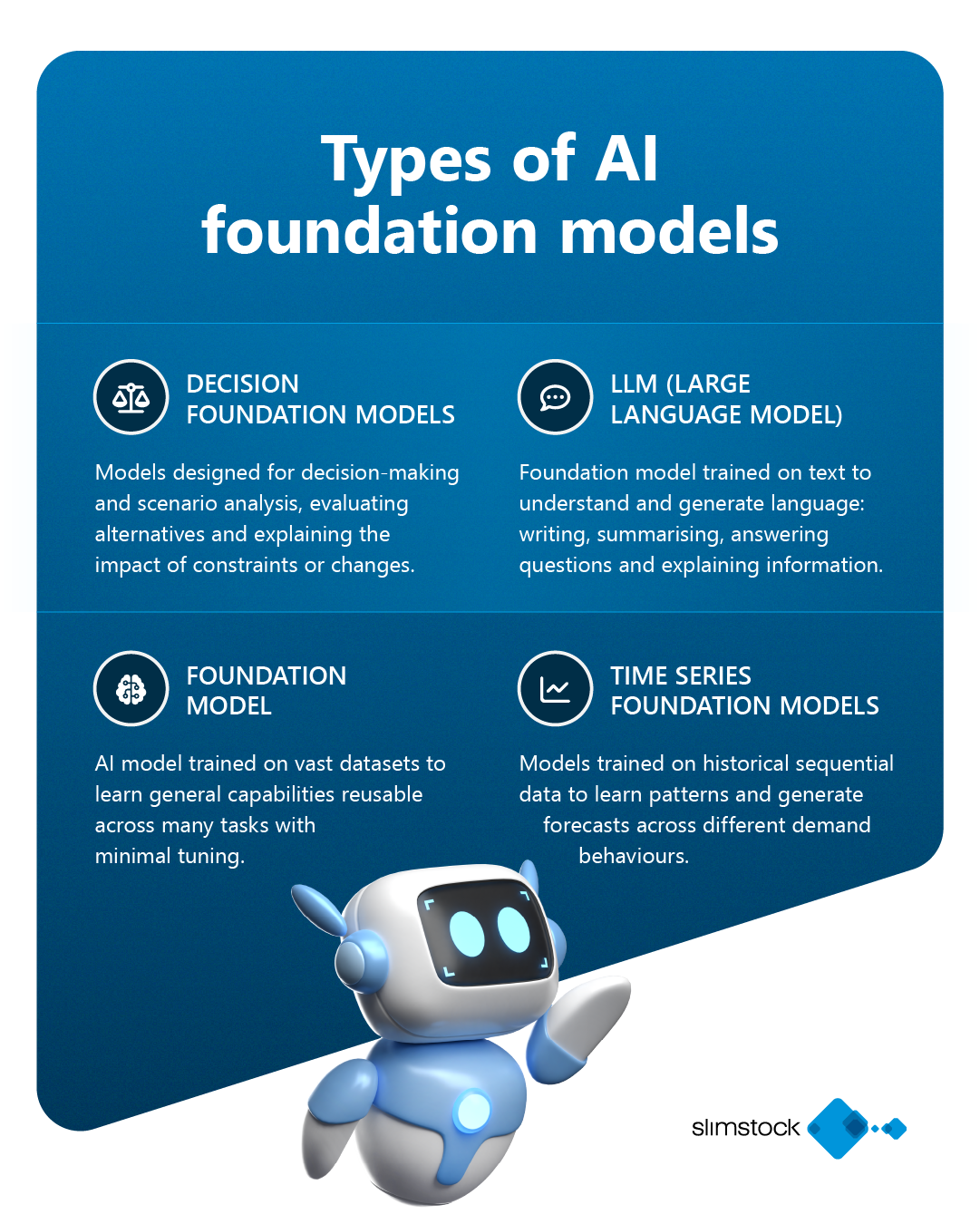
Large Language Models (LLMs) are a specific type of foundational AI model. Trained with massive volumes of textual data, their goal is not to solve a single, specific task, but to learn a general understanding of language that can be reused in multiple contexts.
Thanks to this training, LLMs are capable of writing texts, summarising information, answering complex questions, reasoning from unstructured data and translating technical concepts into more accessible language. Tools such as ChatGPT are a clear example of this approach: a single model that can perform very different tasks without needing to be retrained for each one.
Benefits of AI applied to the supply chain
An LLM is particularly adept at one thing: working with language. In the supply chain, this has enormous potential when connected to existing systems (ERP, WMS, TMS, data warehouses, etc.).
The potential of LLMs in the supply chain is not simply to ask it to “optimise”, a task for which, at least for now, it is not efficient or reliable enough, but to help people interact better with existing planning systems, understand their results, and make faster and more informed decisions.
Let’s look at some of the main benefits.
Simplifying the use of complex advanced platforms
Advanced planning has been shown to reduce costs, improve service levels and contain inventory. The problem is that, on a day-to-day basis, the value of an optimisation system depends not only on finding the best solution, but also on that solution being understandable and generating confidence.
In many companies, this is where the gap appears. The optimisation platform calculates, but the teams that operate it are distrustful. This can lead to questions that take hours or days to resolve, dependence on technical profiles for relatively simple queries and a persistent feeling of: “I don’t know why the system has decided this.”
In this context, LLMs are beginning to play a very specific and useful role: becoming a layer of interaction and translation between people and planning systems, especially when there are complex decisions behind them (constraints, dependencies, scenarios, priorities, etc.).
In supply chain, there are questions that are constantly repeated:
- “Why have we served this demand from this supplier (and not from another)?”
- “What happens if demand in this area increases by 10%?”
- “Can we limit the number of suppliers for quality or risk reasons?”
- “What impact would blocking this transport lane have?”
- “Which SKU is generating the most breakages and why?”
These common questions seek clear answers, but answering them often involves reviewing parameters, consulting tables, performing calculations, simulating scenarios… And in many organisations, this means opening a ticket, waiting for an analyst, consulting a technician, re-running… ultimately losing a lot of agility when it comes to making decisions.
This is where LLMs become very useful tools, not as substitutes for the mathematical engine, but as an intelligent interface for accessing, explaining, and exploring its results.
Time series forecasting
Artificial intelligence is also beginning to be applied to time series forecasting, although in this case, technically we are not referring to LLMs but rather to what are known as Time Series Foundation Models. By training on large volumes of historical data, they can learn common patterns and quickly generate forecasts for a wide variety of behaviours, from intermittent demand to seasonal patterns or one-off events.
In this context, it is possible to imagine a scenario in which the user provides time series along with contextual information to the platform, and the system returns a forecast accompanied by explanations, performance metrics, and recommendations on how to improve it. With this type of model, a high-quality forecasting process could be achieved with minimal effort and without the need for in-depth technical knowledge.
Decision-making and responding to ‘what-if’ scenarios
Again, we are not strictly referring to LLMs but, in this case, to Decision Foundation Models. This type of AI can go beyond time series prediction and also be applied to decision-making problems. Thanks to this prior training, the model can address different types of decisions with minimal adjustment.
In this context, when the user asks a ‘what-if’ question, the LLM interprets the intention (e.g., “block this supplier” or “limit this plant”) and launches the scenario. It then compares the result with the current plan and explains it.
The main benefit is that there is no need to get into advanced mathematics: for business, the answer is usually “increase/decrease cost,” “service is compromised,” “a risk appears,” “the load is shifted,” or “there is no feasible solution.”
Making existing (but scattered) information accessible
Part of the problem is that supply chain data lives in silos: tables, reports, dashboards, different tools, different nomenclatures… and questions often require cross-referencing multiple sources. An LLM can act as a query “orchestrator”: not because it “knows” the data, but because it can request it from the right systems and compose a coherent response.
Risks of applying AI to the supply chain
If you apply LLMs to your supply chain operations, there are two inevitable concerns:
Privacy and sensitive data
The most sensible approach is not to dump the data into the model. Instead, the LLM acts as a layer of reasoning and language, while the data and calculations remain within your environment (databases, solvers, internal systems).
“Hallucinations” and plausible-sounding answers
In supply chain, an incorrect answer is not an anecdotal failure: it can cost money, service, and/or brand reputation.
Therefore, the most recommended modus operandi is not “ask the LLM and trust,” but rather:
- The LLM proposes the action (query, scenario, restriction).
- The system validates it (rules, permissions, checks).
- The supply chain management platform calculates it.
- The LLM explains the result.
The impact of LLMs on the supply chain team
In terms of operational impact, a well-designed “LLM as planning co-pilot” approach usually translates into:
- More autonomy for the planner to explore scenarios without relying on engineering or analytics.
- Less internal friction: less back-and-forth to explain “why.”
- Faster decisions when there are changes (demand, capacity, suppliers, transport).
- Better adoption of the planning system: if it is understood, it is used; if it is used, it generates value.
Conclusion: When planning is understood, it begins to generate real value
In the supply chain, one of the main challenges, beyond calculating the answer to a problem, is turning that answer into a decision that the business understands, trusts, and executes.
From this perspective, the value of LLMs is not in “making the plan” or replacing supply chain optimisation platforms, but in bringing advanced planning closer to the people who make decisions every day. By acting as a layer of interpretation and dialogue, they allow scenarios to be explored, the reasons behind each proposal to be understood, and friction between complex models and operational reality to be reduced.
If the next level of maturity in the supply chain involves closing the gap between what the system calculates and what the business needs to decide, LLMs—responsibly integrated and connected to robust planning tools—are emerging as a key enabler to achieve this.