

Table of contents
Table of contents- Distribution Requirements Planning (DRP): What is it and how does it work?
- What is distribution requirements planning (DRP)?
- How does DRP work in practice?
- How does DRP calculate inventory and replenishment needs?
- Practical Example of DRP in a Distribution Network
- What data is needed for the DRP?
- What are the benefits of DRP for inventory management?
- DRP vs. MRP: What’s the difference?
- DRP, demand planning, and replenishment: what’s the difference?
- What are the main challenges of DRP?
- When should a company use DRP?
- How can technology make DRP more efficient?
- How to integrate DRP into supply chain planning?
- FAQs about DRP
Overview
Distribution Requirements Planning (DRP) helps businesses manage inventory across complex distribution networks by determining what products need replenishing, where they are needed, when they should be restocked, and in what quantities. This article explores how DRP works, the data it relies on, its benefits for inventory management, and how technology can help companies balance stock, improve service levels, and coordinate replenishment decisions across multiple locations.
The more points there are in a distribution chain, the harder it becomes to ensure the right inventory is in the right place at the right time.
Companies with distribution centers (DCs), branches, stores or regional warehouses need to decide how much inventory to keep, but not only that: where to place it and when to move it. And since these decisions become more difficult as the network grows more complex, this can lead to excess inventory in one part of the network and shortages in another.
That’s where DRP comes in: a structured approach to determining what, how much, where, and when to restock.

What is distribution requirements planning (DRP)?
Better known by the acronym DRP, Distribution Requirements Planning is the process of planning distribution needs. It is a periodic planning method that calculates inventory replenishment needs at points in the distribution chain based on forecasted demand and current inventory. The plan combines information such as forecasted demand, available inventory, open orders, lead times, safety stock, and replenishment policies.
How does DRP work in practice?
DRP acts as an orchestrator of the distribution network. In environments with multiple warehouses, stores, or supply points, it starts with the demand at each location and considers available inventory, scheduled receipts, and defined policies to project future needs.
From there, DRP identifies when projected inventory will fall below the required level and, taking into account factors such as lead time, calculates when and how much needs to be replenished. These requirements also feed into planning at higher levels of the network.
How does DRP calculate inventory and replenishment needs?
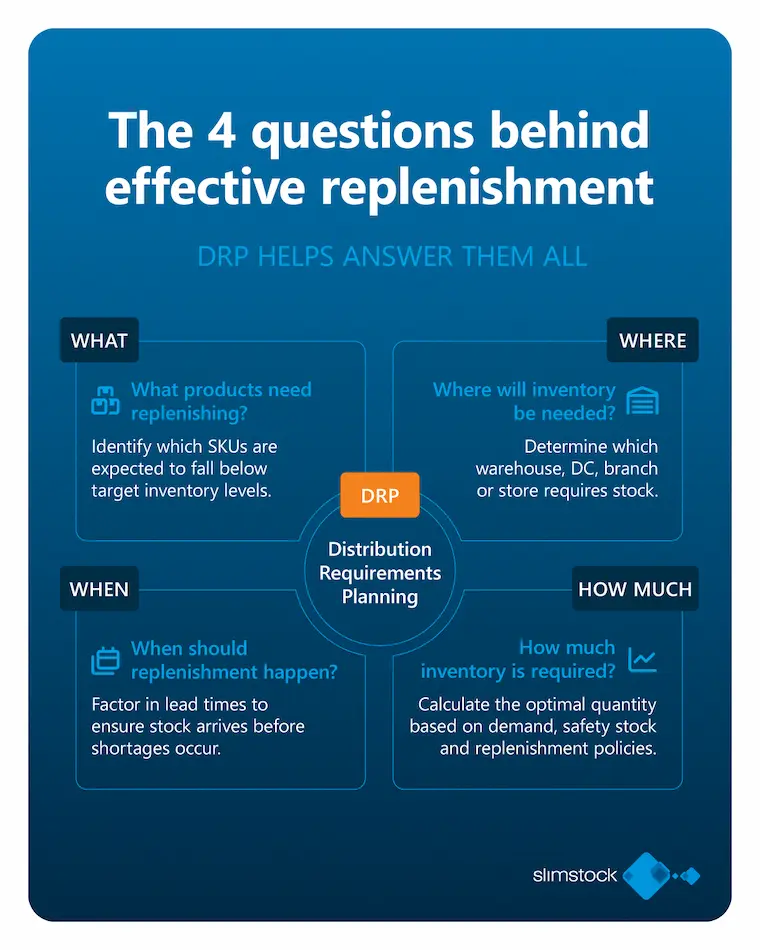
DRP considers key questions for its development:
What needs to be replenished?
It is necessary to assess which SKUs will have future needs, considering demand and current inventory levels.
Where will it be needed?
At which distribution center, branch, warehouse, or retail location will this need arise?
When will it be needed?
During what period will inventory fall below the desired level, and—considering lead time—when does restocking need to begin?
How much should be replenished?
What is the quantity required to meet replenishment needs, taking into account policies, economic order quantities, safety stock, restrictions, etc.?
Practical Example of DRP in a Distribution Network
Consider, in simplified terms, an automotive bearing company with a central distribution center in São Paulo responsible for supplying three regional centers: Recife, Curitiba, and Goiânia. For this example, we’ll consider only the forecasted demand, available inventory, and safety stock at each location to calculate the replenishment requirement.
| Recife | Curitiba | Golânia | |
|---|---|---|---|
| Forecast Demand | 500 | 800 | 300 |
| Available Inventory | 250 | 700 | 350 |
| Safety Stock | 100 | 150 | 80 |
| Reorder Point | 350 | 250 | 30 |
This is just a simple example for educational purposes. The DRP must also consider when this demand will occur, taking into account already planned receipts, lead times, batches, etc.
For the central distribution center, the needs of the three regional distribution centers become a demand signal that must be incorporated into its own purchasing or even production planning.
What data is needed for the DRP?
As mentioned earlier, the DRP must be able to determine what needs to be replenished, where, when, and in what quantity. It is essential that this data accurately reflects the reality of the operation. If a lead time is out of date or an inventory level is incorrect, for example, it can generate replenishment recommendations that appear adequate in the system but do not work in practice.
Demand data
Demand is the starting point for planning. The DRP needs to understand how much of each SKU is expected to be consumed or sold at each location within a given period. It’s important to make a distinction: the demand forecast is an input for the DRP and not the DRP itself.
Inventory data
Here, you must consider data on what is already available or already in transit. This includes current inventory at each location, products in transit, and scheduled transfers or receipts, so that the DRP works not only with a snapshot of current inventory but with a reliable view.
Supply and distribution network data
It is also necessary to understand how and how quickly inventory can reach each point in the network. Supplier lead times and lead times for transfers between distribution centers, delivery schedules, minimum order quantities (MOQs), purchase or shipping multiples, and other operational constraints directly influence the plan.
The network structure itself is critical information; it is essential to understand which nodes supply which locations. This will allow the needs identified at one level of the network to be factored into planning at previous levels.
Inventory policies and parameters
The DRP must take into account the inventory levels the company needs to maintain and the rules that must be followed. This involves important parameters such as safety stock, desired service levels, replenishment cycles, and specific policies by product or location.
What are the benefits of DRP for inventory management?
At inventory management , DRP primarily helps to:
- Anticipate needs: by identifying a potential shortage before it becomes a stockout;
- Optimise inventory placement: achieve better balance, reducing situations where one region has excess inventory while another is short;
- Network visibility: seeing the needs of each location in a coordinated manner;
- Restock more consistently: replacing some reactive decisions with structured planning;
- Make better use of capital: reduce capital tied up in unnecessary inventory.
- Achieve greater operational stability: by anticipating transportation, purchasing, or production needs.
Compare the best inventory management software solutions
DRP vs. MRP: What’s the difference?
DRP and MRP use a similar logic for planning needs over time, but in different contexts. While MRP breaks down a product’s requirements into components and raw materials, DRP propagates inventory requirements across the different levels of a distribution network.
| DRP | MRP | |
|---|---|---|
| Focus | Distribution | Production |
| Key question | Where and when to restock products | What materials will be needed for production? |
| Structure | Distribution network | BOM/Bill of Materials |
| Demand | Network Node Requirements | Demand for Manufactured Products |
| Result | Planned Replenishment/Transfer | Planned material orders |
DRP, demand planning, and replenishment: what’s the difference?
It is important to understand that demand forecasting is one of the inputs for DRP, not its output. While demand planning seeks to understand how much the customer is expected to demand, DRP answers another question: given this demand, where, when, and how much inventory will be needed? From there, it is possible to plan the replenishments necessary to meet demand.
What are the main challenges of DRP?
A DRP can be mathematically correct and still produce a poor plan. This is because, as noted earlier, the quality of the information used determines the quality of the DRP.
The complexity increases when seasonality, promotions, transportation constraints, minimum lot sizes, and multi-tier distribution networks are factored into the equation. Therefore, a good DRP depends on reliable data, proper item segmentation, up-to-date parameters, and management by exception.
When should a company use DRP?
The more complex the distribution network becomes, the greater the value of DRP tends to be. It is particularly relevant in operations with multiple distribution centers, warehouses, stores, or regions that depend on one another, especially when some locations have excess inventory while others face stockouts. The greater the interdependence among the network’s locations, the less effective it is to plan each location as an independent operation.
How can technology make DRP more efficient?
The more SKUs, locations, and variables that need to be considered, the more complex distribution planning becomes. Technology helps organise this information, automate calculations, and identify risks of excess or shortage of inventory. Thus, instead of analysing item by item, the planner can work on an exception basis and focus their time on situations that truly require attention.
Excel and ERP systems can support this process, but they serve different functions. While spreadsheets offer flexibility and ERP systems record and execute operational transactions, specialised software handles the planning layer. This is the case with Slim4, which connects demand, inventory, and supply data to support replenishment decisions in more complex distribution networks.
How to integrate DRP into supply chain planning?
DRP works best when it is part of an integrated planning process. Demand forecasting helps understand what might happen, inventory policies define how much to hold, and DRP translates this information into replenishment needs across the network. When connected to inventory planning, S&OP and IBP, and supply planning, it also helps evaluate scenarios and balance availability, inventory, and capital.
Integrated solutions, such as Slim4, support precisely this connection between demand, inventory, and replenishment, preventing each decision from being made in isolation.
FAQs about DRP
What does DRP mean in the supply chain?
DRP stands for Distribution Requirements Planning. It is an approach used to plan inventory and replenishment needs across a distribution network, taking into account what will be needed, where, when, and in what quantity.
What is the difference between DRP and MRP?
While MRP (Material Requirements Planning) calculates material requirements for production, DRP applies a similar logic to distribution, planning inventory and replenishments across different points in the network.
Is DRP the same as demand forecasting?
No. Demand forecasting estimates future demand and serves as one of the inputs for DRP. DRP uses this information, along with inventory data, lead times, and replenishment policies, to plan the network’s needs.
What data is required for DRP?
DRP uses information such as demand forecasts, available and in-transit inventory, lead times, safety stock, scheduled orders, batches, and the distribution network structure.
What is the main objective of DRP?
The objective is to ensure that inventory is available at the right place and time, balancing availability with the need to avoid unnecessary inventory and movements.