
Table of contents
Table of contents- The best supply chain management software
- Key factors to consider when choosing supply chain management software
- Supply chain management software comparison
- Slim4 (Slimstock) rated among the best supply chain management software providers
- FAQs about supply chain management software
Increasing demand volatility, supplier disruptions, and growing pressure to improve service levels continue to drive investments into technologies that enhance overall supply chain management. This search for a more holistic approach, better synchronisation across supply chain disciplines, end-to-end visibility, and AI-driven efficiency and accuracy is the first step towards optimised processes. And yet, the search for suitable software presents a big challenge and risk in itself.
In tandem and in response to this need, the supply chain planning software market has also evolved rapidly. Today, there are multiple specialised platforms helping organisations improve levels of demand forecasting, inventory management, production planning, and ultimate decision-making across the entire supply chain network.
The challenge comes from the fact that there is no single solution that is best for every company. The right choice depends on each organisation’s specific status quo: their size, their digital maturity, their bottlenecks, their existing infrastructure, their network span.
It is difficult to know where to start when all providers are seeking to facilitate that same end goal of supply chain management optimisation. This guide looks to help that search, comparing and contrasting the leading supply chain management software solutions available in 2026.
Based on research conducted by Gartner Peer InsightsTM, the guide provides a clear and structured overview of the market’s leading providers, dissecting the varying characteristics that are designed to help supply chain, operations, and planning leaders stay resilient to risk and agile to opportunity.
Key factors to consider when choosing supply chain management software
Before dissecting the available solutions, it’s first important to know and understand what’s guiding your search. Selecting the right supply chain planning solution requires a structured evaluation of both technical capabilities and business needs.
Supply chain complexity
The more complex your supply chain, the more advanced your planning solution needs to be. Organisations with multiple warehouses, international suppliers, long lead times, or more volatile and variable demand require a solution that can manage uncertainty and complexity across the network.
Demand forecasting capabilities
Accurate demand forecasting is the foundation of effective supply chain planning. A strong solution should offer:
- Statistical forecasting models
- Machine learning capabilities
- Demand sensing and short-term adjustments
- Scenario-based forecasting
Inventory optimisation
Inventory is one of the largest cost drivers across the supply chain, implicating warehousing, stock movement, labour, production, and the smooth transition from demand, to supply, to fulfilment. An effective solution should help you:
- Balance service levels and stock investment
- Optimise safety stock dynamically
- Manage multi-echelon inventory
- Reduce obsolescence and excess stock
Integration with ERP and other systems
Integration is critical for ensuring data consistency and enabling end-to-end planning, while also keeping the cost and efficiency of your digital transformation viable.
AI and automation maturity
Modern supply chain planning increasingly relies on automation and AI, and knowing where you are currently on that journey will help dictate the extent of transformation, and the kind of software, required. Generally speaking, however, capabilities to look out for include:
- Automated decision-making
- Machine learning-based forecasting
- Scenario simulation and trade-off optimisation
- Exception-based planning
Supply chain management software comparison
Below is a high-level overview of the solutions analysed in this guide, pulling upon Gartner Peer InsightsTM’ comparison of key factors and dynamics, including functionality, implementation times, and their overall rating.
We then go into more specific detail for each of the leading brands, analysing their specific characteristics, strengths, and limitations as deduced by Gartner’s research.
| Software | Ideal for | Key capabilities | Implementation rating | Overall Gartner rating |
|---|---|---|---|---|
| Slim4 | Integrated supply chain planning | Collaboration, user experience, constraint-based planning | 4.6/5 | 4.8 |
| SAP IBP | Enterprise-wide planning | End-to-end planning, constraint-based planning, and ERP integration | 4.2/5 | 4.4 |
| Kinaxis | Complex global supply chains | Concurrent planning, and scenario analysis | 4.1/5 | 4.4 |
| o9 | AI-driven transformation | Digital twin, resource breadth, and a flexible architecture | 4.5/5 | 4.8 |
| Oracle | End-to-end cloud suite | Planning, execution, analytics | 4.3/5 | 4.8 |
| Infor | Industry-specific planning | Multi-enterprise planning | 4.3/5 | 4.6 |
| Anaplan | Connected enterprise planning | Collaborative demand planning | 4.3/5 | 4.5 |
Slim4 (Slimstock) rated among the best supply chain management software providers
With a score of 4.7/5, Slim4 is among the highest-rated solutions in its category according to Gartner Peer InsightsTM.
| Advantages | Lowest scoring attributes | Gartner Peer InsightsTM recommendation rating | Gartner Peer InsightsTM overall rating |
|---|---|---|---|
|
NA (no rating below 4.5/5) | 93% | 4.8/5 |
Slim4, developed by Slimstock, is a specialised supply chain planning platform focused on demand forecasting, inventory optimisation, and replenishment.
Unlike broader enterprise suites, Slim4 is designed to deliver practical and measurable improvements in supply chain performance, elevating levels stock availability, reducing working capital, maximising profits, and enhancing operational efficiency.
The platform combines advanced analytics with a user-friendly interface, enabling planning teams to make better decisions without requiring complex configuration or long implementation cycles. It is widely adopted across areas of retail, wholesale, manufacturing, and distribution.
Slim4 key features
Slim4 provides a comprehensive set of functions focused specifically on supply chain planning:
- Advanced demand forecasting using statistical models and AI.
- Inventory optimisation across single and multi-echelon networks.
- Automated replenishment and order proposals.
- Sales & Operations Planning (S&OP) capabilities.
- Scenario planning and simulation tools.
- Exception-based planning and alerts.
These features are designed to support both operational and tactical decision-making, helping organisations maintain optimal stock levels while responding quickly to changes in demand or supply conditions.
Slim4 strengths
One of the main strengths of Slim4 is its balance between functionality and usability.
The platform is known for:
- Fast user adoption due to its intuitive interface.
- Advanced inventory optimisation and demand planning.
- Rapid time-to-value compared to enterprise platforms.
- High customer satisfaction and support quality.
In addition, Slimstock’s approach combines software with consultancy expertise, ensuring that best practices are embedded into planning processes.
Slim4 suitability
Slim4 is suitable for a wide range of organisations, from medium-sized companies to large enterprises.
It is particularly well suited for:
- Companies with complex inventory structures.
- Organisations seeking to improve planning without a complex and intense IT transformation.
- Businesses looking for a fast return on investment.
Its flexibility makes it suitable for the full retail and omnichannel spectrum, meeting the needs of modern-day retail, manufacturing, wholesale, and ecommerce.
Slim4 Implementation
One of Slim4’s key differentiators is its speed of implementation. Typical deployment timelines range from one to two months depending on scope and complexity. The implementation process is supported by Slimstock consultants, who help configure the system and align it with business processes.
Compared to larger platforms, this results in:
- Lower implementation risk.
- Faster user adoption.
- Quicker realisation of business benefits.
Slim4 Rating
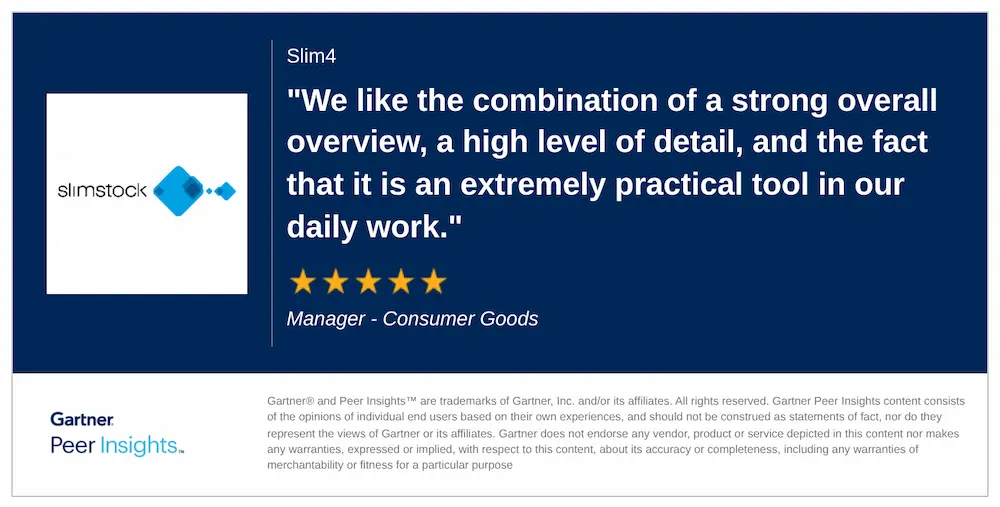
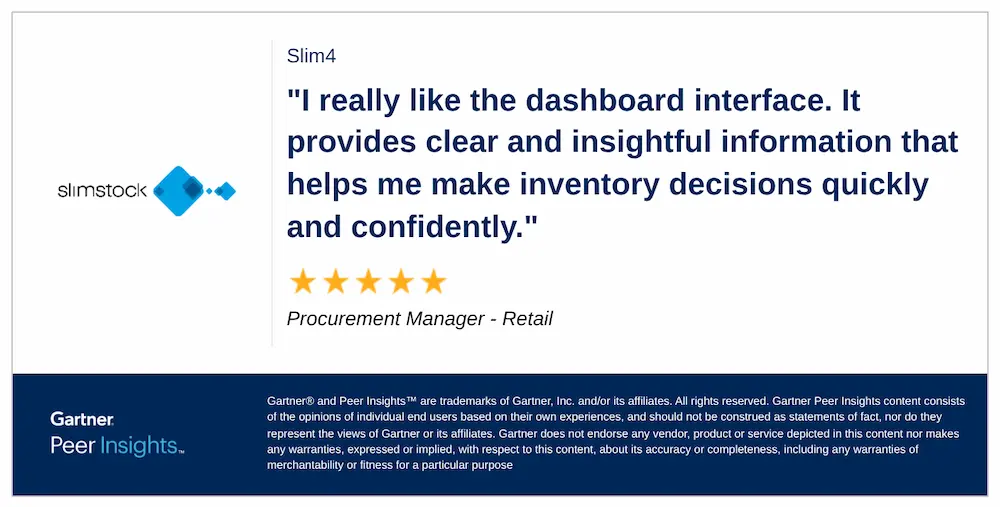
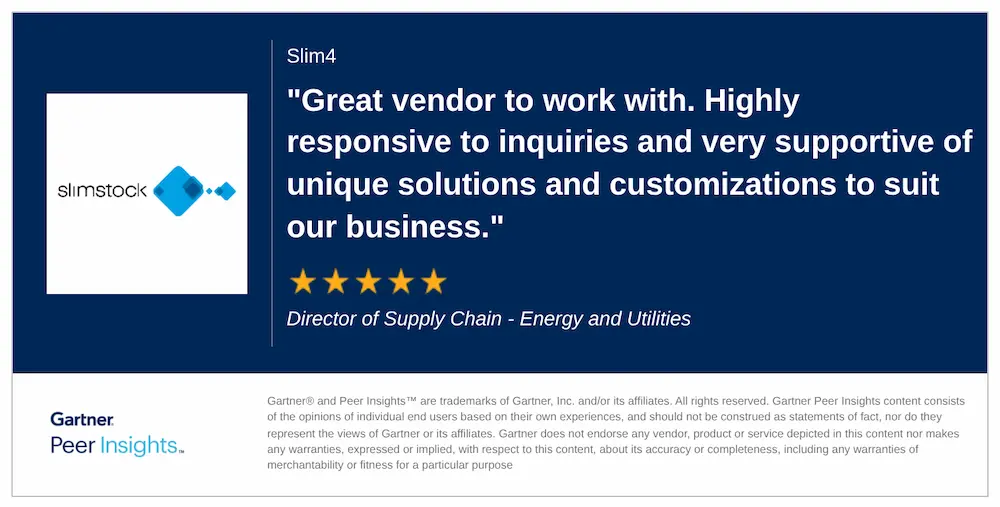
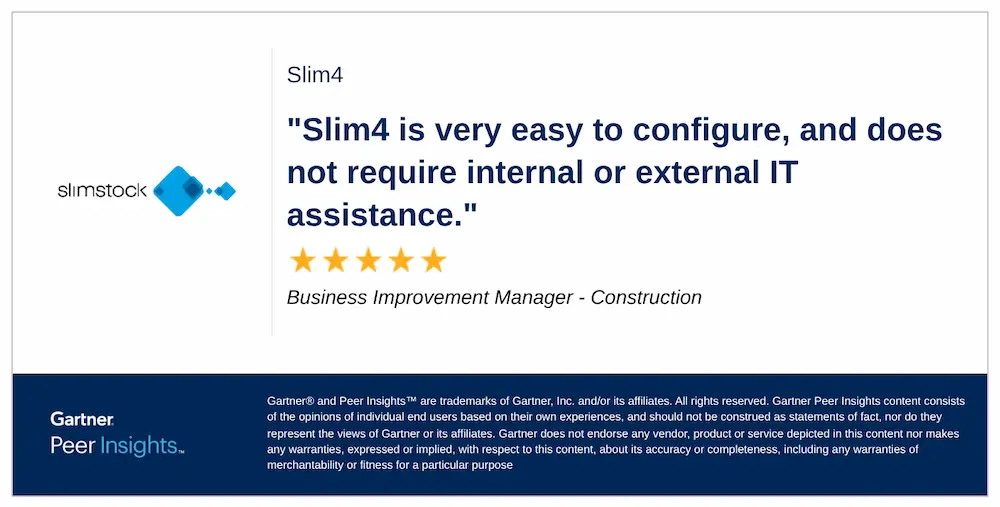
Slim4 has an average rating of 4.7/5 based on verified reviews on Gartner Peer InsightsTM’ within the Supply Chain Planning Solutions category.
User feedback highlights several consistent themes:
Do you need help choosing the right solution?
Our team can help you evaluate different supply chain management software options based on your business needs, your industry context, and your strategic goals.
SAP
SAP Integrated Business Planning (IBP) is a comprehensive solution designed for large enterprises requiring end-to-end supply chain planning integrated with ERP systems.
| Advantages | Lowest scoring attributes | Gartner Peer InsightsTM recommendation rating | Gartner Peer InsightsTM overall rating |
|---|---|---|---|
|
|
77% | 4.4/5 |
Kinaxis
Kinaxis offers a concurrent planning platform designed for real-time decision-making in complex supply chains.
| Advantages | Lowest scoring attributes | Gartner Peer InsightsTM recommendation rating | Gartner Peer InsightsTM overall rating |
|---|---|---|---|
|
|
83% | 4.4/5 |
o9 Solutions
o9 Solutions provides an AI-driven planning platform with advanced modelling capabilities and digital twin technology.
| Advantages | Lowest scoring attributes | Gartner Peer InsightsTM recommendation rating | Gartner Peer InsightsTM overall rating |
|---|---|---|---|
|
|
93% | 4.8/5 |
Oracle
Oracle offers a broad cloud-based suite covering planning, execution, and analytics.
| Advantages | Lowest scoring attributes | Gartner Peer InsightsTM recommendation rating | Gartner Peer InsightsTM overall rating |
|---|---|---|---|
|
|
76% | 4.8/5 |
Infor
Infor delivers industry-specific supply chain solutions tailored to manufacturing and distribution sectors especially.
| Advantages | Lowest scoring attributes | Gartner Peer InsightsTM recommendation rating | Gartner Peer InsightsTM overall rating |
|---|---|---|---|
|
|
100% (only six reviews) | 4.6/5 |
Anaplan
Anaplan is a flexible planning platform used across multiple business functions, including the supply chain.
| Advantages | Lowest scoring attributes | Gartner Peer InsightsTM recommendation rating | Gartner Peer InsightsTM overall rating |
|---|---|---|---|
|
|
79% | 4.5/5 |
FAQs about supply chain management software
What is supply chain management software?
Supply chain management software is a type of solution designed to help organisations plan, optimise, and manage the flow of goods, information, and resources across their supply chain.
These platforms typically include capabilities such as demand forecasting, inventory optimisation, replenishment planning, and scenario analysis. Their main objective is to improve service levels while reducing costs and operational inefficiencies.
What are the benefits of using supply chain planning software?
Implementing a supply chain management solution can deliver several key benefits:
- Improved demand forecasting accuracy
- Reduced inventory levels and working capital
- Better product availability and service levels
- Increased operational efficiency
- Enhanced visibility across the supply chain
- Faster and more informed decision-making
Solutions such as Slimstock focus particularly on delivering quick, measurable improvements in these areas.
What is the best supply chain management software?
There is no single “best” solution for all organisations. The most suitable software depends on factors such as:
- Supply chain complexity
- Company size
- Industry requirements
- Budget and resources
- Existing IT landscape
How long does it take to implement supply chain management software?
Implementation timelines vary depending on the solution and each organisation’s starting point:
- Specialist platforms like Slim4 can be implemented in one-two months
- Mid-range platforms typically take three-six months
- Some larger enterprise solutions may take six–12 months or more
The timeline depends on factors including data availability and quality, system integration, internal resources, and project scope.
How do you choose the right solution for your company?
Selecting the right solution requires the balancing of multiple factors:
- Business objectives (cost reduction, service improvement, growth)
- Operational complexity
- Internal capabilities and resources
- Required speed of implementation
- Budget constraints
In many cases, organisations choose between:
- Comprehensive but complex enterprise platforms
- Or specialised solutions that deliver faster results
A structured evaluation process, including demos and pilot projects, is recommended before making a final decision.
Can supply chain planning software integrate with existing systems?
Yes, most modern supply chain management solutions are designed to integrate with existing systems such as ERP, WMS and BI tools.
- Enterprise platforms like SAP and Oracle offer native integration within their ecosystems
- Other solutions, including Slimstock, typically integrate via APIs and standard connectors
The level of integration required will depend on your current IT architecture and business processes.
What industries use supply chain management software?
Supply chain planning software is used across a wide range of industries, including:
- Retail and e-commerce
- Manufacturing
- Wholesale and distribution
- Consumer goods
- Pharmaceuticals and healthcare
Any organisation managing inventory, demand variability or complex logistics can benefit from these solutions.
How much does it cost to implement a supply chain management solution?
The cost of implementing a supply chain management solution can vary significantly depending on several factors, including the complexity of the organisation, the scope of the project, and the chosen software.
Total investment can range from tens of thousands to several hundred thousand pounds (or more), particularly for large-scale deployments. It is important to evaluate not only the initial cost, but also the return on investment (ROI), including potential savings from reduced inventory, improved service levels, maximised stock turnover and profits, and increased operational efficiency.