
Karl Jolivet
Inventory Director | Lumen
"When I arrived in 2016, we were four analysts. Today, after all this growth, we still have only four analysts."
As a distributor grows, inventory planning doesn’t just get bigger: it gets exponentially harder.
Growth means more replenishments; more products require better forecasting. But customers want everything correct, complete, and punctual nonetheless.
Lumen, the largest electrical wholesaler in Quebec belonging to the Sonepar group, knows such challenges all too well. Within the last ten years, Lumen expanded its branch network from 33 to 40 while increasing its catalogue of products stored at the Laval DC from around 25,000 to 35,000. And throughout those years, Lumen maintained the exact staffing of its planning department.
In this interview between Inventory Director Karl Jolivet, Inventory Analyst Shaziya Khoja, and Ludovic Magne, General Manager of Slimstock Canada, learn how they did it. The story takes us through a transformation from spreadsheet-driven planning, from managing excesses in days to minutes, from an average of 100 days’ worth of inventory to just 68 days, and from manual to collaborative teamwork focused on decision-making rather than number crunching.
Lumen at a glance
| 40 | 35,000 | 900 | 4 |
|---|---|---|---|
| branches | SKUs at the distribution centre | employees | planning team members |
What challenge did Lumen face as the business grew?
Growth of Lumen’s network brought complexity into the process of planning which exceeded what was possible to accomplish manually. The task consisted of accurately forecasting the demand and maintaining balanced inventory across thousands of SKUs and many warehouses, all without impacting the quality of customer service.
Before Slim4, the ERP provided limited forecasting intelligence, so the process relied heavily on Excel. A forecasting cycle could take close to a month, seasonality was difficult to account for, and the team could realistically focus only on the distribution centre. Branch-level planning received less attention because there simply wasn’t the capacity.
“In total, that’s 171,000 SKU-locations to forecast. Doing it manually is practically impossible.”
— Karl Jolivet, Inventory Director at Lumen
How did Lumen scale without increasing the size of its planning team?
The new process from Lumen eliminates endless data collection and spreadsheets, replacing them with exception-based planning. In this scheme, Slim4 analyses demand trends, automatically applies the correct type of forecasting, and identifies areas needing human attention.
Far from being passive, planners spend far less time hunting down potential issues, focusing instead on those exceptions. And this change alone enabled the same four planners to manage an expanded branch network and wider range of inventories.
“When I arrived in 2016, we were four analysts. Today, after all this growth, we still have only four analysts.”
— Karl Jolivet, Inventory Director at Lumen
| 2016 | 2026 | |
|---|---|---|
| 33 | Branches | 40 |
| ~25,000 | SKUs in the distribution centre | ~35,000 |
| Manual (excel) | Min-max management | Automated (Slim4) |
| 4 analysts | Planning team | 4 analysts |
Which KPIs guide Lumen’s inventory decisions?
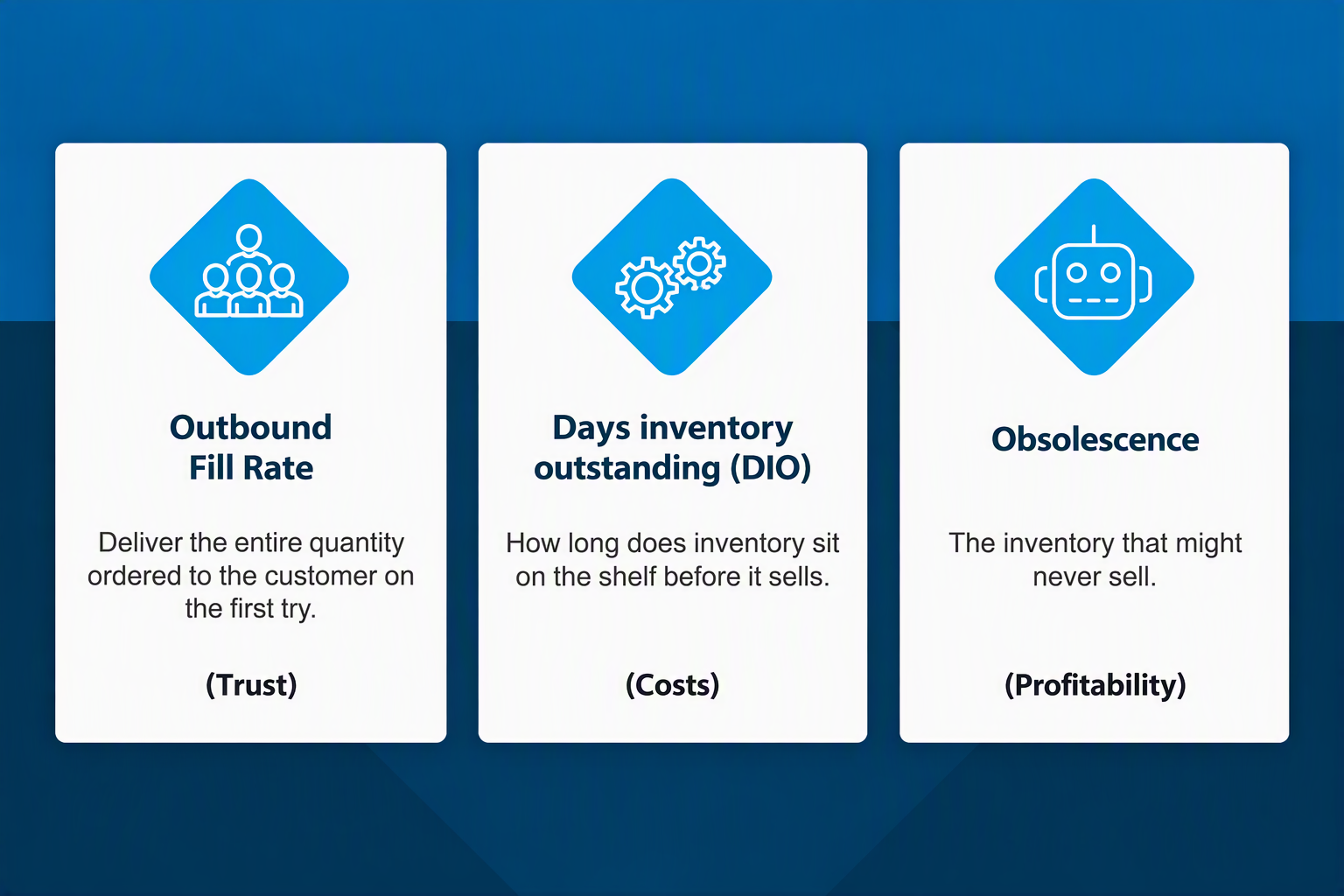
The three critical KPIs tracked by Lumen include outbound fill rate, DIO and obsolescence, together creating a dashboard for balancing service performance and managing working capital in terms of potentially non-productive stock
Outbound fill rate is targeted to hit 98.5%. And this means hitting that percentage perfectly; anything less than perfection means failure here. Why? This is due to the simple truth: the best possible use of inventory investment is to improve service performance, nothing else.
“Our target is a 98.5% outbound fill rate across every product type. And we’re very close, even with everything the supply chain has thrown at us these past six years.”
— Karl Jolivet, Inventory Director at Lumen
Why is surplus inventory such an important focus?
Most Lumen customer orders are fulfilled via its distribution center, yet customers may return products to branch stores. Branches were never designed to accommodate high levels of stock, making returns piling up without a strict rebalancing regime in place across the whole network.
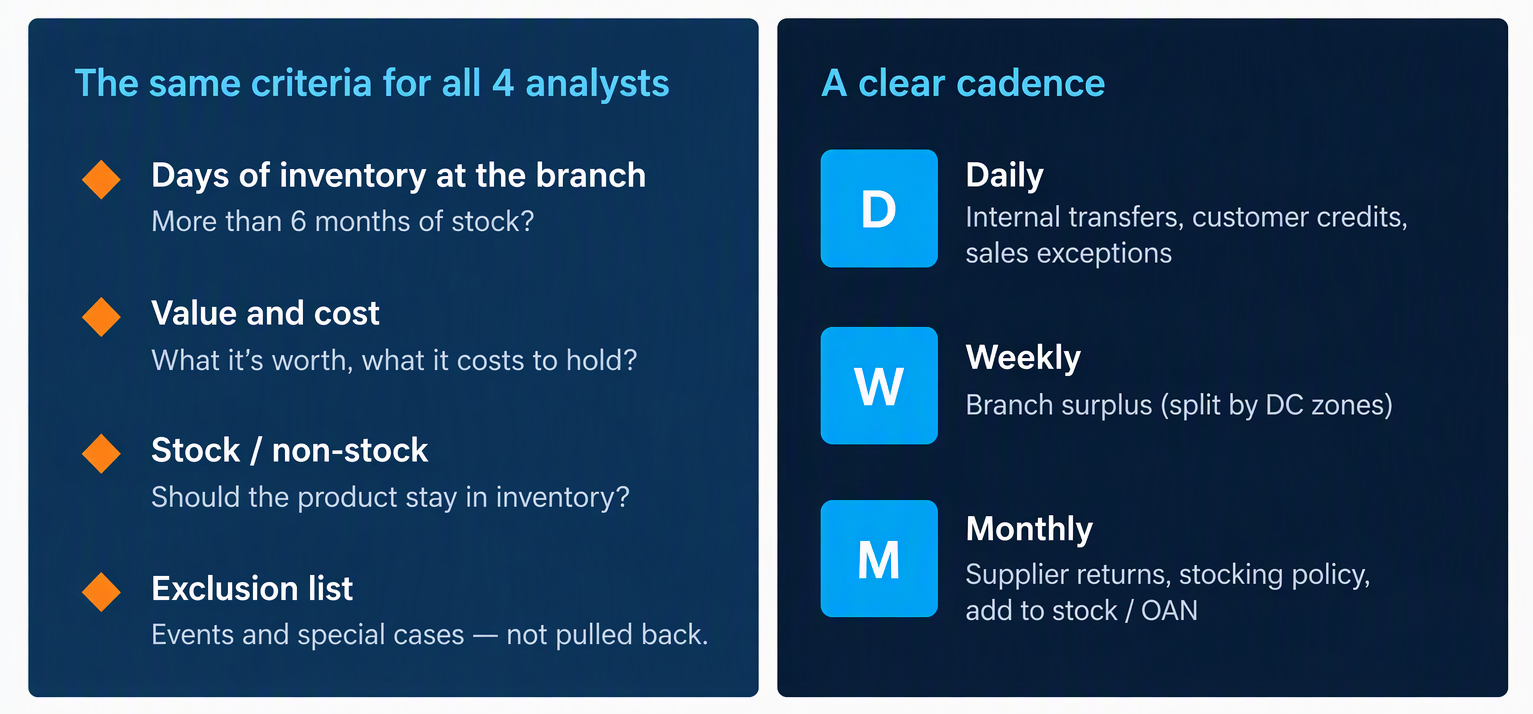
The team defines surplus using standardised rules that account for:
- Forecast coverage
- Days of inventory
- Demand class
- Stock or non-stock status
- Discontinued items
- Supplier returns
- Promotional exclusions
For example, branches are generally not intended to hold more than six months of inventory.
“What Slimstock helped us do was get very granular: to see where to invest our money to hold more safety stock on the right products. That’s something our ERP simply couldn’t do.”
— Shaziya Khoja, Inventory Analyst at Lumen
Standarised rules for the whole team
How much faster is the surplus-management process today?
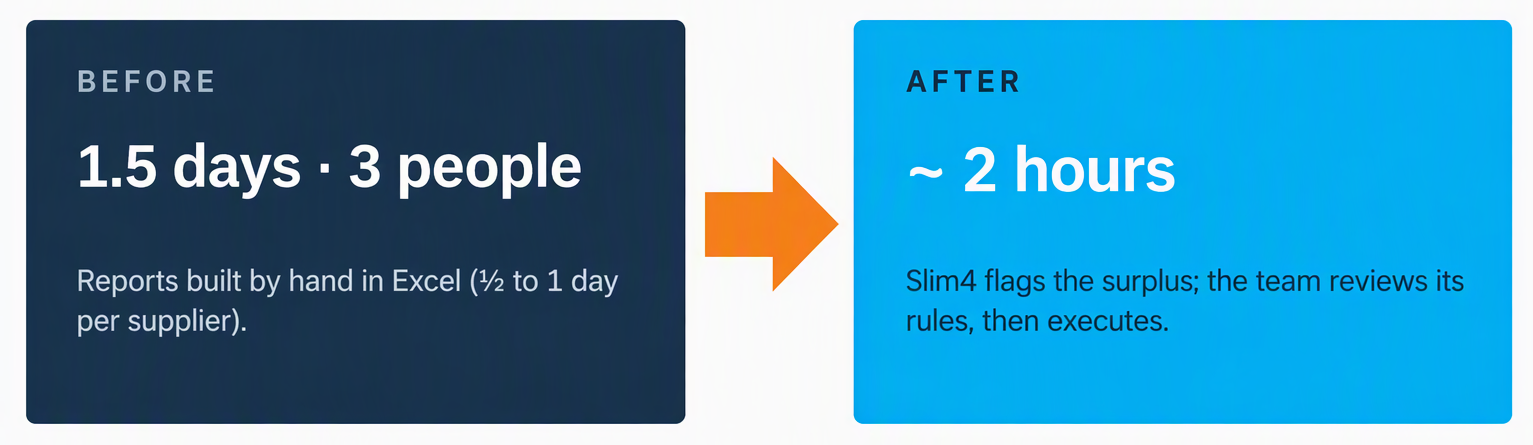
The difference makes itself evident. Previously, branch surplus analysis required around a day-and-a-half of effort by three staff members. Now, updating the underlying spreadsheet data takes roughly five minutes, and after that the team is able to assess the recommended surpluses and arrange return shipments from branches to the distribution centre.
Even when handling the process herself, the inventory director manages to cycle through all 40 branches in around half a day.Time savings alone would be impressive, but there are other factors at play here: increased reliability and actionable guidance being just two examples.
“Before, a branch surplus analysis took a day and a half with three employees. Today, updating the file takes five minutes.”
— Karl Jolivet, Inventory Director at Lumen
What measurable inventory improvements has Lumen achieved?
Lumen reports that overall inventory days improved from roughly 100 days to approximately 68 days across the distribution centre and branches. This was achieved while the organisation continued to manage a wide range of product velocities and maintain a strong focus on customer availability.
The result shows the value of balancing service, working capital, and obsolescence rather than optimising any one measure in isolation.
“We moved from roughly 100 days of inventory to around 68 days overall across the distribution centre and branches.”
— Karl Jolivet, Inventory Director at Lumen
Surplus management: from manual to automated
What do planners do with the time they save?
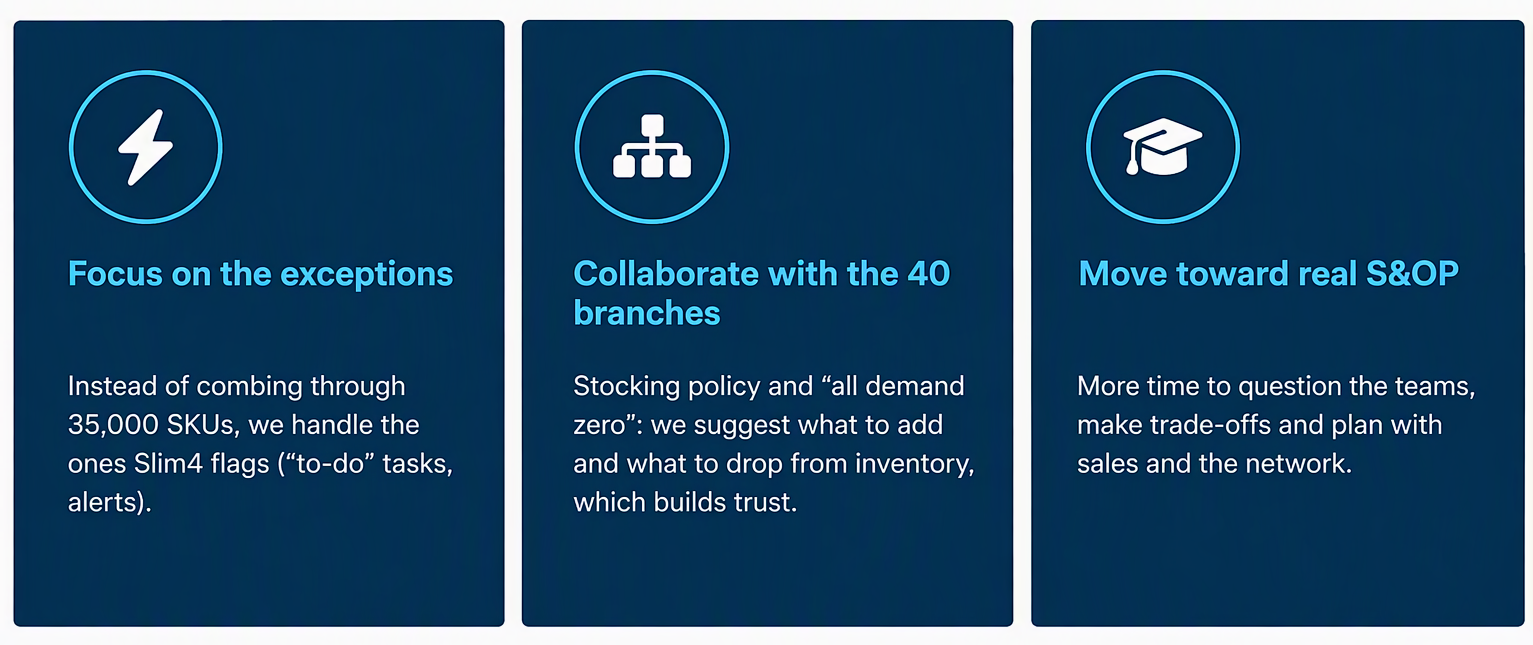
Time gained by automating is redirected towards better uses. Exceptions get attention; promotions are forecast; dormant SKUs are reviewed; policy on stocking gets a new look – and the branch manager is involved at every step.
When there is a SKU that hasn’t sold in ages, the discussion will happen, deciding either to discontinue carrying that product altogether, move to non-stock status, reassign it somewhere else in the warehouse, or send it back to the manufacturer. Alternatively, the conversation might turn towards SKUs that multiple customers have ordered.
How does internal inventory rebalancing create additional value?
The redistribution of Lumen’s inventory between branches is done according to demand, by matching requirements at one point in the network against the inventory that is currently surplus at another point. Rather than initiating an immediate purchase order from the vendor automatically, the team considers the possibility of redirecting some stock from another branch or operation, taking into account transportation costs and pricing factors.
“Instead of buying from the supplier, I can help a colleague and take their surplus. And it’s always based on real need, never just a list.”
— Karl Jolivet, Inventory Director at Lumen
“For us, surplus is anything above the forecast, so everything we don’t expect to sell over a given period. That’s mostly what we pull back from the branches every Monday. There are standardised rules behind it: we look at days of inventory, whether the item is stock or non-stock, whether it’s been discontinued, and we exclude promotions. Depending on the item’s demand class, Slim4 calculates the surplus for us.”
— Shaziya Khoja, Inventory Analyst at Lumen
What makes data quality so critical?
The team mentioned that planning technology is only as reliable as the data and rules behind it. Many things influence planning recommendations:
- Supplier pack sizes
- Cartons
- Pallets
- Layers
- Minimum order quantities
- Lead times
- Ownership fields
Slim4 tasks also help Lumen identify suspicious master data. For example, a minimum order quantity that represents more than 12 months of stock can be flagged for validation. Once corrected in the ERP, the updated information flows back into the planning process.
“The most important thing is your data. Bad data gives you bad information in Slim4. One of the worst offenders is your supplier logistics quantities: boxes, cartons, pallets, layers. Slim4 has a task that flags any minimum order quantity worth more than twelve months of stock. Often, it’s bad data that’s been sitting in your ERP for years that we never used to see. If it’s a mistake, you fix it in the ERP, and the next day Slim4 recalculates correctly. That helped us enormously.”
— Karl Jolivet, Inventory Director at Lumen
What implementation lessons would Lumen share with other companies?
Three lessons stand out for Lumen:
- Clean and govern the data.
- Agree on clear, standardised processes before go-live.
- Involve strong IT resources early, especially during blueprint decisions that determine how forecasts, transfers, order levels, and ownership will work across systems.
When Lumen launched, just before COVID-19 radically altered supplier lead times, that highlighted just why it is essential that maintenance remain constant, exceptions be managed effectively and processes remain adaptable to new realities.
“You’ll have a lot of decisions to make in it: how transfers are handled, whether forecasts drive your order levels, which parameters you choose. Clean your data, get your processes clear, and involve strong IT people early. For us, building shared Canadian processes across all our operating companies was a big challenge. Blueprint definition, processes and data: that’s what it all comes down to.”
— Karl Jolivet, Inventory Director at Lumen
What is next for Lumen’s planning journey?
Continuing its improvements in Sales and Operations Planning (S&OP), Lumen has started involving strategic clients and regions in this process. The team uses client forecasts and sales and marketing intelligence in order to enhance planning and visibility for its suppliers.
This initiative becomes highly important at this stage of development because any planning system would easily spot trends in historical data; however, understanding of current market conditions usually remains exclusive to clients, field sales reps, branch directors and even suppliers themselves. Combining insights helps react much faster to fluctuations.
Key lessons of Lumen’s case for supply chain leaders
- Growth doesn’t automatically require more planners. Removing repetitive work creates capacity within the existing team.
- Automation pays off when it redirects people. Its value lies in moving planners towards exceptions, collaboration, and decisions that require business judgement.
- Optimise together, not in isolation. Service, inventory investments, and obsolescence have to be balanced as a set.
- Network-wide visibility unlocks hidden stock. Surplus in one location can become useful stock in another.
- Foundation matters. Data quality, process alignment, and IT involvement are key to a successful implementation.
- Go-live is a starting point. Planning maturity keeps growing through maintenance, learning, and strong S&OP collaboration.
Conclusion
Experience with Lumen demonstrates that forecasting alone does not deliver optimisation. It is possible to build a sustainable organisational process based on sound planning principles, enriched with powerful data analysis, automation of exceptions and increased partnership with those who matter. All achieved without growing the planner workforce. That was done by allowing planners to shift from Excel maintenance to branch engagement, stocking decisions, client collaboration and S&OP development.

Related case study