
Table of contents
Table of contents- What is promotion management in supply chain? Challenges, impact and best practices
- How to plan profitable promotions without disrupting your supply chain
- What is promotion management in supply chain?
- The hidden risks behind promotions
- Common problems in promotion planning
- Best practices for effective promotion management
- From promotion planning to promotional risk management
- Conclusion
Overview
Promotions can quickly boost sales, but without proper planning they often disrupt the supply chain. Sudden demand spikes can lead to stockouts, excess inventory and forecasting issues. In this article, you’ll learn how to manage promotions as a supply chain discipline, improving demand control, inventory decisions and overall operational performance.
Promotions can drive volume fast, but they can also destabilise your supply chain. From a supply chain perspective, a promotion is not only a commercial tactic, it’s a planned shock to demand. If you don’t model that shock properly, you will usually pay for it in one of three ways: lost sales, excess stock or operational disruption.
That’s why promotion management shouldn’t be treated as “marketing execution”, it’s a supply chain discipline that helps you plan profitable promotions while protecting service levels, inventory health and planning stability.
In this article you will learn what promotion management means in supply chain terms, what can go wrong and why, and how to build a repeatable process that improves outcomes over time.
How to plan profitable promotions without disrupting your supply chain
Most promotion failures are not caused by poor intent but because teams plan promotions with one set of objectives (sales and margin), while the supply chain absorbs the consequences (availability and inventory).
A supply‑chain‑led approach focuses on four practical questions:
- What demand would you have without the promotion? (baseline)
- What uplift is realistic and where will it land? (volume and locations)
- What secondary effects will follow? (stockpiling, cannibalisation, halo)
- What does the promotion do to inventory and execution capacity? (risk and feasibility)
When you answer these questions before you launch, promotions stop being a gamble and start becoming a controlled lever.

What is promotion management in supply chain?
Promotion management in supply chain is the structured process of planning, forecasting, executing and evaluating promotions in a way that controls demand volatility and inventory risk.
This means you treat promotional activity as part of your demand and inventory decision‑making, not as an exception handled with last‑minute forecast overrides.
A strong promotion management process helps you separate baseline demand from promotional effects, plan and forecast uplift with evidence instead of assumption, align replenishment and inventory policies to promotional demand, evaluate outcomes and improve your next promotion.
It’s not about “running campaigns”, it’s about ensuring your operation can support commercial ambition without creating unnecessary cost.
The hidden risks behind promotions
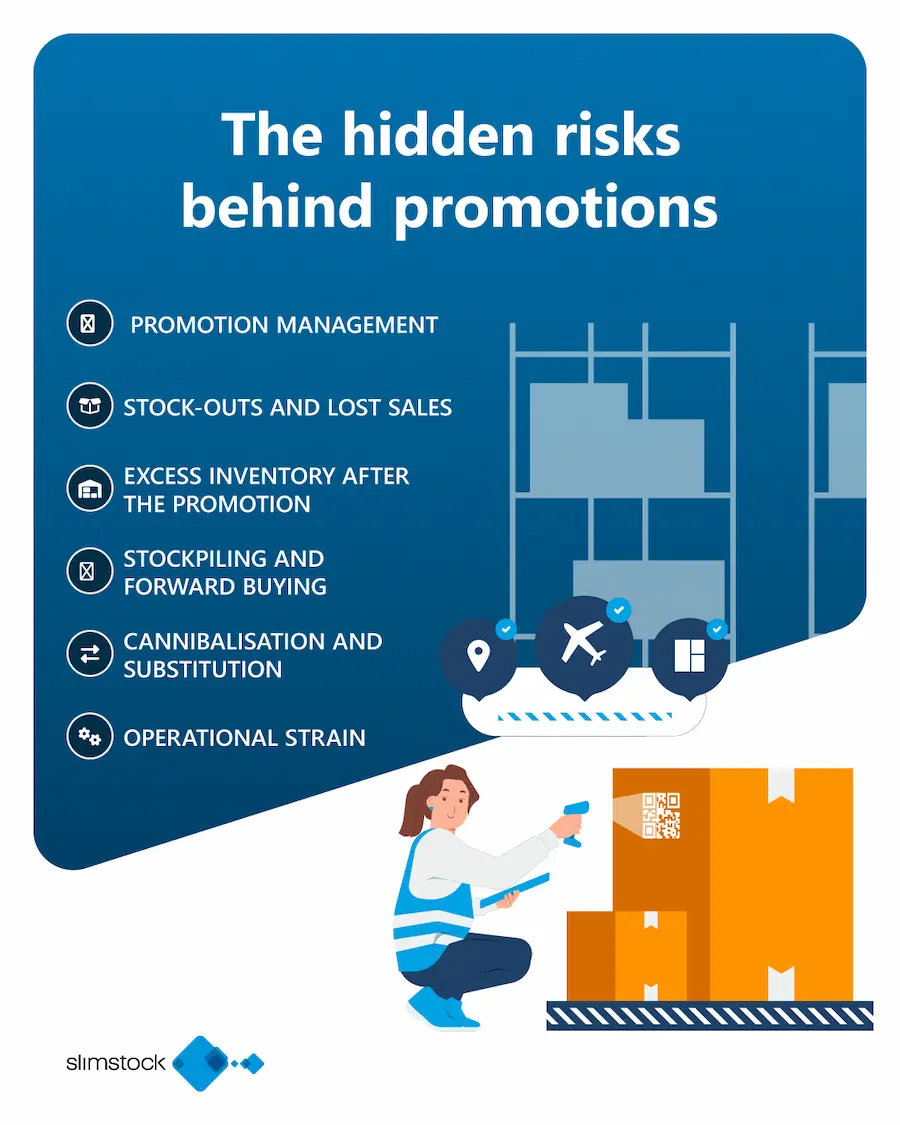
Promotions often look successful if you only measure sales uplift. The hidden risk sits in how that uplift behaves, what it replaces and what it leaves behind. Here are the most common risks.
1) Forecast distortion
Promotions disrupt normal demand patterns. If you don’t isolate the promotional effect from underlying demand, you risk contaminating your future forecast.
This becomes especially damaging when promotional weeks are fed into statistical models without adjustment, year‑on‑year comparisons include different promotional activity, or blanket overrides obscure what actually happened at SKU level.
The result is not only a poor promotional forecast, it’s a weaker forecast for weeks or months afterwards.
2) Stock‑outs and lost sales
Underestimating uplift creates shortages at the worst possible moment: when demand is most valuable and customers are most likely to switch.
When you run out of stock during a promotion, you don’t just lose a sale. You waste marketing spend, frustrate customers and end up with a distorted view of demand because what looks like low demand was actually demand you couldn’t meet.
3) Excess inventory after the promotion
When you overestimate uplift you don’t feel it straight away, you pay for it once demand settles back down. You’re left with extra stock that ties up cash, costs more to hold, risks becoming obsolete and often ends up discounted, eating away the margin you were trying to protect.
In short, you “win” volume today and spend the following weeks paying for it.
4) Stockpiling and forward buying
A lot of promotions don’t actually create extra demand, they just bring it forward. Customers buy earlier or buy more than usual, and then slow down afterwards.
If you don’t plan for that stockpiling effect, your forecast starts to lie to you: demand looks overstated during the promotion, understated once it’s over, and replenishment decisions end up chasing the wrong signals.
That’s why promotions so often feel like a never‑ending cycle of spikes and dips.
5) Cannibalisation and substitution
A promotion can shift demand between products rather than increasing total demand. You may see a “successful” promoted SKU while the category remains flat, or you simply replace higher‑margin items with lower‑margin volume.
Without cannibalisation analysis, you risk repeating promotions that look good in isolation but deliver weak net impact.
6) Operational strain
Promotional peaks put pressure on the whole supply chain. Replenishment teams rush last‑minute changes, warehouses deal with bigger-than-normal waves, transport plans become harder to stick to, and stores have more to juggle on the shop floor.
Even if you have enough stock overall, poor timing or the wrong allocation can still trigger local stock‑outs and operational chaos and these risks aren’t inevitable. They only become unavoidable when promotion planning happens in isolation, separate from forecasting and inventory optimisation.
Common problems in promotion planning
If the risks are well known, why do promotions still cause so much disruption? Because many organisations struggle with the same structural issues, not because people don’t care but because the process makes control difficult.
1) Siloed planning and late supply chain involvement
Promotions are usually driven by commercial teams, with the supply chain brought in late, often only once problems start to surface. But once decisions are already made, you’re no longer planning, you’re just trying to limit the damage. That’s when things get messy: last‑minute changes, reactive expediting, rushed substitutions and service levels dropping for reasons that could have been avoided.
2) No clear baseline
Teams often jump straight to “uplift” without first agreeing on what normal demand actually looks like, and without that baseline you can’t really tell what happened. You don’t know what demand was genuinely incremental, what was just pulled forward, what you lost because stock wasn’t available or how the promotion really changed buying behaviour. Without that clarity, learning from promotions becomes almost impossible.
3) Manual overrides that cannot be repeated
Spreadsheets and one‑off overrides are everywhere. Using judgement isn’t the real problem, the problem is that those decisions rarely get captured in a clear, structured way. The result is familiar: planners working with different uplift assumptions, limited visibility for stakeholders, endless questions about what changed and why, and the same debates coming back every cycle instead of making real improvements.
4) Weak use of promotion history
Many companies run the same or very similar promotions year after year but the learnings rarely get reused properly. The data exists, but insight doesn’t. That’s usually because information is spread across different systems, results are reviewed only at a very high level, and there’s no consistent way to assess uplift or the knock‑on effects. So each promotion ends up being treated like a one‑off, instead of building on what’s already been learned.
5) Inventory risk identified too late
In many organisations, the inventory impact only gets looked at after promotional demand has already been forecast or after the promotion is already running. By that point, your choices are few, reactive and expensive.
6) No closed‑loop learning
Some teams do a post‑promotion review. Far fewer take those lessons and build them back into forecasting and planning. Without that feedback loop, promotions stay unpredictable and the same mistakes get repeated cycle after cycle.
Best practices for effective promotion management
Best practice promotion management is not about making promotions “perfect”, it’s about making them repeatable, measurable and safer. Here is a practical framework that supply chain teams can use to increase control and reduce volatility.
1. Start with a reliable baseline
Your baseline is your anchor. Build it with the same discipline as your normal forecast: clean historical data, remove known one‑offs, account for seasonality and trend, segment where needed (store, channel, region). Then treat uplift as an additional layer on top of baseline, not a replacement.
2. Model uplift with evidence, not optimism
Use historical promotions as proof points: similar products, similar mechanics (discount depth, display, multibuy), similar timing (season, pay cycles, holidays), similar channels and customer behaviour. When you don’t have a perfect match, use ranges and scenarios instead of false precision.
3. Plan for the full demand shape (not just the peak)
Promotions have a “shape”: pre‑build, peak, and post‑dip. Manage all three.
In practice: plan stock build where it makes sense, protect availability during peak, and anticipate post‑promotion slowdown and avoid over‑ordering. This single habit reduces both stock‑outs and excess inventory.
4. Account for secondary effects explicitly
Don’t hide secondary effects inside a single uplift number. Call them out:
- stockpiling (forward buying),
- cannibalisation (switching within assortment),
- halo effect (wider basket impact).
Even a directional estimate is better than ignoring them.
5. Link promotional forecasts to inventory policy and execution
A forecast is not a plan until you connect it to decisions: replenishment parameters, safety stock rules, allocation logic, lead times and order cycles, capacity constraints in warehouse and transport.
This is where promotion management becomes operationally real, and where most companies gain immediate benefits.
6. Use scenario planning for high‑risk promotions
Not every promotion deserves the same effort. Identify the ones that carry higher risk: high uplift expectations, long lead times, constrained supply, low substitutability, and limited capacity.
For those, run scenarios (best case, expected, worst case) and define triggers: when to expedite, when to reallocate, when to adjust the plan.
7. Evaluate performance and improve the next cycle
After the promotion, measure what matters:
- baseline accuracy,
- uplift accuracy,
- lost sales (availability impact),
- post‑promotion surplus,
- operational issues (expedites, substitutions, extra handling).
Then feed those learnings back into how you model uplift and risk next time. That’s how promotions become more predictable over time.
From promotion planning to promotional risk management
Promotion planning helps you design promotions. Promotional risk management helps you protect the supply chain while you run them.
It means you treat promotions as planned sources of volatility and you actively manage exposure, rather than hoping the forecast is right.
In practice, promotional risk management includes:
- a clear way to classify promotions by risk,
- an agreed process for ownership and sign‑off,
- scenario thinking where uncertainty is high,
- a structured method to learn and reduce variance over time.
This shift is what separates organisations that “cope” with promotions from those that run them confidently.
Conclusion
When you treat promotion management as a supply chain discipline, you gain: clearer demand signals, better inventory decisions, fewer stock‑outs and less surplus, and a repeatable process that improves with every cycle.
If you want promotions to drive sustainable growth, make sure your supply chain is not simply reacting to them: make it part of how they are planned.