
Table of contents
Table of contents- Super El Niño 2026: Is your food supply chain ready for the storm?
- A Super El Niño could be a food supply chain disaster
- Crops in crisis
- From farm to shelf: how disruption travels
- The planning gap: why most food businesses aren’t ready
- 4 ways to build a weather-resilient food supply chain
- Testimonials from the food & grocery industry
- The storm’s coming, are you stocked for it?
- Want to understand how your current demand planning approach stacks up?
- Sources and further reading
Overview
The forthcoming “super” El Niño in 2026 threatens to cause severe disruption to global food supply chains due to its unusual strength and the context of current multiple crises. This extreme weather phenomenon could significantly affect the production and distribution of essential food staples.
Weather’s always been a wildcard for food businesses. But what’s building in the Pacific right now isn’t just another unpredictable season of change.
It’s been dubbed a Super El Niño. Potentially the strongest in decades1, with scientists fearing the combined effects could reshape weather around the world, as business analysts warn global supply chains in the food industry are certain to falter.
According to most experts, the window to prepare is fast running out. The World Meteorological Organisation2 is forecasting a 60% probability of El Niño development by summer 2026.
For food supply chain businesses, the ramifications could be devastating3.
A Super El Niño could be a food supply chain disaster
The last one in 2016, triggered severe drought in Ethiopia, devastating wildfires across Indonesia, and an estimated $327 million in agricultural losses alone. Global economic damage was estimated to be trillions during the following years.
What makes the current outlook in 2026 far more serious is the context around it. This Super El Niño is arriving into a system that’s already under severe stress. Oil prices are still being heavily impacted from the closure of the Hormuz Straight, meaning transpacific container rates are already running 40% above pre-crisis levels due to Middle East trade disruptions.
And on top of that, fertiliser exports of urea and phosphorus are currently restricted.
Energy costs are elevated across the world and supply chains that have historically struggled in absorbing one significant shock at a time, are now being asked to absorb several simultaneously. This is the era of polycrisis, and it is set to disrupt a food industry that was already under significant pressure.

Crops in crisis
Some commodities are far more exposed than others4. But the list of ‘at-risk staples’ should concern any business in the food industry.
Rice is one of the most vulnerable. India, one of the world’s largest exporters, saw output fall by nearly 3.8 million tonnes during the 2023–24 event.
A Super El Niño could trigger even deeper crises.
Palm oil is another staple at risk as Southeast Asia and Australia face drought-like conditions.
And the softer commodity picture is just as concerning.
Cocoa, coffee, tea and sugar are all flagged as highly sensitive to the weather pattern, particularly products linked to tropical growing regions. Analysts are also highlighting broader pressure on wheat, soy and citrus, with major exporting nations including Australia, Brazil and parts of the US all in the projected impact zone.
For food manufacturers and retailers, this is a huge worry for margins, continuity and visibility.
From farm to shelf: how disruption travels
The direct crop impact is only the start of the problem for businesses in the food industry. What makes El Niño events so disruptive for supply chains is the way shocks cascade downstream. And this is no normal El Niño.
During the last event, there was an Iceberg lettuce shortage5. Severe snowfall in southern Spain devastated crops, squeezing the supplies of broccoli, spinach and courgettes reaching the UK, with many supermarkets resorting to rationing.
And on top of that, reduced yields in key growing regions drive commodity price volatility6.
Forecasters are predicting up to a 40% premium above current spot rates for ‘at-risk’ agricultural goods.
That pressure can quickly flow into input costs, with fertilisers, energy for processing, and packaging materials all feeling the effects.
And then there’s logistics
Flooding and severe weather events along coastal South America can put port infrastructure at huge risk.
Eastern Pacific port facilities are likely to face an elevated risk of operational disruption as unusual storm patterns move into the area. For a shipping environment that’s already under huge pressure, that means lead times can become harder to predict and longer to plan around.
The end result is gaps on shelves, like in 2017, elevated cost prices for both suppliers and customers, reduced flexibility, and massively reduced service levels leading to rationing.
These are pressure points that damage retail relationships and erode consumer trust. Ultimately, severely hitting the brands of those ill-prepared.
The planning gap: why most food businesses aren’t ready
The challenge for a food business is that these issues rarely arise at the same time.
Price inflation typically comes anywhere up to 8 months after a climate event’s onset, as the lag is felt from lower production.
Positively, that delay can be a planning window for businesses watching the signals early enough to act. But be warned, the timeframe can be anywhere from 4 months up. So staying on top of the situation is a must.
Most supply chain planning models simply aren’t built for this kind of disruption.
Traditional demand forecasting relies heavily on historical patterns. But those models are poorly equipped to handle the kind of structural supply disruption that a Super El Niño brings, because there’s no recent comparable event in most businesses’ data history.
Even working from the last El Niño event might not be enough to estimate the disruption.
This creates a strategic blind spot for you and your business.
Many food supply chain leaders will continue to plan as if agricultural production will continue as it has in years gone by. So, sourcing from the same geographies, at similar price points, with the same lead times they’ve come to rely on.
But those assumptions will break.
If a Super El Niño does hit, which appears more likely than not, they’ll break faster than you can reactively manoeuvre around.
Research shows the vast majority of businesses in the food industry7 vastly underestimate the risk associated with regular forecasting and reactive approaches.
A food manufacturer sourcing cocoa, for example, from a single West African origin, or coffee from a single Colombian supplier, has very little room to pivot when that entire region is hit hard.
The businesses that attempt to weather the storm of these disruptions don’t typically experience luck in navigating the impacts.
Those that ask difficult questions about where their exposure lies and do something about it, typically find far better outcomes.
4 ways to build a weather-resilient food supply chain
Panic-buying and bulk-ordering won’t cut the mustard in helping your supply chain woes when a Super El Niño hits.
You have to build structural resilience into your supply chain planning before the pressure arrives.
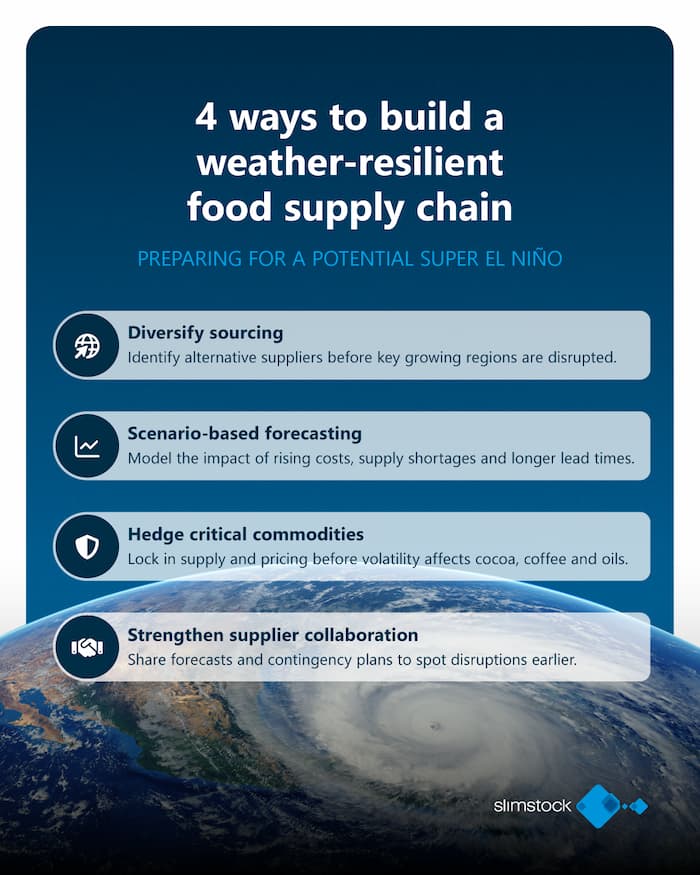
1. Diversify your sourcing geography
This sounds like an obvious step in navigating supplier woes, but it’s one businesses often fail to do, until the crisis hits.
To stay ahead of the worry, map your commodity exposure by origin.
For every ingredient or raw material that comes from a region in the Super El Niño impact zone, try to unearth at least one alternative source.
This means building relationships, qualifying sources, and understanding the lead time differences before you need them.
For categories like cocoa, coffee and tropical oils, this might mean accepting some cost premium in the short term in exchange for supply security.
2. Scenario-based demand and supply forecasting
Try to move beyond historical averages in your forecasting. In a Super El Niño event, history won’t help you8.
Instead, you’ll need to build scenario models that account for climate variability.
What does your replenishment plan look like if rice costs 30% more in Q4?
What would happen if your primary palm oil supplier has a 3-month lead time extension? How would that impact your ability to supply your own customers?
This kind of sensitivity analysis turns abstract risk into concrete decisions you can make in advance, rather than reactively under pressure.
Businesses that do this will build climate volatility as a standard planning variable.
3. Hedging strategies for ‘at-risk’ commodities
Some ingredients are naturally more exposed to price volatility.
Cocoa, sugar, vegetable oils, coffee are all examples. And some others too. Serious conversations must be had with procurement and finance teams about forward contracting and hedging your bets.
Lock in supply at contracted prices ahead of the peak volatility period.
These are likely to be Q3–Q4 in 2026 and possibly into 2027. Especially given the 4-8 month lead time in price volatility after the event.
Cost certainty can come from locked-in prices simply won’t be available to you with reactive measures.
In a market where analysts are forecasting 20–40% price premiums above current spot rates, the cost of inaction can be a significant worry if you’ve done nothing to plan ahead.
4. Strengthen your supplier collaboration and communication
Resilience is rarely built in isolation, but cooperation and communication with your suppliers. This is something Slimstock promotes even in fair weather. With a Super El Niño event round the corner, it’s a necessity.
Food businesses with close supplier relationships, typically create robust supply chains, especially during volatile periods.
Make sure information flows both ways before problems escalate.
Transactional purchasing won’t help you create strong bonds with suppliers, so invest in genuine supply chain partnerships that are mutually beneficial.
Share your demand forecasts proactively with suppliers and ask key suppliers about their own exposure to El Niño impacts and contingency plans.
Doing this will build clear communication for early warnings, be that yield shortfalls, lead time extensions, or quality issues in key growing regions.
Suppliers who feel like partners are far more likely to prioritise your orders when their own capacity’s constrained.
Testimonials from the food & grocery industry
See what our customers think


working capital improvement

reduction in stock write-off


Improved cash flow
"The impact of Slim4 on our business has been immeasurable and surpassed our expectations."

Louise Lyle
Director of Supply Chain


Availability increased

Excess stock cut

Service level increased
“We used to make decisions based on intuition; now we rely on data.”

Eva Herrero
Supply Chain and CSR Director at bofrost*



Halving stock-outs


Control over delivery times


Less wastage
“We have more control over erratic lead times and their impact on our service levels.”
Dick van der Kolk
CEO at Asian Food Group
Surpluses reduced
Service level increased


Enhanced visibility
“The good results are due to various process improvements we have implemented, but without Slimstock’s support, this would certainly not have been possible.”

Menno Cleton
Group Supply Chain Manager at Goodlife Foods


Service level

Stock reduction

Less stock days
“With Slim4, we have reduced stock by 17%, which equates to €5 million less in inventory.”

María Pérez
Supply Chain Manager at Distrivet


Working capital improvement
Increase in sales
Reduction in excess stock
“Slimstock's platform has played a pivotal role in helping us reduce inventory levels by $1.4m while still enabling significant sales growth.”

Marthinus Ferreira
Head of Inventory Optimization at Choppies

Service level

Better stock balance

Only 3% loss
“We can calculate what is needed more quickly for atypical orders and bring orders forward faster. The platform really works in a solution-oriented way for us.”

Filip Van Vyve
Senior Purchase Manager at Ameel Candy World
The storm’s coming, are you stocked for it?
An El Niño event isn’t a new worry, and given their arrival every few years are common events. But the severity of the one around the corner has to get your attention.
What’s exacerbating this one is both the ferocity of the individual event, and the environment it’s arriving into.
Strained trade routes, elevated input costs, and supply chains that have been tested hard over the past 5 years will suffer far more if planning is left to an after-thought.
The good news?
The 2026 Super El Niño is still forming. The extent to which it will hit global supply chains in the food industry are still unknown. But that could be good news, or bad.
You still have time to act.
The planning window, while narrowing every week, is still open at time of writing this article.
Make sure you treat your demand forecasting and inventory planning as strategic priorities, not operational functions, and you’ll be better placed to absorb the pressure than those who don’t.
Climate disruption is the new operating environment to plan for. Even in a poly-crisis like the one we’re currently seeing.
The question is, will you see it coming early enough to do something about it?
Want to understand how your current demand planning approach stacks up?
Talk to the Slimstock team about building climate resilience into your supply chain planning.
Sources and further reading
- Prepare for El Niño, UN warns – it could be the strongest in decades
- ENSO: Recent Evolution, Current Status and Predictions
- Impacts of an impending “Super” El-Niño on global supply chains
- Possible ‘Super El Niño’ Could Further Threaten Food Supply
- Great lettuce crisis is a taste of climate crop chaos to come
- From war to weather: A ‘super El Niño’ event poses fresh risks to global food costs
- El Niño’s Supply Chain Impact: 2026 Weather Risks for Buyers
- El Niño and the global food system: the warnings from history